Content Engine
Sitemap & Liftability
How Grandranker reads your sitemap and scores existing pages.
Two things here: how Grandranker reads your XML sitemap, and the Liftability Score — a 0-100 score for how likely AI models are to cite a page.
How Grandranker uses your sitemap
Your sitemap tells Grandranker which pages exist. It feeds internal linking (sitemap pages become link candidates — see Article Settings), the GEO Site Audit (checks a sitemap exists and robots.txt points to it), and onboarding (auto-detects your sitemap and blog URL).
Automatic discovery
Usually nothing to configure. Grandranker reads robots.txt for Sitemap: directives, checks common locations (/sitemap.xml, /sitemap_index.xml, /wp-sitemap.xml), and validates the response is real XML. Indexes are followed recursively; non-page sitemaps and asset URLs are skipped.
Pages are cached 24 hours — use Refresh in Internal Linking settings to re-fetch.
Setting the sitemap URL manually
Non-standard path? Set it in onboarding (Connect Your Blog → Sitemap URL) or later in Article Settings → Links → Sitemap URL.
No sitemap set? Without a sitemap (or Google Search Console), Grandranker can't discover your pages for internal links.
Liftability Score
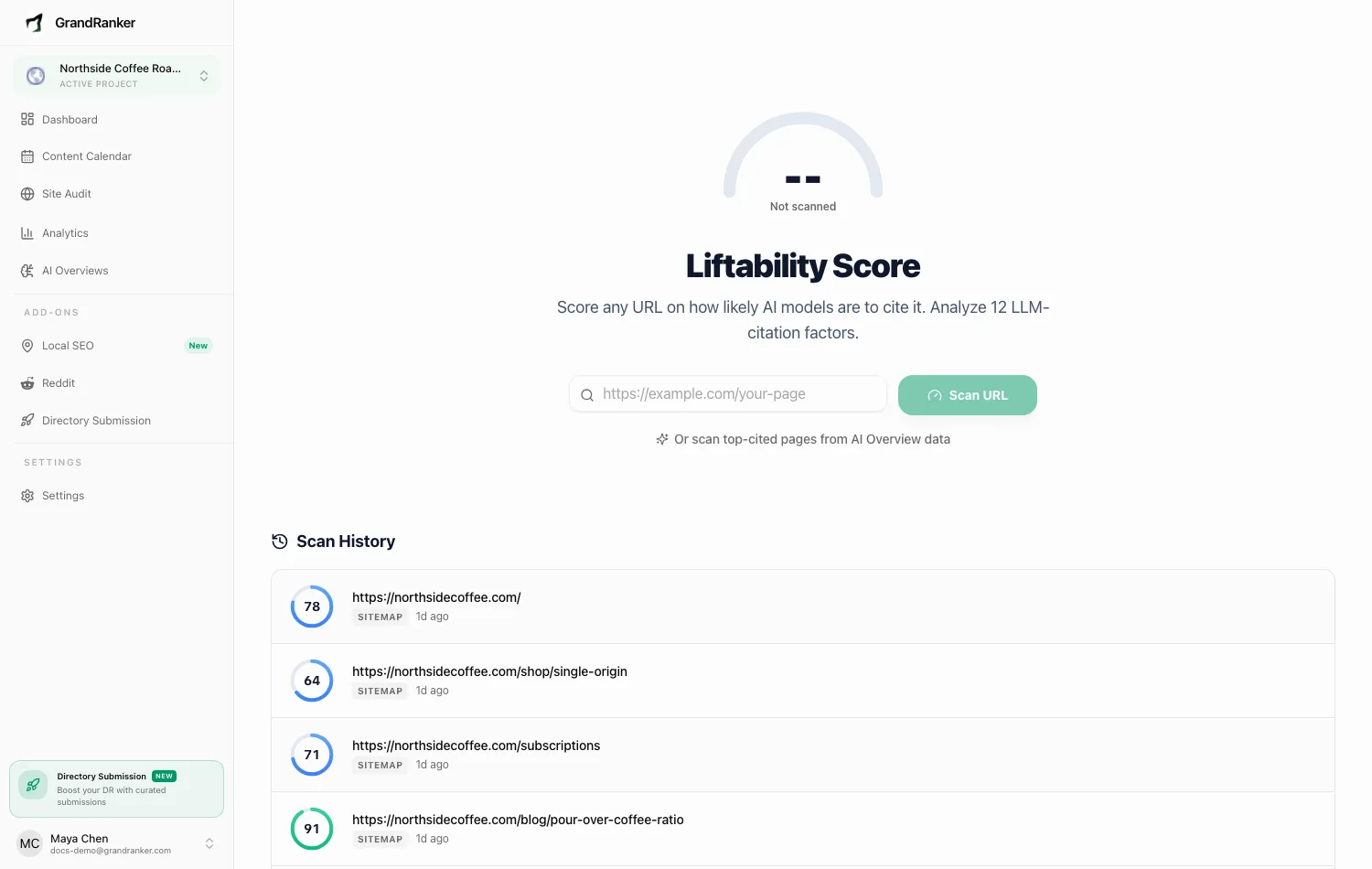
The Liftability screen scores any URL on how likely AI models like ChatGPT, Claude, and Perplexity are to cite it. Paste a URL and click Scan URL, or Or scan top-cited pages from AI Overview data to score pages AI engines already cite most in your space.
The 12 LLM-citation factors
Each scan scores 12 weighted criteria, 0-10 each:
| Factor | Weight |
|---|---|
| Answer-first structure | 12% |
| Heading hierarchy | 10% |
| Structured lists | 10% |
| FAQ sections | 10% |
| Schema markup | 10% |
| Table data | 8% |
| Citation-worthy stats | 8% |
| Readability | 8% |
| Content length | 7% |
| Author/expertise signals | 7% |
| Internal linking | 5% |
| Freshness signals | 5% |
The weighted total lands 0-100: 80+ Excellent, 60+ Good, 40+ Fair, 20+ Poor, below 20 Very Poor.
Reading the results
- Criteria Breakdown: every factor's score.
- Recommendations: up to five fixes, tagged High Priority or Improvement.
- Your Page vs. Top-Cited: after scanning cited pages, a comparison against the pages cited most.
- Scan History: click a row to reload it. Re-scanning overwrites the previous score.
FAQ
What does "liftability" mean?
How easily AI engines can cite, quote, and reference your content.
Why does "scan cited pages" say there's no citation data?
It needs AI Overview monitoring running first. See the AI Visibility overview.
The scan failed to fetch my URL. Why?
The page must be publicly reachable — firewalls, bot protection, or an unpublished page will block it.
Does Grandranker generate a sitemap for my site?
No, it reads your existing one. The GEO Audit flags a missing sitemap.
Still stuck? [email protected]