Key Takeaways
- Why Integrating AI Into: Why Integrating AI Into SEO Is No Longer Optional in 2026
- AI SEO Tools for: AI SEO Tools for Content Optimization That Fit Your Current Workflow
- Step 1: Audit Your Current SEO Stack and Identify Gaps
- Step 2: Layer AI Into Keyword Research and Content Planning
- Step 3: Set Up AI-Assisted Content Production and Publishing
- Step 4: Measure, Iterate, and Prove ROI
Why Integrating AI Into SEO Is No Longer Optional in 2026
AI-driven search traffic grew 527% year over year, according to Semrush's 2026 AI search analysis. That single number explains why integrating AI into existing SEO strategy has moved from a nice-to-have to a baseline requirement. This guide from GrandRanker breaks down exactly how to do it without wrecking the rankings you already have.
The shift is structural, not cosmetic. Traditional keyword matching is giving way to AI-driven answer engines, a change researchers describe as a full paradigm shift in how visibility gets calculated (Roumeliotis et al., MDPI, 2026). Meanwhile, 58.5% of searches now end without a click, and 83% of AI-driven queries finish right on the results page (GoodFirms search landscape data, 2026).
Here's the uncomfortable part: most teams are still optimizing for a search engine that no longer exists in the form they learned. Below, we'll show you the exact four-step process for layering AI into the SEO stack you already run.
AI SEO Tools for Content Optimization That Fit Your Current Workflow
AI SEO tools for content optimization are software platforms that handle keyword research, drafting, on-page optimization, and publishing with minimal manual input. The right tool fits the workflow you already have instead of forcing a rebuild.
Adoption is already mainstream. SQ Magazine (2026) reports that 86% of SEO professionals have integrated AI into their strategy, and the average enterprise team now runs 4.2 different AI tools.
That tool count matters. Too many disconnected tools create more work, not less. A common mistake is buying five tools before you have a content calendar that can feed them.
When you evaluate options, score them on four things:
- Does it plug into your current CMS and analytics?
- Can it handle your niche terminology and compliance language?
- Does it produce content you can edit, not just publish?
- Can it show which pages drove traffic and leads?
That last point separates real platforms from novelty. Nearly seven in 10 companies report better returns after integrating AI into SEO and content workflows (Semrush AI SEO statistics, 2026). The gains come from measurement, not magic.
Step-by-Step: Integrating AI Into Your Existing SEO Strategy
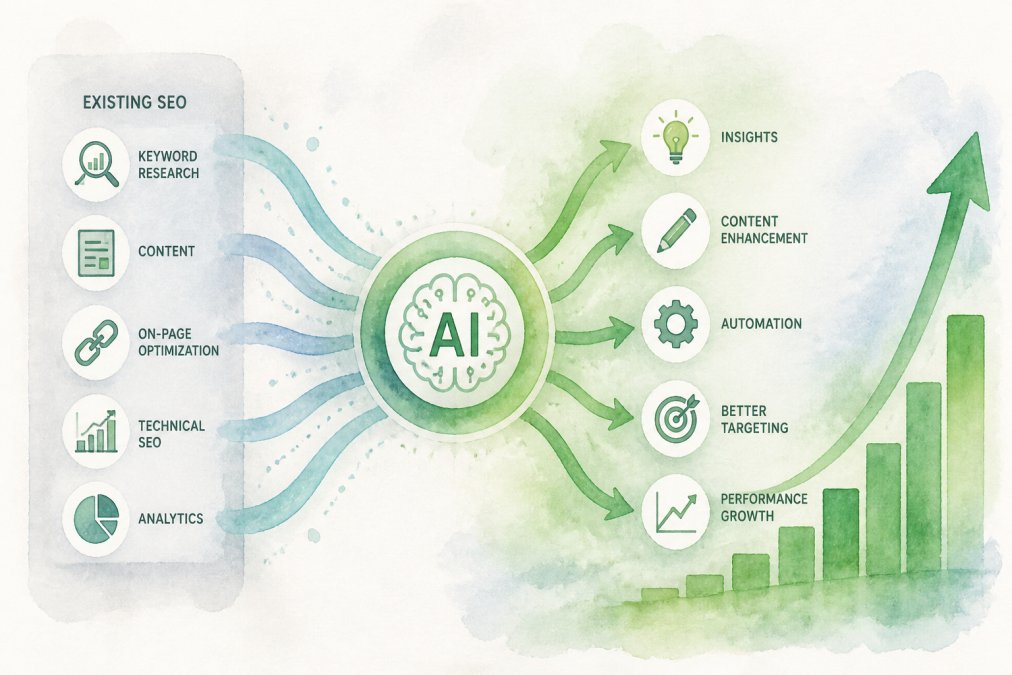
Integrating AI into an existing SEO strategy means auditing your current stack, adding AI at the keyword and content stages, then measuring results against your old baseline. You keep what works and replace only the slow parts.
Step 1: Audit Your Current SEO Stack and Identify Gaps
List every tool you pay for and what it actually does. Mark the tasks that eat the most hours: keyword research, briefs, drafting, internal linking, reporting.
Most teams find the same gap. Research and reporting take the longest, yet produce the least direct output. That's where AI pays off first.
Step 2: Layer AI Into Keyword Research and Content Planning
Feed your existing keyword list into an AI research tool and ask it to cluster by intent, not just volume. You'll usually find 3-5 topic clusters you've been ignoring.
Keep your human filter here. AI surfaces patterns fast, but you decide which clusters match your business. HubSpot Community discussions in 2026 flag over-reliance on automation as a real risk, and they're right. Speed without judgment produces content nobody needs.
Step 3: Set Up AI-Assisted Content Production and Publishing
Connect your AI tool to your CMS so drafts land where your editors work. Set a rule: AI drafts, humans approve. This keeps your brand voice intact.
A practical setup looks like this:
- AI generates the outline and first draft
- Your specialist adds proprietary data and examples
- An editor checks accuracy and tone
- The tool handles meta tags, internal links, and publishing
Step 4: Measure, Iterate, and Prove ROI
Track three numbers: organic sessions, AI citation appearances, and leads from organic. Compare them to your pre-AI baseline.
Send that report to leadership monthly. Vague claims about "better content" won't survive a budget review. Hard numbers will.
Best Practices for AI-Generated SEO Content That Ranks and Converts
The best practices for AI-generated SEO content come down to one rule: AI handles volume, humans handle trust. Google's guidance rewards content written for people, so thin AI output with no original insight is a liability, not a shortcut.
Start with these habits:
- Add at least one original data point or example per article
- Keep your brand voice in every draft, edited by a human
- Answer the search query in the first 50 words
- Use clear headings that match how people phrase questions
- Update old posts instead of only publishing new ones
94% of marketers plan to integrate AI into content creation workflows in 2026 (SEO Profy AI SEO statistics, 2026). The teams that win won't be the ones publishing the most. They'll be the ones publishing the most trustworthy content at scale.
How to Rank in AI Search Engines and Get Cited by Assistants
Ranking in AI search engines means structuring your content so assistants can extract a clean, self-contained answer. Citations, not blue links, are the new visibility metric.
Brands recommended by AI assistants are 2.5 times more likely to be visited within a week (Digital Synergy AI SEO strategies, 2026). That's the payoff for getting cited.
To earn those citations:
- Put the direct answer in the first sentence after each heading
- Use question-based headings that match real queries
- Include specific numbers, names, and dates
- Keep definitions in one clean sentence AI can quote alone
- Maintain consistent entity details across your site
This is where GrandRanker's approach to getting cited by AI assistants fits naturally. The platform structures content for both Google rankings and AI extraction, so the same page works in two places at once.
Common Mistakes When Integrating AI Into SEO (and How to Avoid Them)
The most common mistake is treating AI as a replacement for strategy instead of a layer on top of it. Teams that automate everything lose the expertise that made them worth citing in the first place.
Watch for these four:
| Mistake | What It Costs You | The Fix |
|---|---|---|
| Publishing unedited AI drafts | Rankings and reader trust | Human review on every post |
| No baseline before AI | Can't prove ROI | Record pre-AI traffic and leads |
| Chasing volume over depth | Weak AI citations | One original insight per post |
| Tool sprawl | Wasted budget and time | Consolidate to 2-3 core tools |
A second trap is ignoring your niche. If you operate in a specialized field, generic AI output reads as generic to both readers and AI systems. Feed the tool your terminology and compliance language, then check every draft against it.
The third trap is impatience. AI speeds up production, but rankings and citations still take weeks to build. Judge the program on a 90-day window, not a two-week one.
Conclusion
The teams still treating AI as optional are quietly losing ground to competitors who've already integrated it, and the gap compounds every quarter. GrandRanker gives you the tools to close it: automated keyword research, content on autopilot, and a system built to get you cited by every AI assistant while you rank on Google. With 421+ founders already growing on the platform, the playbook is proven. Start your free trial and let GrandRanker find you first.
Ready to dominate search results?
Join 8020+ businesses using GrandRanker to track rankings, fix SEO issues, and grow organic traffic.
Buy NowFrequently Asked Questions
AI shifts SEO from keyword matching to answer optimization. With 58.5% of searches now zero-click and 83% of AI-driven queries ending on the SERP, ranking alone is not enough. You need your content to be extractable and trustworthy so AI assistants cite it. This means structuring content with clear answers, using schema markup, and building authority signals that AI models recognize. The core goal remains visibility, but the path now includes winning citations inside AI-generated answers, not just blue links.
The main risks are thin content that lacks expertise, loss of brand voice, and over-reliance on automation without human oversight. Google's helpful content system rewards experience and authority, so AI-generated drafts need human editing to add original insights and data. Another risk is factual errors if AI is not grounded in verified sources. To mitigate, use AI for research, outlining, and first drafts, then have a subject-matter expert review and enrich the content before publishing.
Maintain E-E-A-T by using AI as a tool, not a replacement for expertise. Have named authors with real credentials review and sign off on content. Add original data, case studies, and firsthand experience that AI cannot generate. Cite authoritative sources and keep content updated. Google's guidelines emphasize that content should demonstrate experience, expertise, authoritativeness, and trustworthiness. AI can help you scale production, but the human expert layer is what satisfies E-E-A-T and earns citations in AI search engines.
Continue Reading
More guides to level up your SEO strategy.