Key Takeaways
- Why an AI Driven: Why an AI Driven SEO Content Audit Beats a Manual One
- Step 1: Pull Every URL Into One Crawlable Inventory
- Step 2: Score Each Page for Accuracy, Depth, and Citation Potential
- Step 3: Fix, Merge, Update, or Delete
- AI SEO Content Optimization Tools: What Actually Earns AI Citations
- SEO Content Audit Best: SEO Content Audit Best Practices for 2026
Why an AI Driven SEO Content Audit Beats a Manual One
An AI driven SEO content audit uses machine learning to score every page on your site for accuracy, depth, and citation potential in one pass. Manual audits can't keep that pace. According to Jasper's 2026 AI marketing data via SEOProfy, 91% of marketers now use AI in their work, up from 63% in earlier periods. At GrandRanker, we've watched that shift reshape how teams handle SEO content audits.
Here's the core problem. Traditional audits check rankings and backlinks. AI engines read differently. They pull fresh, well-structured answers and cite the source. Research from AIOSEO's 2026 SEO statistics shows AI search traffic is up 527%. Meanwhile, Conductor's analysis via Digital Applied found 25.11% of searches now trigger an AI Overview.
So a manual audit that ignores AI visibility misses a quarter of the search landscape. This guide breaks down a 6-step process you can run this week.
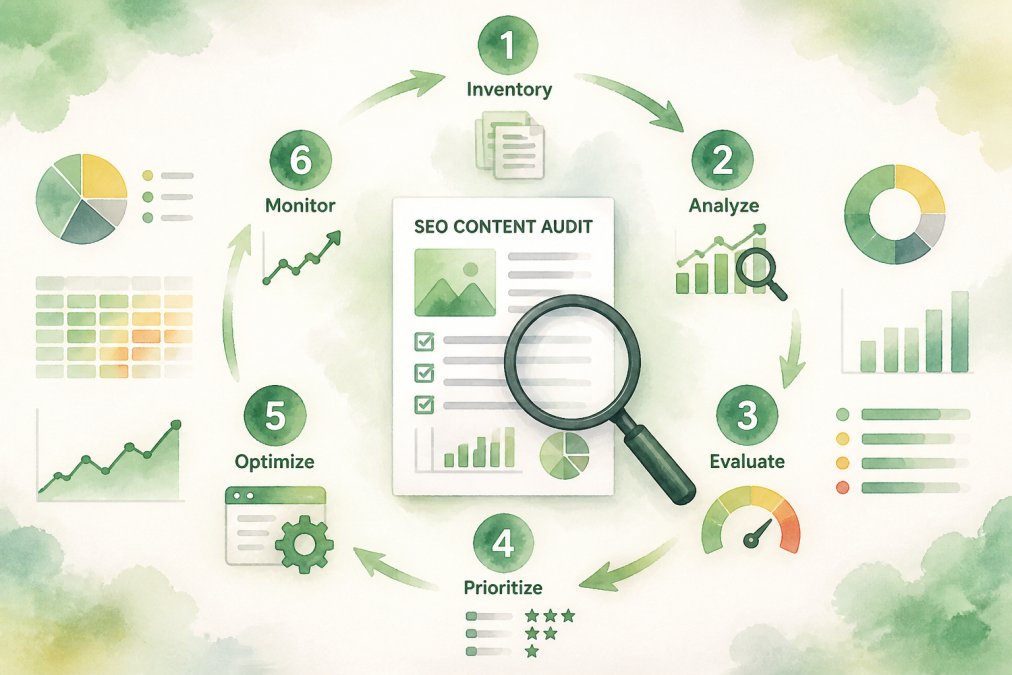
How to Audit Content for AI Search Engines: The 6-Step Process
Auditing content for AI search engines means scoring each page for how well an AI can extract, trust, and cite it. The process takes six steps, from inventory to tracking.
Step 1: Pull Every URL Into One Crawlable Inventory
Start with a full URL list from your sitemap and CMS. Most sites carry pages nobody remembers publishing. You can't score what you can't see.
Step 2: Score Each Page for Accuracy, Depth, and Citation Potential
Score every page on three factors:
- Accuracy: Are facts current and sourced?
- Depth: Does it answer the full question?
- Citation potential: Would an AI quote this?
Step 3: Fix, Merge, Update, or Delete
Every page gets one of four verdicts. Fix thin pages. Merge duplicates. Update stale data. Delete what earns nothing.
AI SEO Content Optimization Tools: What Actually Earns AI Citations
The right tools cut audit time from weeks to hours. AI audit tools now handle about 44% of technical and content SEO tasks, according to 2Point Agency's 2026 SEO audit guide.
What separates tools that work from tools that don't? Citation tracking. Most platforms score keywords. Fewer show whether ChatGPT or Perplexity actually quoted you.
GrandRanker automates keyword research, content creation, optimization, and publishing in one workflow. It tracks how your pages perform in both Google and AI assistants, so you see which content earns citations, not just rankings.
| Audit Task | Manual Approach | AI Tool Approach | Time Saved |
|---|---|---|---|
| URL inventory | Spreadsheet + sitemap | Auto-crawl | 2-3 hours |
| Page scoring | Human review | ML scoring | 1-2 weeks |
| Content refresh | Ad hoc | Scheduled alerts | Ongoing |
| Citation tracking | Not tracked | Dashboard | New capability |
SEO Content Audit Best Practices for 2026
Strong SEO content audit best practices start with one rule: audit continuously, not annually. AI bots re-crawl constantly, so a one-time cleanup decays fast.
Follow these habits:
- Re-score your top 20 pages every month
- Add direct answers in the first 50 words of each section
- Use schema markup so AI can parse your structure
- Cut "content debt" before adding new pages
Metrics That Prove Your Audit Worked
Track AI visibility, not just rankings. Only 14% of organizations currently measure their AI visibility, per GoodFirms' 2026 SEO statistics, which means most teams are flying blind.
Watch these numbers:
- AI citation count per page
- Zero-click impressions (58.5% of searches end without a click)
- Organic traffic from AI referrals
- Pages updated vs. pages created
Xponent21 used AI SEO to engineer rankings in Perplexity, ChatGPT, and Google AI Mode, hitting 4,162% traffic growth in under a year (Xponent21 case study). That's the ceiling when audits run continuously.
Common Mistakes That Wreck an AI Content Audit
The biggest mistake is treating AI content as a volume game. Generic AI output blends together. As Andy Crestodina noted in 2026, standard AI patterns lack the personal differentiation answer engines now reward.
Other common errors:
- Auditing once and calling it done
- Ignoring zero-click searches
- Chasing rankings while ignoring citations
- Publishing without updating old pages
Most teams know their content needs an audit but never find the hours to run one. GrandRanker handles the crawl, scoring, optimization, and publishing automatically, so your pages stay current for Google and every AI assistant. With automated keyword research, content on autopilot, and citation tracking built in, you get customers from Google and ChatGPT without hiring a content team. Start your free trial with GrandRanker and let your SEO run itself.
Ready to dominate search results?
Join 8020+ businesses using GrandRanker to track rankings, fix SEO issues, and grow organic traffic.
Buy NowFrequently Asked Questions
An AI-driven SEO content audit uses machine learning and generative AI to inventory your pages, score each one for accuracy, depth, and citation potential, and flag what to fix, merge, update, or delete. Unlike a manual audit, AI tools can process thousands of URLs at once. According to 2Point Agency (2026), 44% of SEO audit tasks are now handled by AI tools. The goal is to remove content debt, improve how your pages perform in both classic search and AI answer engines.
AI improves accuracy by scanning every URL against live SERP data and AI Overview triggers, not just the pages you remember to check. With 25.11% of searches triggering an AI Overview (Conductor, 2026), a manual audit will miss AI-specific signals. AI tools also flag stale statistics, duplicate paragraphs, and missing schema at scale. Trust Insights (2026) found that predictive auditing can identify which keywords and topics will drive the highest performance, so you fix the pages that matter first.
Run a full AI-driven audit quarterly, and a lighter scan monthly on your top 20 revenue pages. AI search traffic is up 527% (AIOSEO, 2026), and AI bots favor recent, updated data over stale content. Pages that were fine six months ago may now be missing from AI Overviews or ChatGPT citations. A quarterly cadence lets you catch content debt before it costs rankings, while monthly checks on your highest-value pages keep them citation-ready.
Traditional audits focus on crawl errors, backlinks, meta tags, and keyword rankings. AI-driven audits add citation tracking, AI Overview presence, entity coverage, and answer-format readiness. With 58.5% of searches now zero-click (GoodFirms, 2026), ranking alone does not guarantee traffic. An AI-driven SEO content audit checks whether your content is structured to be quoted in an AI answer, not just indexed. That means schema, direct answers, and fresh statistics are part of the audit scope.
Continue Reading
More guides to level up your SEO strategy.