Key Takeaways
- Why Competitor Content Weaknesses: Why Competitor Content Weaknesses Are Your Fastest Ranking Opportunity
- Run a Competitor Content: Run a Competitor Content Gap Analysis Before You Audit Anything Else
- The Content Audit Checklist: The Content Audit Checklist for Spotting Weak Pages
- Content Gap Analysis Tools: Content Gap Analysis Tools That Surface Weaknesses Fast
- Build a Competitor Content: Build a Competitor Content Audit Template You Can Reuse
- Prioritize the Weaknesses Worth: Prioritize the Weaknesses Worth Attacking First
Why Competitor Content Weaknesses Are Your Fastest Ranking Opportunity
Most SaaS founders treat competitor research as a scouting mission. They look at what rivals publish, nod at the polish, and assume every live page is a fortress. It isn't. A large share of competitor pages rank on domain strength alone, not because the content deserves the position.
That gap is your opening. Learning how to identify competitor content strategy weaknesses means finding pages that hold rankings they haven't earned, then building something better in the same spot. Here's the uncomfortable part most guides skip: you don't need a bigger content budget to win these fights. You need a sharper eye for decay.
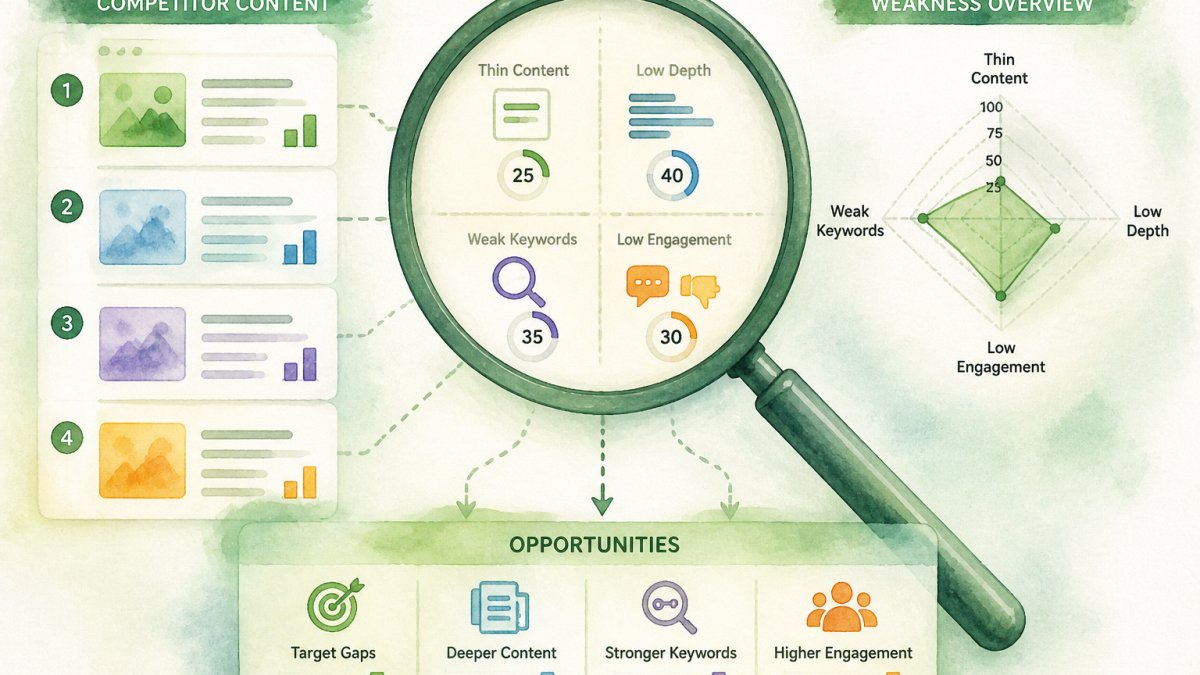
Weak pages fall into a few predictable buckets:
- Outdated stats and dead examples
- Thin coverage that never answers the real question
- Missing schema or broken internal links
- No clear search intent match
Find those pages and you've found your next content brief. This guide walks through the exact audit process, from gap analysis to prioritization, so you can stop guessing and start taking ground.
Run a Competitor Content Gap Analysis Before You Audit Anything Else
A competitor content gap analysis is the process of mapping the topics your rivals cover against your own library to find missing or underperforming subjects. Do this first, because auditing individual pages without a map wastes time on fights you can't win.
Start with a simple topic map. List the keywords your competitors rank for that you don't. Group them by theme, not by individual term. You're looking for clusters, not one-off phrases.
Then ask three questions about each cluster:
- Does the competitor cover this topic deeply or just touch it?
- Is the ranking page recent, or has it gone stale?
- Do we have any existing content that could compete with a rewrite?
That last question matters more than people think. A common mistake is chasing brand-new topics when an existing page just needs a refresh. In practice, updating a page you already own is faster than building from zero.
Once the map is built, you audit. Not before.
The Content Audit Checklist for Spotting Weak Pages
A content audit checklist is a fixed set of pass/fail tests you run on each competitor page to score its real strength. The goal is consistency: same checks, same order, every page.
Run these six checks on every page you're evaluating:
- Intent match: Does the page answer the query, or does it chase a different one?
- Depth: Does it cover subtopics a serious buyer would expect?
- Freshness: Are the examples, dates, and references current?
- Internal links: Does the page connect to related content, or sit orphaned?
- Schema: Does it use structured data for articles, FAQs, or how-tos?
- AI citation readiness: Are there clear, quotable answer blocks?
A page that fails two or more checks is a target. A page that fails none is a wall, so skip it and move on.
The freshness check is where most audits find gold. Competitors publish and forget. A page with an old publication date and no updates signals a team that moved on, and that's your invitation.
Content Gap Analysis Tools That Surface Weaknesses Fast
Content gap analysis tools are software platforms that compare your site against competitors and flag missing keywords, thin pages, and ranking opportunities. You don't need a dozen of them. You need two or three that cover the bases.
Here's how we'd split the stack:
| Tool Type | What It Surfaces | Best For |
|---|---|---|
| Keyword gap tools | Terms rivals rank for, you don't | Building the topic map |
| Site audit tools | Broken links, missing schema, slow pages | Scoring page health |
| Rank trackers | Position changes over time | Spotting decay early |
| AI visibility tools | Whether rivals get cited by AI assistants | Finding unclaimed answer space |
The AI visibility layer is the one most teams still ignore. As Google's guidance on helpful content makes clear, pages built for people and clearly structured tend to perform across surfaces, including AI answers. If a competitor's page has no clean answer blocks, an AI assistant has little reason to cite it. That's a weakness you can exploit.
Pick your tools, run the checks, and log everything in one place. Which brings us to the template.
Build a Competitor Content Audit Template You Can Reuse
A competitor content audit template is a repeatable scoring sheet that turns your checklist into comparable numbers. Build it once, use it every quarter.
Here's the structure we recommend. One row per page, with these columns:
| Column | What to Record | Scale |
|---|---|---|
| URL | Page address | Text |
| Target keyword | Primary term | Text |
| Intent match | Does it answer the query? | 1-5 |
| Depth | Subtopic coverage | 1-5 |
| Freshness | Recency of examples | 1-5 |
| Internal links | Connectivity | 1-5 |
| Schema | Structured data present | 1-5 |
| AI citation readiness | Quotable blocks | 1-5 |
| Total score | Sum of the six | 6-30 |
Score each column from 1 (weak) to 5 (strong). A total under 18 means the page is attackable. Above 24, leave it alone.
The template does two jobs. It forces consistent judgment, and it gives you a ranked list you can hand to a writer without a meeting. When you're running this across a SaaS team or a distributed one, the shared sheet is what keeps everyone aligned.
Pair the template with a platform that automates the boring parts. GrandRanker handles keyword research, content creation, and publishing on autopilot, which means the audit findings turn into published pages without a manual handoff.
Prioritize the Weaknesses Worth Attacking First
Not every weak page deserves your effort. Prioritize by two factors: how weak the page is, and how much traffic the topic could send you.
Use this simple ranking:
- High opportunity, high weakness: Rivals rank with thin, stale pages on valuable topics. Attack first.
- High opportunity, low weakness: Strong pages on valuable topics. Skip for now.
- Low opportunity, high weakness: Easy wins, but small payoff. Do these when you have spare capacity.
- Low opportunity, low weakness: Ignore entirely.
The trap is chasing easy wins because they feel productive. A quick rewrite of a low-value page feels good and moves nothing. Spend your first sprint on the pages where a real gap meets real demand.
One more filter: check whether the competitor page gets cited by AI assistants. If it doesn't, and the topic is one buyers ask about, you have a double opportunity, ranking on Google and getting picked up by ChatGPT and Claude. GrandRanker's platform is built to chase both.
Conclusion
The hardest part of competitor research isn't finding weaknesses. It's resisting the urge to audit everything and instead attacking the few pages that actually matter. Start with the gap map, run the checklist, score it in your template, and let the numbers pick your targets.
That's where GrandRanker earns its place in your stack. Our AI-powered SEO platform automates keyword research, content creation, and publishing, so the weaknesses you find turn into pages that rank on Google and get cited by AI assistants. With 421+ founders already growing on the platform, the process is proven. Start your free trial and turn your next competitor audit into published content that pulls traffic.
Ready to dominate search results?
Join 8020+ businesses using GrandRanker to track rankings, fix SEO issues, and grow organic traffic.
Buy NowFrequently Asked Questions
Start by pulling their sitemap and ranking pages, then group them by topic cluster. For each cluster, note the target keyword, word count, publish date, and whether the page appears in AI assistant citations. Compare that map against your own to see where they cover ground you don't. A competitor content gap analysis at this stage takes about two hours per competitor and gives you a prioritized list of topics to attack.
Focus on six signals: thin pages under 600 words, outdated posts with stale dates, missing schema markup, weak internal linking, no original data or examples, and zero presence in ChatGPT or Perplexity answers. A content audit checklist keeps the review consistent across competitors so you can compare scores side by side instead of relying on gut feel.
Use a crawler to pull sitemaps and page metadata, a rank tracker to see which pages actually earn traffic, and an AI visibility checker to test whether competitors get cited in ChatGPT or Claude answers. Content gap analysis tools that map keyword overlap between you and a competitor save the most time. GrandRanker bundles keyword research, content creation, and AI citation tracking in one platform, so you can run the audit and act on it without stitching three subscriptions together.
Run a full audit quarterly and a lightweight check monthly on your top three competitors. Content decays faster than most teams expect: a page that ranked well in January can lose citations by April if a rival publishes a deeper update. Set a calendar reminder, reuse your competitor content audit template, and log changes so you can spot patterns like a competitor pivoting to a new topic cluster before it shows up in rankings.
Continue Reading
More guides to level up your SEO strategy.