Key Takeaways
- How Mobile Optimization Shapes: How Mobile Optimization Shapes Local Search Rankings
- Mobile Search Behavior and: Mobile Search Behavior and Local RankingsWhy the Local Pack Rewards Mobile-Ready Sites
- Why the Local Pack: Why the Local Pack Rewards Mobile-Ready Sites
- Google Mobile-First Indexing and: Google Mobile-First Indexing and What It Means for Local Visibility
- Mobile Page Speed and Local Rankings: The Data Behind the Delay
- What a Mobile-Friendly Website: What a Mobile-Friendly Website for Local SEO Actually Includes
How Mobile Optimization Shapes Local Search Rankings
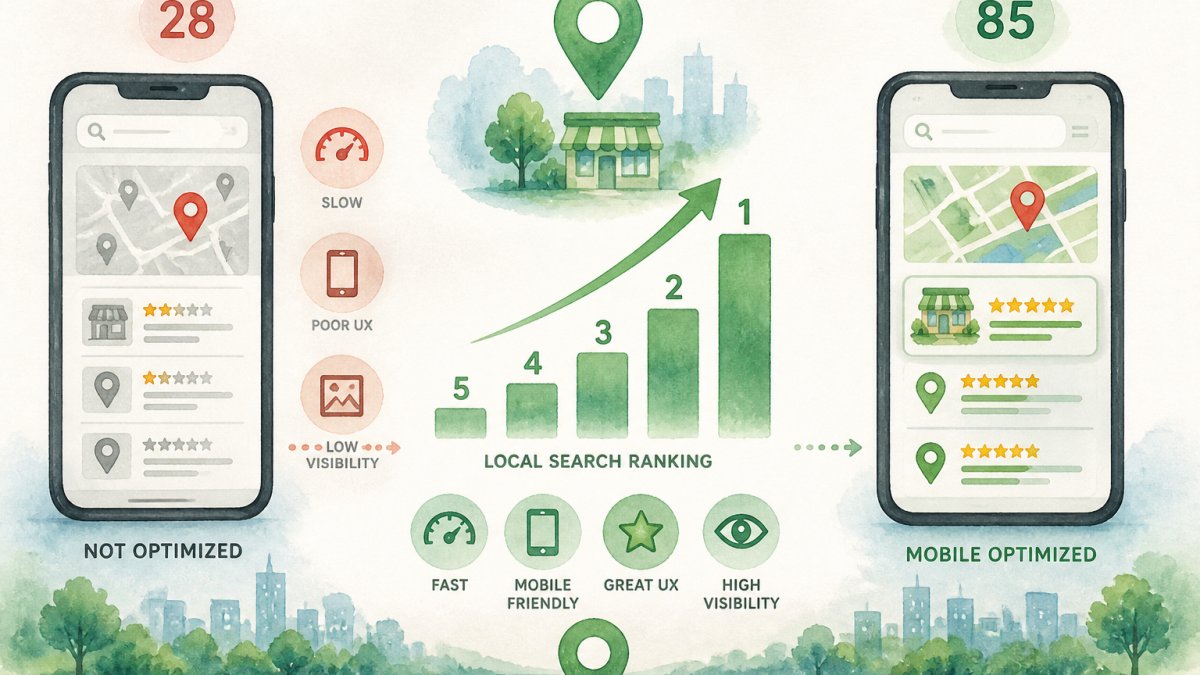
Mobile optimization's impact on local search rankings is direct, measurable, and growing. According to Digital Applied's 2026 local SEO statistics roundup, 64% of local searches happen on mobile devices, and 76% of smartphone users who search for something nearby visit a business within 24 hours. That gap between a search and a store visit is where rankings are won or lost. This guide breaks down how Google's mobile-first index treats local businesses, what page speed costs you in visibility, and a checklist to fix it.
Here's the uncomfortable part most guides skip: Google doesn't rank "websites" for local queries. It ranks the mobile version of your site. If your desktop page loads in one second and your mobile page takes five, the slow version is the one being scored.
Below, we'll show you exactly how mobile signals feed into the local pack, and a checklist that closes the gap.
Mobile Search Behavior and Local Rankings
Local searchers behave differently on phones than on laptops. They act faster, scroll less, and expect an answer in seconds.
The numbers back this up:
- 78% of mobile local searches lead to an offline purchase within 48 hours (Digital Applied's 2026 data)
- 61% of mobile users are more likely to contact a local business
- 47% higher engagement goes to mobile-optimized sites
So a slow, cramped mobile page doesn't just lose a click. It loses a customer who was ready to walk in.
Why the Local Pack Rewards Mobile-Ready Sites
The local pack is the map result with three businesses and a "Directions" button. Google picks those three using proximity, relevance, and prominence.
Proximity you can't change. Relevance and prominence you can. And both are measured on the mobile version of your site first.
What most guides miss is that Google checks how fast a user can tap "Call" or "Directions" after landing. If your phone number is buried under a pop-up, that counts against you.
Google Mobile-First Indexing and What It Means for Local Visibility
Google mobile-first indexing means Google uses the mobile version of your page for ranking and indexing. The desktop version is secondary.
For local businesses, this creates a specific trap. Many sites still hide content on mobile, drop schema markup, or serve a stripped-down template. Google sees the stripped version, not the full one.
Check these three things today:
- Your mobile page shows the same text as desktop
- Your LocalBusiness schema appears on mobile
- Your address and hours are visible without scrolling
If any of those fail, your local visibility is being scored on incomplete data.
Mobile Page Speed and Local Rankings: The Data Behind the Delay
Mobile page speed and local rankings are linked through user behavior. Slow pages get abandoned, and abandonment signals tell Google the result wasn't useful.
Three seconds is the practical ceiling. Past that, bounce rates climb sharply.
The fix isn't always a rebuild. Often it's:
- Compressing images that are still full desktop size
- Cutting third-party scripts you added and forgot
- Switching to a lighter theme or caching layer
That's the part that surprises people. Speed is a ranking input you can fix in a weekend.
What a Mobile-Friendly Website for Local SEO Actually Includes
A mobile-friendly website for local SEO is one where a phone user can find your address, call you, and understand what you do in under ten seconds. That's the whole standard.
Everything else supports those three jobs. Tap targets sized for thumbs. Text that doesn't require pinch-zooming. A phone number that's a live link, not an image.
The local-specific pieces matter just as much:
- Embedded map that loads without blocking the page
- Click-to-call button above the fold
- Store hours in plain text, not a graphic
- City and service area named in the copy
Most local sites get the design right and the local signals wrong. A beautiful mobile page that never says "Ljubljana" won't rank for Ljubljana searches.
Local SEO Mobile Optimization Checklist
This is a local SEO mobile optimization checklist. Work through it in order.
Technical Checks
- Mobile page loads in under 3 seconds
- No content hidden behind toggles that Google can't read
- LocalBusiness schema present on mobile
- Tap targets at least 48 pixels
- No intrusive interstitials on entry
On-Page and Local Signals
- NAP (name, address, phone) matches your Google Business Profile
- Click-to-call link on every page
- City and region named in headings and body copy
- Embedded map loads lazily
- Reviews visible without scrolling past ads
| Problem | Fix | Expected Impact |
|---|---|---|
| 5+ second mobile load | Compress images, cut scripts | Lower bounce, better map position |
| Content hidden on mobile | Show full text on all devices | Full indexing of services |
| Missing schema on mobile | Add LocalBusiness markup | Stronger local relevance signals |
| No click-to-call | Add tel: link above fold | More calls from mobile searchers |
How to Measure Mobile Optimization's Effect on Local Rankings
Measuring impact means tracking mobile separately from desktop. Blended reports hide the signal.
Start with these four:
- Mobile Core Web Vitals in Search Console
- Local pack position for your top five "near me" queries
- Mobile conversion rate (calls, direction taps, form fills)
- Mobile vs desktop bounce rate gap
Check rankings every two weeks for eight weeks after a fix. Local rankings move slowly, then all at once.
Tracking mobile and desktop visibility as separate metrics can tell different stories. A site can rank well on desktop and be invisible on mobile for the same query. That gap is the whole game for local search.
Local rankings now live and die on the phone in your customer's hand. If your mobile site is slow, hides content, or buries the phone number, no amount of new content will fix it. GrandRanker automates the technical and content side of that work, from keyword research to publishing, so your mobile pages stay fast and your local signals stay current. With 421+ founders already growing on the platform, you can start a free trial and see where your mobile visibility actually stands.
Ready to dominate search results?
Join 8020+ businesses using GrandRanker to track rankings, fix SEO issues, and grow organic traffic.
Buy NowFrequently Asked Questions
Google's local results are pulled from the mobile version of your site. A mobile-friendly website for local SEO loads quickly, displays your address and phone number clearly, and works on any screen size. When those elements are missing, your site can drop out of the local pack. Data from Digital Applied shows 76% of smartphone users who search for something nearby visit a business within 24 hours, so mobile visibility directly affects foot traffic and calls.
Yes. Google mobile-first indexing means Google crawls and indexes the mobile version of your site for all rankings, including local results. If your mobile pages have less content, broken navigation, or missing structured data, Google sees that weaker version when deciding local search rankings. The fix is to keep mobile and desktop content identical, with the same business name, address, phone number, and service descriptions on both.
Page speed is a confirmed ranking factor on mobile. When a page takes more than a few seconds to load, visitors leave before it finishes, and that engagement drop signals low quality to Google. Digital Applied reports 47% higher engagement from local searchers for mobile-optimized sites, which includes fast-loading pages. Compress images, remove unused scripts, and test with Google's PageSpeed Insights to see where the delays are.
It can. The local pack pulls signals from your Google Business Profile and your website. A mobile-friendly website for local SEO reinforces those signals with clear location data, embedded maps, and click-to-call buttons. Digital Applied reports 61% of mobile users are more likely to contact a local business when the site works well on their phone. Combine that with a complete Google Business Profile and consistent NAP data across directories.
Continue Reading
More guides to level up your SEO strategy.