Key Takeaways
- Why Integrating AI Into: Why Integrating AI Into Content Marketing Workflows Matters
- AI Content Marketing Tools: AI Content Marketing Tools That Actually Deliver Results
- The Real Workflow: How to Set Up AI for Content ProductionPhase 1: Strategy and Keyword PlanningPhase 2: Content Brief GenerationPhase 3: Draft Creation and Optimization
- Phase 1: Strategy and Keyword Planning
- Phase 2: Content Brief Generation
- Phase 3: Draft Creation and Optimization
Why Integrating AI Into Content Marketing Workflows Matters
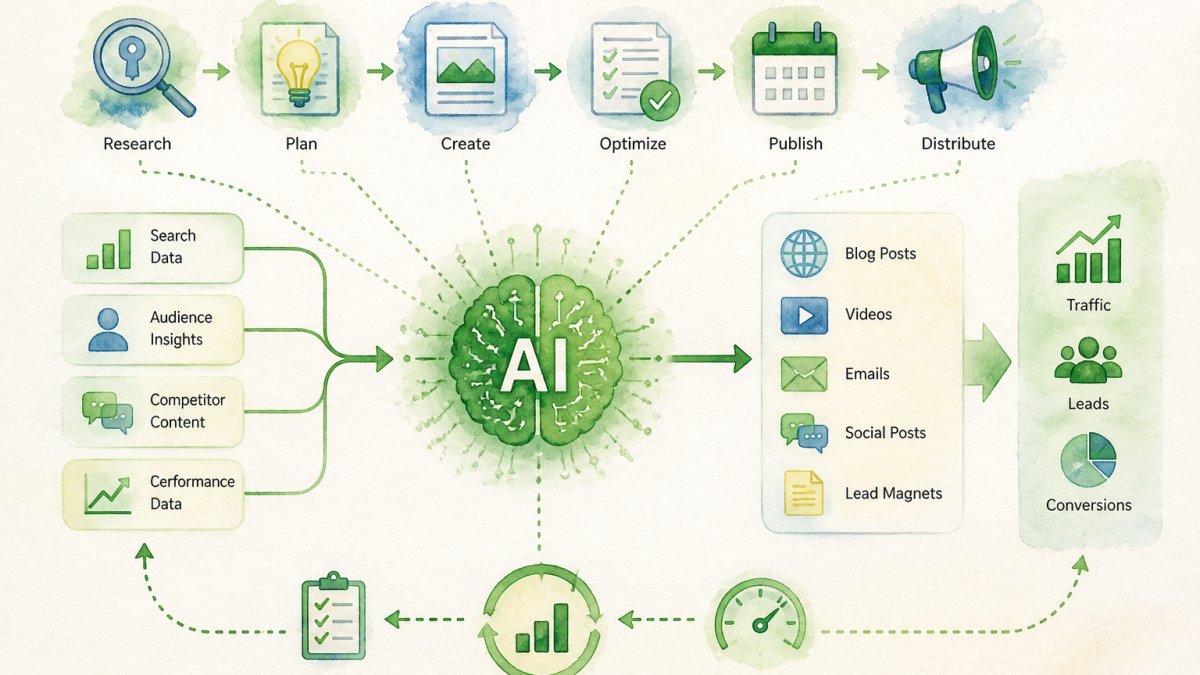
Integrating AI into content marketing workflows is no longer optional, it's how teams compete. When you automate keyword research, content creation, and optimization, you free your team to focus on strategy while AI handles the repetitive work.
The challenge most marketers face is simple: there's too much content to create and not enough time to create it well. Manual workflows take weeks. AI workflows take days. That speed difference compounds over months and years.
Here's what happens when you skip AI integration: your competitors publish more content, rank for more keywords, and capture more organic traffic. Your domain authority stagnates. You miss opportunities to get cited by AI assistants like ChatGPT and Claude, which increasingly drive discovery.
At GrandRanker, we've helped founders and marketing teams automate this exact problem. The teams that integrate AI into their content marketing workflows see results faster because they're not bottlenecked by manual writing and optimization.
The workflow we outline below is proven. It's built on the assumption that you want to maintain brand voice and quality while scaling content production. That's the real tension: automation without losing authenticity.
AI Content Marketing Tools That Actually Deliver Results
The market is flooded with AI writing tools. Most of them generate mediocre content that reads like it was written by an algorithm. The ones that actually deliver results do three things: they understand your brand voice, they optimize for search intent, and they produce content that ranks.
When evaluating AI content marketing tools, look for:
- Keyword research integration, The tool should pull real search data, not guess at what people are searching for
- Content brief generation, It should analyze top-ranking pages and create a brief that tells you what to write about
- Optimization guidance, It should show you exactly where to place keywords, how long sections should be, and what structure works
- Brand voice preservation, It should let you train it on your existing content so new pieces sound like you, not a generic AI
- Publishing automation, It should connect to your CMS so you can schedule content without manual steps
The tools that combine these features tend to be platform-based rather than standalone. A standalone AI writer is useful for one task. A platform that handles keyword research, brief generation, writing, and optimization is useful for your entire workflow.
GrandRanker combines all of these in one place. You research keywords, generate briefs, write and optimize content, and publish, all without leaving the platform. That integration reduces friction and keeps your team focused.
The Real Workflow: How to Set Up AI for Content Production
Most guides skip over how to actually set this up. They talk about benefits but not the mechanics. Here's the real workflow, broken into phases.
Phase 1: Strategy and Keyword Planning
Start with clarity on what you're trying to rank for. AI is excellent at finding keywords, but it's not good at deciding which keywords matter to your business.
Define your target audience and business goals first. Are you trying to drive traffic to a landing page? Build domain authority in a specific niche? Get citations in AI responses? Your goal changes which keywords you prioritize.
Once you know your goal, use AI to research keywords at scale. Pull search volume, ranking difficulty, and intent data. Look for keywords with commercial intent if you're trying to drive sales. Look for informational keywords if you're building authority.
The mistake most teams make here is targeting too many keywords at once. Pick 20-30 high-priority keywords to start. Rank for those. Then expand.
Phase 2: Content Brief Generation
A content brief tells your AI exactly what to write. The better the brief, the better the output.
Use AI to analyze the top 10 ranking pages for your target keyword. Extract:
- Average word count
- Main sections and their order
- Keywords they rank for
- What they get right and what they miss
Then create a brief that tells your AI: write 2,000 words, include these 5 sections, target these 15 keywords, and make it sound authoritative but accessible.
This phase is critical. A weak brief produces weak content. A strong brief produces content that's 80% ready to publish.
Phase 3: Draft Creation and Optimization
Feed your brief to the AI and let it write. Most AI writing tools produce first drafts that need editing. That's normal.
What matters is that the draft has the right structure, hits the target word count, and includes the keywords in the right places. Your job is to add examples, refine voice, and fact-check claims.
Then optimize. Use AI to check keyword placement, readability, and internal link opportunities. Make sure the content actually answers the search query.
This phase typically takes 2-4 hours per article, depending on how much editing you need to do. That's still faster than writing from scratch.
Automating Content Creation With AI Without Losing Your Brand
The biggest fear teams have is that AI content sounds generic. It does, if you let it.
The fix is training. Feed the AI examples of your best content. Show it your tone, your structure, your vocabulary. Let it learn what "you" sounds like.
Then when you give it a brief, specify: "Write this in the voice of [your brand]." The AI will match that voice much more closely than if you just say "write an article."
Another approach: use AI for the heavy lifting (research, structure, first draft) and have your team do the refinement. AI handles 60% of the work. Your team handles the 40% that requires judgment, examples, and authenticity.
This hybrid approach scales content production without sacrificing quality. You're not replacing your team with AI. You're making your team more productive.
The teams that do this well report that their content feels more authentic, not less. That's because they're using AI to remove the busywork, leaving more time for the creative work that actually requires a human.
AI Content Marketing Best Practices for Sustainable Growth
Integrating AI into content marketing workflows only works if you do it right. Here are the practices that separate teams that succeed from teams that burn out:
Start small. Don't automate your entire content calendar on day one. Pick one content type or one section of your site. Get the workflow right. Then expand.
Review everything before publishing. AI makes mistakes. It hallucinates data. It misunderstands context. Your job is to catch those before readers see them.
Maintain a brand voice guide. Write down how your brand sounds. What words do you use? What tone do you take? What topics do you avoid? Give this to your AI tool so it can match you.
Track what works. Not all AI-generated content ranks equally. Track which pieces drive traffic. Learn from the winners. Adjust your briefs accordingly.
Update old content. AI is fast. Use it to refresh your top-performing older articles. Add new sections. Update examples. Keep your content current.
Don't publish everything AI writes. Some AI outputs are mediocre. That's okay. Use them as drafts, not finished pieces. Your editing process is where quality happens.
Teams that follow these practices see consistent, sustainable growth. Teams that skip them publish low-quality content that doesn't rank.
Measuring ROI: Proving AI Content Marketing Works
You need to prove that integrating AI into content marketing workflows actually drives business results. Otherwise, leadership won't fund it.
Track these metrics:
- Organic traffic growth, Month-over-month increase in traffic from search
- Keyword rankings, How many keywords you rank for, and at what positions
- Content production speed, How many pieces you publish per month, before and after AI
- Engagement metrics, Time on page, scroll depth, click-through rate
- Conversions, How many visitors convert to leads or customers
- Domain authority, Your site's overall authority score over time
The strongest ROI signal is traffic growth paired with conversion growth. If you're getting more traffic but not more customers, something's wrong with your content or your funnel.
Most teams see a 2-3 month lag before results appear. You publish content in month one. It ranks in month two. It drives traffic in month three. Plan for that timeline.
GrandRanker provides reporting that shows you exactly which pieces are driving traffic and which aren't.
Common Mistakes When Integrating AI Into Content Marketing
Teams make predictable mistakes when they start automating content. Knowing them helps you avoid them.
Mistake 1: Publishing AI content without editing. This produces low-quality content that doesn't rank. Always edit before publishing.
Mistake 2: Targeting too many keywords at once. You dilute your effort. Pick 20-30 keywords. Dominate those. Then expand.
Mistake 3: Ignoring search intent. You can rank for a keyword and still get no traffic if your content doesn't match what searchers actually want. Understand intent first.
Mistake 4: Forgetting about brand voice. AI can write. It can't capture what makes your brand unique. You have to guide that.
Mistake 5: Setting it and forgetting it. AI isn't a fire-and-forget system. You need to monitor performance, update content, and adjust your strategy based on what's working.
Mistake 6: Using AI for everything. Some content requires human expertise. Use AI for research, structure, and first drafts. Use humans for judgment, examples, and authenticity.
Integrating AI into content marketing workflows isn't about replacing your team, it's about multiplying their output. The teams that win are the ones that use AI to handle the repetitive work while their people focus on strategy and creativity.
GrandRanker makes this possible by automating keyword research, brief generation, and optimization in one platform. You get more content published faster, with better SEO, without losing your brand voice. Start your free trial today and see how much faster you can scale.
Ready to dominate search results?
Join 8020+ businesses using GrandRanker to track rankings, fix SEO issues, and grow organic traffic.
Buy NowFrequently Asked Questions
AI automates repetitive tasks like keyword research, outline generation, and first-draft creation, freeing your team to focus on strategy and brand voice. Instead of spending 8 hours researching keywords and planning content, your team can do it in 1-2 hours with AI tools. The real efficiency gain comes from reducing the time between strategy and publication, allowing you to test and iterate faster than competitors still working manually.
The best tools depend on your workflow stage. For keyword research and content planning, platforms that integrate SEO data with AI writing capabilities work best. For draft generation, tools that understand your industry terminology and can maintain consistent tone are essential. Look for solutions that offer end-to-end automation—from research through optimization to publishing—rather than point tools you have to stitch together manually.
Set clear brand guidelines before you start: define your tone, vocabulary, perspective, and key messages. Use these guidelines to prompt your AI tools or create custom templates. Always have humans review AI-generated content before publishing—this isn't optional. The AI handles the heavy lifting of research and structure; your team ensures every piece reflects your brand's unique perspective and expertise.
Google doesn't penalize content for being AI-written if it's high-quality, helpful, and original. What Google penalizes is thin, low-quality, or purely regurgitated content—whether written by humans or AI. AI-generated content that's well-researched, optimized for search intent, and edited for accuracy and brand voice ranks the same as human-written content. The quality of your strategy and editing matters far more than the tool used to draft it.
Continue Reading
More guides to level up your SEO strategy.