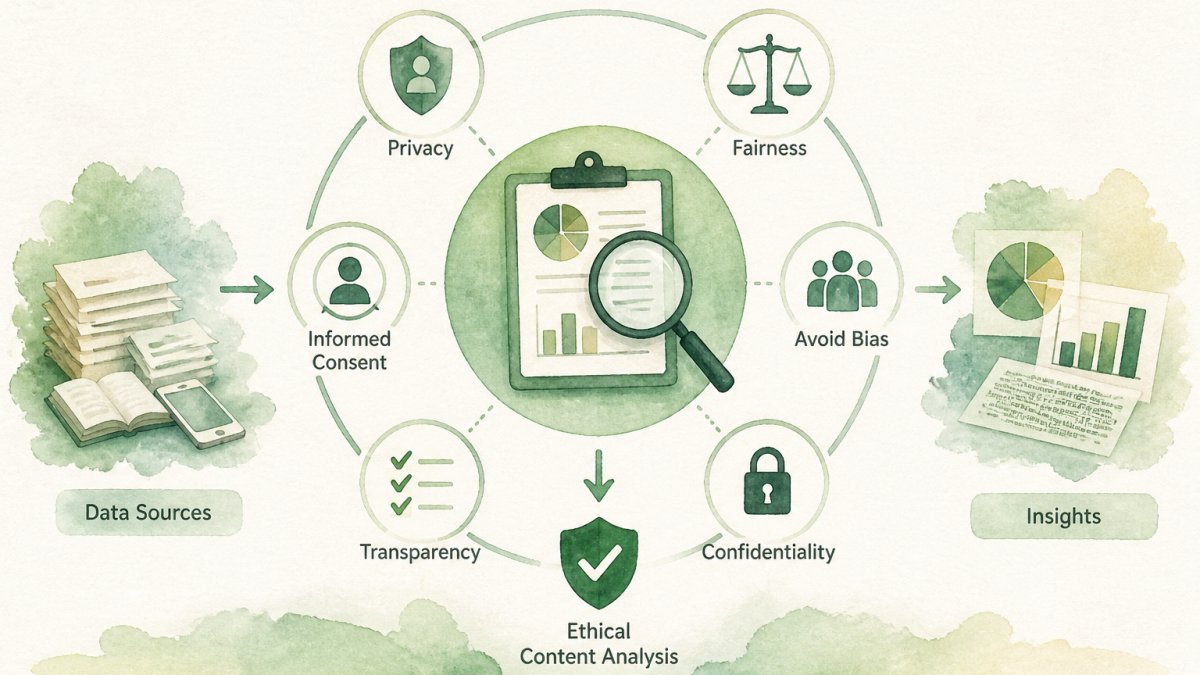
Key Takeaways
- What Ethical Considerations in: What Ethical Considerations in Content Analysis Actually Mean
- Social Media Research Ethics: Privacy and Consent
- Ethical Considerations in Research Examples: Real Scenarios
- Institutional Review Board Approval: Institutional Review Board Approval for Research
- Research Ethics Checklist: Before You Analyze
- Addressing Bias and Representation: Addressing Bias and Representation in Content Analysis
What Ethical Considerations in Content Analysis Actually Mean
Ethical considerations in content analysis involve protecting participant privacy, ensuring informed consent, and maintaining research integrity throughout your study. These principles guide how you collect, analyze, and report data responsibly.
Content analysis, the systematic examination of text, images, or media, raises distinct ethical challenges. Unlike experiments, content analysis often involves analyzing existing materials without direct participant interaction. But that doesn't mean ethics take a backseat.
The core tension is this: just because content exists publicly doesn't mean it's ethical to analyze it. Automated content analysis at scale amplifies ethical risks. Extracting patterns from thousands of social media posts, reviews, or articles requires careful consideration of privacy, consent, and representation.
Three ethical pillars matter most:
- Privacy and confidentiality, protecting identities and sensitive information
- Informed consent, ensuring participants understand how their data will be used
- Representation and bias, avoiding skewed conclusions that harm groups
According to research from PubMed Central's review of ethical challenges in qualitative research, ethical considerations span all stages of a study, from design through reporting. The challenge intensifies when your content analysis touches social media, personal blogs, or other online spaces where anonymity feels assumed but privacy remains fragile.
Social Media Research Ethics: Privacy and Consent
Analyzing social media content presents unique privacy risks that traditional research frameworks sometimes miss. Posts shared publicly don't automatically become fair game for extraction and analysis.
The ethical problem: people post on social media expecting a specific audience, not researchers. A tweet shared with 500 followers differs fundamentally from that same text republished in a research paper. Context collapses. Consent vanishes.
SAGE Journals' guidance on ethical considerations for unobtrusive qualitative research involving online content highlights that methodological concerns pair with participant-related concerns. Researchers must ask: Did users expect their content to be analyzed? Can they be identified through your data?
Key privacy protections include:
- Anonymization, remove usernames, profile pictures, and identifying details
- Aggregation, report patterns across groups, not individual quotes
- Consent verification, check platform terms and institutional policies
- Data minimization, collect only what you need
Social media research ethics also require transparency about your methods. If you're scraping thousands of posts, users deserve to know. If your analysis informs decisions affecting them, disclosure becomes mandatory.
Ethical Considerations in Research Examples: Real Scenarios
Real-world cases show how ethical considerations in content analysis play out in practice.
Scenario 1: Public Health Monitoring A researcher analyzes tweets mentioning a health condition to track disease spread. The content is public, but individuals didn't consent to epidemiological analysis. The ethical fix: anonymize completely, report aggregate trends only, and avoid identifying vulnerable populations by location or demographic markers.
Scenario 2: Brand Sentiment Analysis A company analyzes customer reviews across platforms to assess product satisfaction. Reviews are public, but customers posted them on specific sites expecting limited visibility. The ethical approach: disclose the analysis in your privacy policy, aggregate findings to prevent individual identification, and avoid using sentiment data to target criticism.
Scenario 3: Political Discourse Study A researcher examines forum discussions about policy debates. Participants posted in semi-public spaces, expecting conversation among informed peers. The ethical consideration: obtain institutional review board approval before analyzing, anonymize all quotes, and consider whether your findings could harm marginalized groups mentioned in the discourse.
Each scenario illustrates the same principle: public availability ≠ ethical permission.
Institutional Review Board Approval for Research
An Institutional Review Board (IRB) reviews research involving human subjects to ensure ethical standards are met. If your content analysis involves identifiable people or sensitive materials, IRB approval is mandatory.
When do you need IRB approval? The answer depends on three factors:
- Identifiability, Can individuals be recognized from your data?
- Sensitivity, Does your analysis touch health, financial, or personal information?
- Intent, Will results be published or shared beyond your organization?
If you answer yes to any of these, pursue IRB approval before beginning analysis. The process typically takes 2-8 weeks and involves submitting a protocol describing your methods, data protections, and consent procedures.
IRB approval protects both participants and researchers. It establishes a documented record that your study meets ethical standards. Institutional affiliation determines which IRB reviews your work. Universities have their own boards. Companies may contract with independent IRBs.
The approval process isn't bureaucratic friction, it's a safeguard that catches risks you might miss.
Research Ethics Checklist: Before You Analyze
Before you begin any content analysis, work through this checklist to identify ethical gaps.
- Identify your data source. Is it public, semi-public, or private? Does the platform's terms of service permit research use?
- Assess identifiability. Can individuals be recognized from usernames, location, or unique characteristics?
- Check institutional requirements. Does your organization require IRB approval? Contact your compliance office.
- Plan anonymization. How will you remove identifying information without losing analytical value?
- Document consent. If participants posted with research expectations, do you have explicit permission?
- Review platform policies. Many platforms (Twitter, Reddit, Facebook) restrict scraping and analysis. Confirm compliance.
- Consider harm potential. Could your findings expose vulnerable groups to discrimination or targeting?
- Establish data security. How will you store and protect collected data?
This checklist applies whether you're conducting academic research or analyzing content for business intelligence. Ethical considerations in content analysis don't disappear because your work is commercial, they intensify.
Addressing Bias and Representation in Content Analysis
Bias creeps into content analysis at every stage: what you choose to analyze, how you code it, and what conclusions you draw. Ethical content analysis requires deliberate bias reduction.
Common bias sources include:
- Selection bias, analyzing only easily accessible content, skewing toward certain perspectives
- Coder bias, interpreting ambiguous language through your own lens
- Representation bias, undersampling marginalized voices, then generalizing findings to entire populations
According to Kwantlen Polytechnic University's research methods guide on content analysis, privacy, bias, and representation are central ethical considerations for content analysts. The challenge: these biases operate invisibly until you actively look for them.
Mitigation strategies include:
- Multiple coders, have 2-3 people independently code samples to catch individual biases
- Diverse sampling, intentionally include underrepresented voices in your data
- Transparent methods, document your coding rules and decision logic so others can audit your work
- Reflexivity, acknowledge your own assumptions and how they shape interpretation
Representation matters especially when your analysis informs decisions. If you're analyzing customer feedback to improve products, excluding non-customers creates a distorted picture. If you're studying social discourse, oversampling dominant voices marginalizes minorities.
Ethical content analysis names these limitations explicitly in your reporting.
How to Apply Ethical Standards to Your Content Analysis
Translating ethical principles into action requires a structured approach. Start with these steps:
Step 1: Define your research question clearly. Vague questions lead to scope creep and ethical drift. "How do people feel about X?" is too broad. "What concerns do parents express about X in online parenting forums?" is specific and bounded.
Step 2: Map your data sources. List every place you'll collect content. Note whether each source is public, semi-public, or private. Check platform terms of service for research restrictions.
Step 3: Assess participant vulnerability. Are you analyzing content from minors, people with health conditions, or other vulnerable groups? Higher vulnerability = stricter ethical protections.
Step 4: Design your anonymization strategy. Decide what identifying information you'll remove. Test your approach by attempting to re-identify a sample of your data, if you succeed, anonymization failed.
Step 5: Document everything. Write down your methods, ethical decisions, and limitations. This documentation protects you and helps others understand your work's scope.
Step 6: Get external review. Share your protocol with an IRB, ethics committee, or experienced colleague. External eyes catch risks you've normalized.
Ethical standards aren't constraints on research, they're guardrails that keep your work credible and your participants safe.
Ethical considerations in content analysis determine whether your research builds trust or erodes it. Teams conducting content analysis face the same core challenge: extracting insights responsibly from data that often wasn't created with research in mind.
The stakes are real. Poor ethical practices expose individuals to harm, violate regulations, and damage your organization's reputation. Strong ethical practices create research that stakeholders cite, build on, and trust.
GrandRanker helps teams automate content creation and SEO optimization, but ethical considerations remain central to any analysis work. Whether you're analyzing competitor content, customer feedback, or social media trends, the frameworks in this guide apply. Start with your IRB checklist, document your methods transparently, and address bias actively. Your research will be stronger for it.
Ready to dominate search results?
Join 8020+ businesses using GrandRanker to track rankings, fix SEO issues, and grow organic traffic.
Buy NowFrequently Asked Questions
IRB approval is required when your content analysis involves human subjects research, particularly when analyzing identifiable personal data, private communications, or content from vulnerable populations. If you're analyzing publicly available, non-identifiable content without intervention, you may not need IRB approval, but this varies by institution. Contact your organization's IRB directly to determine your specific requirements, as the decision depends on your methodology, data source, and whether your analysis could harm participants.
Consent requirements depend on whether the content is truly public and whether individuals are identifiable. Publicly posted social media content may not require explicit consent, but ethical practice suggests considering whether users reasonably expected their posts to be analyzed for research. If you plan to quote or identify individuals, informed consent becomes more critical. Many institutions recommend obtaining consent even for public content when analyzing social media research ethics, especially if your findings could affect the poster's reputation or privacy.
Protect privacy by anonymizing usernames, removing identifying details, and avoiding direct quotes that could lead back to individuals. Use aggregated data rather than individual examples when possible. If you must use quotes, alter non-essential details while preserving meaning. Store raw data securely and limit access to your research team. Document your anonymization process in your ethics statement. These practices align with social media research ethics standards and help ensure participants cannot be identified or harmed by your published findings.
Your ethics statement should describe your data sources, explain how you obtained access, detail your anonymization and confidentiality procedures, and justify why IRB approval was or was not required. Include your consent process (if applicable), explain how you addressed potential harm to participants, and describe steps you took to minimize bias. If analyzing sensitive topics or vulnerable populations, explain additional safeguards. A complete research ethics checklist ensures you've documented informed consent, data security, conflict of interest, and your approach to handling sensitive findings responsibly.
Continue Reading
More guides to level up your SEO strategy.