Key Takeaways
- Why Ethical Considerations Matter: Why Ethical Considerations Matter in AI Link Building
- AI Link-Building Best Practices: AI Link-Building Best Practices That Maintain Integrity
- Transparency in AI-Generated Outreach: Transparency in AI-Generated Outreach Emails
- AI Link-Building Risks and: AI Link-Building Risks and How to Avoid Them
- Compliance With Google Link: Compliance With Google Link Spam Policies
- Building Trust Through Human: Building Trust Through Human Oversight
Why Ethical Considerations Matter in AI Link Building
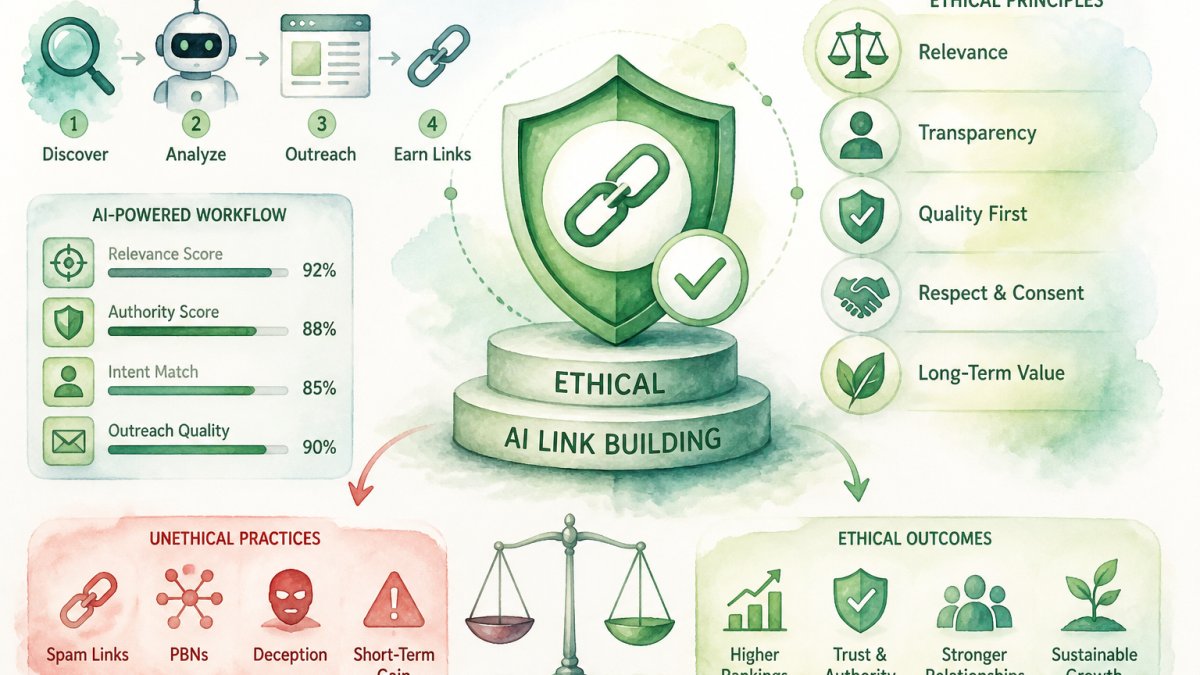
Ethical considerations for AI link building are no longer optional. They're foundational to sustainable SEO strategies that protect your domain, maintain your brand reputation, and align with how search engines actually rank content today.
Here's why ethical considerations for AI link building matter now. AI systems can generate outreach emails, identify link prospects, and even draft relationship-building content at scale. But speed without ethics creates risk. Research on ethical considerations in AI deployment shows that automation without oversight introduces bias, transparency gaps, and compliance exposure. Your AI tool might flag a prospect as high-value when it's actually a poor fit for your brand. Your generated email might sound robotic or misleading. Your link targets might violate Google's policies without you realizing it.
The stakes are real. Google penalizes manipulative link-building. Your domain authority suffers. Worse, your brand loses trust with prospects who discover inauthentic outreach.
This guide covers how to use AI responsibly in link building, without sacrificing speed or scale.
AI Link-Building Best Practices That Maintain Integrity
The best AI-assisted link-building workflows combine automation with human judgment at critical checkpoints. This isn't about slowing down. It's about directing AI where it excels and keeping humans in charge where it matters.
Start with clear criteria. Before your AI identifies prospects, define what "relevant" means for your business. Not every high-authority site is a good fit. A SaaS company selling project management tools shouldn't pursue links from fitness blogs, no matter the domain authority. AI doesn't understand brand fit the way humans do.
Next, use AI to handle the heavy lifting:
- Keyword research and prospect identification
- Initial outreach email drafting
- Content gap analysis on target sites
- Relationship mapping and follow-up scheduling
Then, insert human review before any outreach goes live. Your team should verify that each prospect aligns with your brand, that the generated email sounds authentic, and that the proposed content angle actually solves a problem for that publication.
Guidelines on ethical AI use across the lifecycle emphasize that responsibility spans data collection, algorithm design, validation, deployment, and ongoing use. This applies directly to link building. Your AI system should be audited regularly. You should track which prospects convert to actual links and which don't, and adjust your criteria based on real results, not just AI confidence scores.
One more practice: document your process. When you combine AI with human oversight, you create a defensible record. If Google ever questions your links, you can show that real humans reviewed each outreach for relevance and authenticity.
Transparency in AI-Generated Outreach Emails
Transparency is where many teams stumble. They use AI to draft outreach, send it without modification, and assume the recipient won't notice. They notice.
Here's the principle: your outreach should be honest about who you are and what you want. It doesn't need to say "this email was written by AI." But it shouldn't be deceptive about your intent or hide the fact that you're reaching out for a link.
AI-generated emails often fall into two traps. First, they sound too polished. A real person pitching a link usually sounds more casual, more specific to that publication, more human. Second, they're generic. The AI might reference the target's content accurately, but it doesn't explain why YOUR content matters to THEIR audience.
Fix both. After your AI drafts the email, have a human rewrite the opening and closing. Add a specific detail that shows you actually read their recent article. Reference a real conversation or mutual connection if one exists. Make the value proposition clear: why would their readers benefit from linking to you?
Transparency also means disclosing relationships. If you have a prior connection to the editor or publisher, say so. If your company has worked with them before, mention it. These details build trust and reduce the risk of your outreach being flagged as spam or manipulative.
AI Link-Building Risks and How to Avoid Them
AI systems inherit bias from their training data. This is the most significant risk in automated link building. Your AI might consistently favor prospects from certain industries, geographies, or company sizes, not because those are better targets, but because the training data reflected those patterns.
Research on bias in AI systems and training data confirms that biased training information produces biased results. In link building, this means your AI might overlook high-quality prospects that don't fit its learned patterns.
The fix: regularly audit your prospect list by industry, geography, and company type. If you notice patterns (e.g., 80% of your prospects are in tech), investigate why. Is that actually your best market, or is your AI showing bias? Adjust your criteria and retrain the model if needed.
Another risk is the black-box problem. Your AI recommends a prospect as high-value, but you can't explain why. The system weighted domain authority, content relevance, and traffic metrics, but you don't know the formula. This opacity creates accountability gaps.
Mitigate this by requiring explainability. Your AI tool should show its reasoning: "This prospect scores 8/10 because: Domain Authority 65 (40% weight), Content relevance match 90% (35% weight), Recent posts in your category (25% weight)." Now you can evaluate whether that reasoning makes sense.
A third risk is scale without review. AI can generate 500 outreach emails in an afternoon. Sending all 500 without human review is reckless. You'll inevitably include irrelevant prospects, poor-fit pitches, or emails that violate Google's policies. One batch of bad outreach can damage your reputation and trigger spam flags.
Always maintain a review bottleneck. Set a rule: no outreach goes live without human approval. This slows you down slightly, but it prevents catastrophic mistakes.
Compliance With Google Link Spam Policies
Google's link spam policies are clear: links obtained through manipulation, deception, or artificial inflation of authority are violations. Your link-building strategy, whether AI-assisted or manual, must comply.
The key principle: links should be earned, not bought or coerced. This means your outreach should offer genuine value. You're asking for a link because your content solves a problem for their audience, not because you're paying for it or using social engineering.
AI can help you comply. Use it to identify sites where your content genuinely fits. Use it to draft outreach that explains the value. But use it carefully. Don't use AI to:
- Generate fake testimonials or social proof to make your content seem more authoritative
- Create multiple variations of the same outreach to spam different contacts at the same site
- Disguise commercial intent as editorial collaboration
- Automate link requests to hundreds of sites without relevance checks
Google's systems detect these patterns. Your domain will be flagged. Recovery is slow and painful.
One more compliance point: private link networks (PBNs) and link schemes are off-limits. Even if your AI can identify expired domains and build a network of sites linking to you, don't do it. Google penalizes this aggressively.
Building Trust Through Human Oversight
The most effective link-building programs combine AI speed with human judgment. This isn't a compromise. It's a competitive advantage.
Here's why: humans understand context. Your team knows your brand, your audience, and your industry in ways AI doesn't. A human can read a prospect's recent article and instantly recognize whether it aligns with your values. A human can sense when an outreach email sounds authentic or forced. A human can make judgment calls that an algorithm can't.
Set up a clear oversight process. Define roles: who reviews prospect lists? Who approves outreach? Who tracks results and adjusts strategy? Make these decisions explicit.
Your oversight process should include these checkpoints:
- Prospect validation: A human confirms each prospect is relevant and brand-aligned
- Email review: A human rewrites or approves the generated outreach before sending
- Content check: A human verifies that any content you're promoting actually solves the target's audience problem
- Relationship tracking: A human documents the relationship and follow-up strategy
- Results analysis: A human reviews which outreach converted to links and why
This process adds time. It's worth it. You'll see higher conversion rates, fewer spam complaints, and stronger long-term relationships with publishers.
Measuring the Quality and Impact of AI-Assisted Backlinks
Not all backlinks are equal. A link from a high-authority site in your industry is worth far more than a link from an irrelevant directory. AI can help you identify quality prospects, but only humans can measure whether the links you earn actually move the needle.
Track these metrics:
| Metric | What It Measures | Why It Matters |
|---|---|---|
| Domain Authority of linking site | Authority of the source | Higher DA = more SEO value |
| Content relevance | How well the linking content matches your topic | Relevant links carry more weight |
| Referral traffic | Actual visitors from the link | Proves the link drives real value |
| Anchor text quality | Whether the link text matches your target keywords | Anchor text signals topic relevance |
| Link velocity | How quickly you earn links over time | Rapid spikes can trigger spam flags |
Use these metrics to evaluate your AI tool's recommendations. If your AI is suggesting high-DA sites but they're generating zero referral traffic, the tool's criteria need adjustment. If most of your links come from irrelevant sites, your relevance filter is too loose.
You can see which link-building campaigns drive traffic, which prospects convert, and which content angles work best. This data feeds back into your AI model, making it smarter over time.
The goal isn't the highest number of links. It's the highest-quality links that drive real traffic and authority to your site.
Ethical link building isn't a constraint on growth. It's the foundation of sustainable growth. When you combine AI automation with transparent practices and human oversight, you build links that last, earn trust with publishers, and comply with Google's standards. Start by auditing your current process. Where are you cutting corners? Where could human review prevent mistakes? Then layer in AI to handle the repetitive work, prospect research, initial outreach, follow-up scheduling, while keeping your team in charge of decisions that matter. We've built our platform around this principle: AI handles scale, humans handle judgment. That's how you build links that actually move the needle for your business.
Ready to dominate search results?
Join 8020+ businesses using GrandRanker to track rankings, fix SEO issues, and grow organic traffic.
Buy NowFrequently Asked Questions
The primary ethical considerations include transparency (disclosing AI use to recipients), fairness (avoiding bias in prospect selection), privacy (protecting recipient data), and accountability (maintaining human oversight). According to UNESCO's AI ethics framework, these principles should apply across the entire AI lifecycle—from data collection through deployment. Ethical AI link building means being honest about automation, ensuring your targeting logic doesn't discriminate, and maintaining quality standards that benefit both your site and the websites linking to you.
Clear disclosure builds trust and demonstrates integrity. Include a statement in your outreach like 'This message was drafted with AI assistance but reviewed and personalized by our team' or 'We use AI tools to identify relevant partnership opportunities, though all outreach is personally reviewed.' Transparency about AI use complies with emerging best practices and helps recipients understand your process. Avoid presenting AI-generated content as entirely human-written, as this undermines trust and may violate FTC guidelines on deceptive practices.
Key risks include bias reproduction (AI trained on biased data may unfairly target or exclude prospects), low-quality backlinks (automation without human review can result in irrelevant links that don't help ranking), spam flagging (Google penalizes unnatural link patterns and manipulative outreach), and brand damage (poor-quality outreach reflects badly on your company). Research from Capitol Technology University and Franklin University shows that AI systems can inherit societal biases from training data. The opacity of AI decision-making also makes it harder to audit why certain prospects were selected, limiting accountability.
Google's link spam policies prohibit unnatural links, paid links, and manipulative outreach schemes. AI-generated link-building campaigns must still comply with these policies. If your AI generates mass, low-quality outreach or targets irrelevant sites, Google may penalize your domain. The key difference is human oversight: AI can identify prospects faster, but humans must verify that each outreach is relevant, personalized, and compliant with Google's guidelines. Automation doesn't exempt you from responsibility—it increases the importance of quality control.
Continue Reading
More guides to level up your SEO strategy.