Key Takeaways
- Why AI Changes Guest: Why AI Changes Guest Post Outreach at Scale
- Finding Relevant Websites for: Finding Relevant Websites for Guest Posting at Scale
- Creating AI Guest Post: Creating AI Guest Post Outreach Email Templates That Convert
- Best AI Guest Post: Best AI Guest Post Outreach Tools to Automate Your Workflow
- Guest Posting Outreach Best: Guest Posting Outreach Best Practices When Using Automation
- Building Your Guest Post: Building Your Guest Post Outreach Follow-Up Sequence
Why AI Changes Guest Post Outreach at Scale
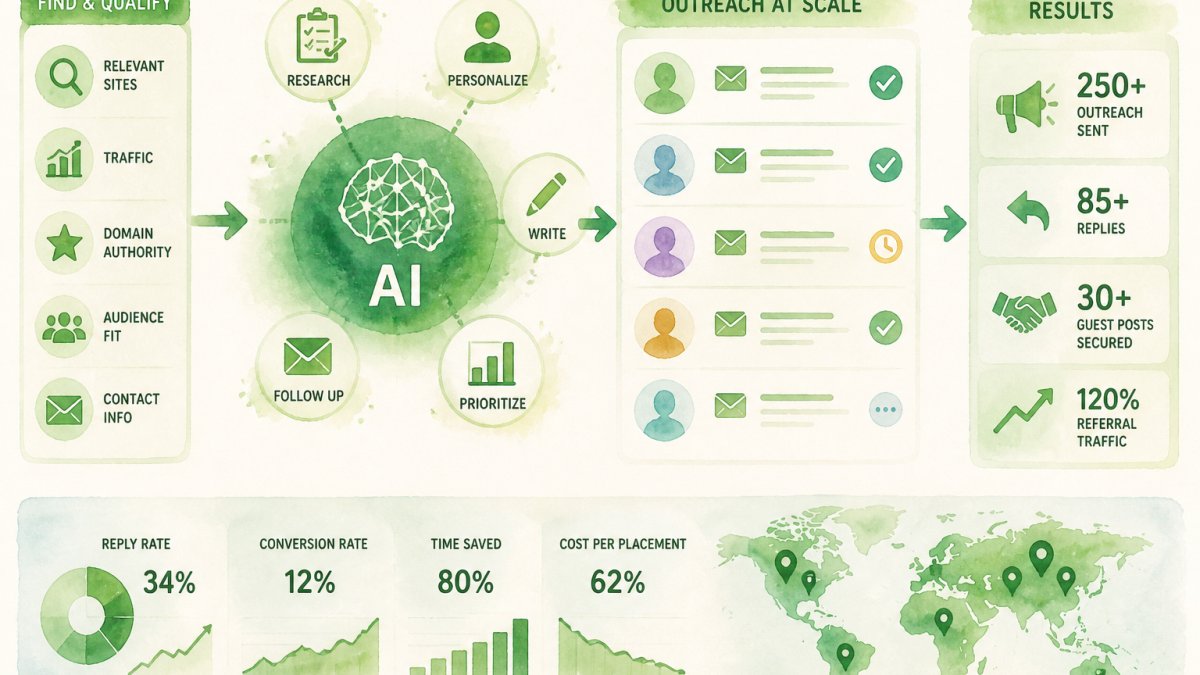
AI for guest post outreach at scale transforms how you find websites, write pitches, and manage follow-ups. Instead of spending hours manually researching sites and crafting emails, AI handles the repetitive work while you focus on strategy.
The shift matters because guest posting drives domain authority and referral traffic. But scaling it manually is brutal. You need to find relevant sites, personalize pitches, track responses, and follow up with dozens of prospects. Most teams either give up or hire expensive outreach specialists.
AI solves this by automating the parts that waste time. It finds target websites based on your criteria. It generates personalized email templates. It tracks which prospects responded and when to follow up. You still make the final decisions, AI just removes the grunt work.
The quality stays high because AI handles discovery and drafting, leaving your team to refine strategy and close deals.
Finding Relevant Websites for Guest Posting at Scale
Finding the right sites to pitch is where most outreach fails. You can send 100 pitches to irrelevant websites and get zero placements. Send 20 pitches to the right sites and you'll land several guest posts.
AI accelerates this discovery process by scanning thousands of websites and filtering for relevance. Instead of manually checking each site's domain authority, content quality, and audience fit, AI does the screening in minutes.
Here's what to look for when using AI tools for site discovery:
- Domain authority and traffic metrics, AI should pull DA/PA scores and estimated monthly visitors
- Content relevance, The site should publish content related to your industry or niche
- Author guidelines, AI should flag whether the site accepts guest posts and what the submission process looks like
- Audience overlap, The site's audience should match your target customer profile
- Recent activity, Sites with fresh content are more likely to accept new pitches
Start by giving AI tools a clear brief. Tell it your industry, target audience, and what you want to achieve. The more specific you are, the better the results. Vague prompts like "find sites in marketing" will waste time on irrelevant results.
Many teams make the mistake of targeting only high-authority sites. Yes, a guest post on a major publication helps. But mid-tier sites with engaged audiences often convert better. They have less competition for placement and their readers are more loyal.
Creating AI Guest Post Outreach Email Templates That Convert
Your email template makes or breaks the pitch. A generic template gets ignored. A personalized, value-first template gets responses.
AI can generate templates in seconds, but the best approach is to use AI as a starting point and customize from there. Here's the structure that works:
Subject line: Reference something specific about their site or recent article. Avoid generic pitches like "Guest post opportunity."
Opening: Show you've read their content. Mention a specific article or topic they cover. This proves you're not mass-pitching.
Value proposition: Explain what your guest post will do for their audience. Focus on their benefit, not yours.
Your pitch: Keep it short. One paragraph describing the topic idea. Make it relevant to their existing content.
Bio/credentials: Briefly explain why you're qualified to write on this topic. Link to your best work or relevant experience.
Call to action: Ask a simple yes/no question. "Does this topic fit your editorial calendar?" works better than "Let me know if you're interested."
AI tools can generate these sections quickly. The key is personalizing the opening and value proposition for each site. Mass-sending identical templates kills response rates.
A common mistake is leading with what you want. "I'm launching a new product and would love to write a guest post about it." Editors see through this immediately. Lead with what their audience needs.
Best AI Guest Post Outreach Tools to Automate Your Workflow
Several tools can help automate parts of the guest posting process. The best choice depends on your budget, volume, and technical comfort level.
AI-powered research and outreach platforms combine site discovery, email generation, and tracking in one place. They use AI to find relevant websites, suggest pitch angles, and help you manage follow-ups.
Email automation tools let you send personalized sequences to prospects. You set the timing and conditions (e.g., "send follow-up if no response in 3 days"), and the tool handles delivery.
Content generation tools help you draft guest post ideas and outlines based on a site's existing content. This saves time on the creative side.
CRM and tracking tools keep your outreach organized. You can log contacts, track responses, and schedule follow-ups in one dashboard.
The most effective setups combine tools. Use an AI research tool to find sites, a content tool to draft pitches, and an email automation platform to manage sequences.
| Tool Type | Primary Use | Best For |
|---|---|---|
| AI Research Platforms | Site discovery + filtering | Finding high-quality targets quickly |
| Email Automation | Sequence management + follow-ups | Scaling outreach without manual work |
| Content Generators | Pitch drafting + topic ideation | Speeding up creative work |
| CRM Systems | Contact tracking + reporting | Staying organized at scale |
When choosing tools, prioritize ease of use. A powerful platform you don't understand wastes time. Start simple and add complexity as your process scales.
Guest Posting Outreach Best Practices When Using Automation
Automation is powerful, but it requires discipline. Automated outreach that ignores best practices will damage your reputation and tank response rates.
Personalization matters more with automation, not less. When you're sending 50 pitches instead of 5, each one needs to feel custom.
Respect email frequency limits. Sending 100 pitches in one day looks like spam. Spread outreach over days or weeks. Most email providers flag accounts that send large volumes at once.
Monitor bounce rates and unsubscribes. If your list quality is poor, your sender reputation suffers. Clean your email list regularly and remove invalid addresses.
Test your templates before scaling. Send 10 pitches manually first. Track response rates and refine your approach before automating 100+.
Avoid over-automation. Some parts of outreach should stay manual. Automation is a tool, not a replacement for strategy.
Many teams make the mistake of assuming automation means "set it and forget it." It doesn't. You still need to monitor results, adjust templates, and refine your targeting as you go.
Building Your Guest Post Outreach Follow-Up Sequence
Most pitches don't get responses on the first try. A follow-up sequence is essential. But how many follow-ups is too many? The answer depends on your audience and outreach goals.
A typical follow-up sequence looks like this:
- Day 0: Send initial pitch
- Day 3: First follow-up (gentle reminder, add new information)
- Day 7: Second follow-up (different angle or new pitch)
- Day 14: Final follow-up (last chance to connect)
- Day 21: Move prospect to next list or archive
This timing gives editors time to respond without feeling pressured. Most responses come on the second or third touch, not the first.
The content of each follow-up matters. Don't just resend the same email. Each follow-up should add value or offer something new.
Personalize follow-ups just like your initial pitch. Mention something from your first email to show continuity. "I sent this idea last week and wanted to check in" beats a generic follow-up.
Some editors need multiple touches. Others respond quickly or not at all. Use automation to manage timing, but review responses manually. If someone says no, respect it and move on.
Measuring Success: Metrics That Matter for Guest Post Campaigns
Tracking results is how you improve. Without data, you're guessing whether your outreach is working.
The key metrics to track are:
- Pitches sent, How many prospects did you contact?
- Response rate, What percentage replied (yes, no, or maybe)?
- Placement rate, What percentage of responses turned into published posts?
- Traffic from posts, How much referral traffic did each guest post drive?
- Domain authority gained, Did your domain authority improve from the backlinks?
Response rate is your first filter. If you're getting 5% responses, your targeting or pitch quality needs work. If you're getting 25%+ responses, your approach is solid.
Placement rate tells you how good your pitches are. If 50% of responses turn into posts, your pitches are strong. If only 10% do, the pitch quality or site fit needs improvement.
Traffic and authority are the ultimate measures. A guest post that doesn't drive traffic or build authority isn't worth the effort. Track which sites send the most valuable traffic and prioritize similar outlets in future campaigns.
Set up tracking before you start outreach. Use a spreadsheet or CRM to log each pitch, response, and outcome. This data becomes invaluable as you scale.
Conclusion: Scale Guest Post Outreach Without Sacrificing Quality
Guest posting is one of the most effective ways to build domain authority and drive organic traffic. But scaling it manually is exhausting.
AI for guest post outreach at scale removes the bottlenecks. It finds relevant sites, drafts personalized pitches, and manages follow-ups, all while you focus on strategy and content quality.
The key is balancing automation with human judgment. Use AI to handle research, drafting, and scheduling. Keep humans in charge of targeting decisions, pitch refinement, and relationship building.
GrandRanker automates the entire guest posting workflow. Our platform finds high-quality target sites, generates personalized pitch templates, and tracks responses in one dashboard. You get more placements with less manual work, so your team can focus on writing great content instead of hunting for opportunities. Start your free trial and see how AI can scale your guest posting strategy.
Ready to dominate search results?
Join 8020+ businesses using GrandRanker to track rankings, fix SEO issues, and grow organic traffic.
Buy NowFrequently Asked Questions
AI automates three critical bottlenecks in guest post outreach: finding relevant websites at scale, personalizing pitch emails without sounding generic, and managing follow-up sequences. Instead of manually researching 50 sites and writing 50 unique emails, AI tools identify prospects that match your niche, generate personalized subject lines and opening paragraphs based on each site's content, and trigger follow-ups automatically. This means you can reach 500 relevant editors in the time it took to reach 50 manually, while maintaining the personalization that actually gets responses.
A high-converting guest post outreach email has five elements: a personalized subject line referencing something specific about their site, an opening that shows you've read their recent content, a clear pitch for 1-3 specific topic ideas relevant to their audience, a 1-2 sentence bio with your credentials and a link, and a soft call-to-action asking when they might be open to pitches. AI tools generate these sections by analyzing the target site's topics, tone, and recent articles, then inserting your expertise and angle. The key is specificity—generic pitches get deleted; personalized ones get responses.
Most professionals use a 3-touch sequence: an initial pitch, a follow-up after 3-4 days if no response, and a final follow-up after 7-10 days. Some teams add a fourth touch after 14 days if targeting high-authority sites. Automation makes this effortless—you set the sequence once and it triggers based on time or engagement signals. The goal is visibility without annoyance; more than 4 touches typically triggers spam filters or blocks. AI outreach platforms manage this timing automatically, so you don't accidentally send 10 emails to the same editor.
Avoid spam filters by personalizing subject lines and opening sentences (not mass mail), spacing follow-ups at least 3-4 days apart, sending from a real domain and professional email address (not a generic noreply), keeping pitch length under 150 words, and using natural language without excessive links or promotional language. AI tools help by generating unique subject lines for each prospect, randomizing send times, and flagging overly generic or spammy-sounding copy. The difference between spam and legitimate outreach is personalization—AI makes that scalable by analyzing each target site and adapting your message to fit their specific audience and tone.
Continue Reading
More guides to level up your SEO strategy.