Key Takeaways
- Why Broken Links Matter More in 2026: The AI Citation Problem
- How AI Tools Find Broken Links: What's Actually Happening
- Best Practices for Broken: Best Practices for Broken Link Building and Prevention
- How to Fix Broken: How to Fix Broken Links in WordPress and Other Platforms
- AI-Powered SEO Audit Tools: AI-Powered SEO Audit Tools That Detect Broken Links at Scale
- Building Your Broken Link: Building Your Broken Link Detection Workflow
Why Broken Links Matter More in 2026: The AI Citation Problem
Broken links have become a critical SEO problem. Not because they hurt user experience (though they do), but because AI assistants now cite your content to millions of people. When those citations lead to broken pages, your domain authority suffers.
Here's the problem: AI models send users to broken links far more often than traditional search engines. ChatGPT directs users to broken pages 1.8% of the time, according to SuffDigital's 2026 analysis of AI citation accuracy. That might sound small. But when you're cited by millions of AI conversations, 1.8% means thousands of users hit dead ends instead of your content.
Compare that to Google's AI Overviews, which link to broken pages only 0.5% of the time. SE Ranking's comparative study shows ChatGPT is twice as likely to send users to broken links. And Semrush's analysis of 260 billion data points found that AI assistants overall send users to broken links 3x more frequently than traditional search engines.
The impact is real. Every broken link in your content is a missed opportunity. It's a citation that doesn't convert. It's domain authority leaking away.
Using AI to find broken links isn't optional anymore. It's essential for maintaining your online visibility in 2026.
How AI Tools Find Broken Links: What's Actually Happening
AI doesn't magically crawl your entire website. It works by analyzing patterns in your content and cross-referencing links against known databases of dead pages. The process is faster than manual checking but requires human oversight to stay accurate.
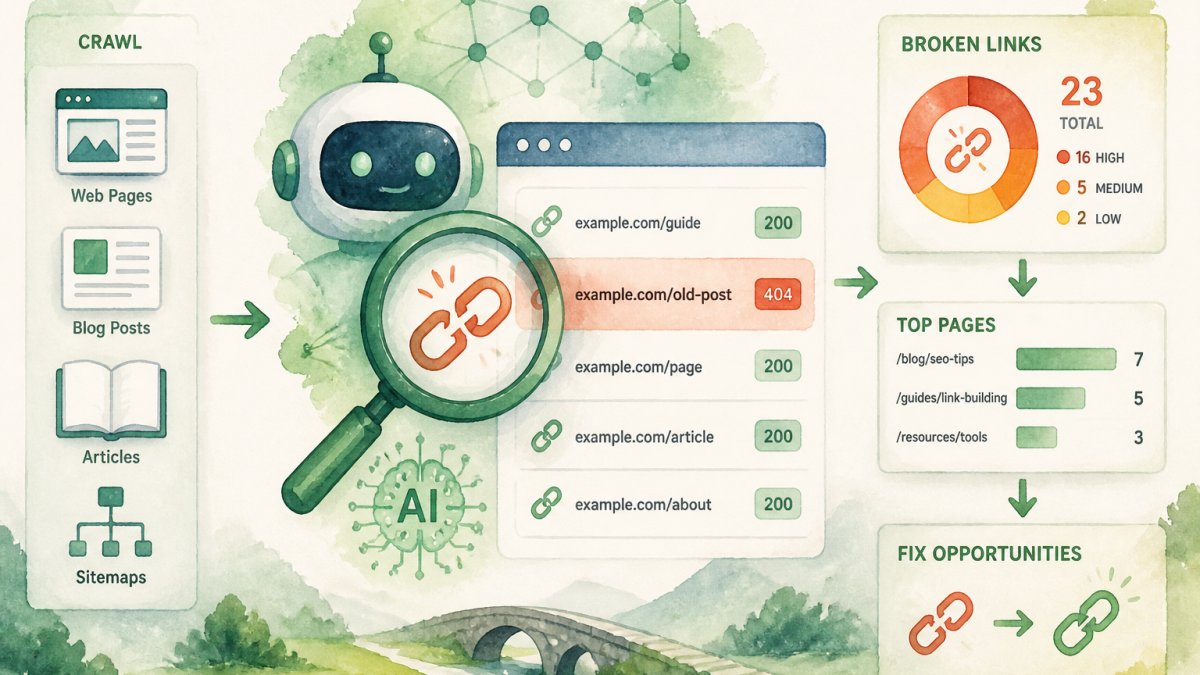
Most AI-powered broken link detection tools work in three steps:
- Scan your website for all external links
- Check each link against live web servers
- Flag pages that return 404 errors or timeout responses
The real power comes from automation. A tool can scan thousands of links in minutes. A human would need weeks. This speed matters because broken links can appear overnight when websites go down or change their URL structure.
But here's what most guides miss: full automation isn't there yet. No mainstream AI tool currently re-finds moved links automatically. If a page moved from /blog/old-post to /blog/new-post, the tool flags it as broken. You still need to manually find the new URL or use hybrid approaches like combining Perplexity AI with the Wayback Machine to locate moved content.
The best approach combines automation with human judgment. Let the AI find the broken links. Then use your own research skills to determine whether the link is truly dead or just moved.
Best Practices for Broken Link Building and Prevention
Broken link building is a strategy where you find broken links on other websites, then pitch your own content as a replacement. It's one of the most effective ways to earn backlinks. But it only works if you're not creating broken links on your own site first.
Start with prevention. Audit your own site monthly for broken links. This should be non-negotiable. A broken link on your homepage damages trust instantly. Visitors bounce. AI assistants cite your page and send users to dead ends.
When you find broken links, prioritize by traffic. A broken link on a high-traffic page costs you more than one on a page few people visit. Fix the high-impact ones first.
For broken link building, the process is straightforward:
- Find broken links on competitor websites or industry sites
- Identify the topic of the broken page
- Create better content on that same topic
- Reach out to the site owner with your replacement
This strategy works because site owners want their broken links fixed. They're not rejecting you, they're solving a problem they already have. The pitch is easy: "I found a broken link on your site. Here's a better resource that covers the same topic."
How to Fix Broken Links in WordPress and Other Platforms
WordPress makes fixing broken links easier than most platforms. The process depends on whether the link is internal or external.
For internal broken links in WordPress, use a plugin like Broken Link Checker. It scans your site automatically and flags dead links. Once you identify the broken link, edit the post and update the URL. If the linked page no longer exists, either delete the link or replace it with a link to similar content.
For external broken links, you have options:
- Update the link: If the page moved, find the new URL and update the link
- Remove the link: If the page no longer exists and you can't find a replacement, delete it
- Link to the Wayback Machine: If the page is gone but archived, link to the archived version instead
External links are trickier because you don't control the destination. The best practice is to regularly audit external links and update them before they break. This prevents the situation where users click your link and hit a 404.
Other platforms like Webflow and custom-built sites require manual checking or third-party tools. The principle is the same: identify broken links and fix them quickly.
AI-Powered SEO Audit Tools That Detect Broken Links at Scale
Several tools now use AI to find broken links faster than traditional methods. The best ones combine automated crawling with intelligent reporting.
GrandRanker's AI-powered SEO platform includes broken link detection as part of its comprehensive site audit. Rather than requiring separate tools, the platform identifies broken links while analyzing your content for SEO optimization. This integration means you catch broken links before they damage your rankings or hurt your AI citability.
The key difference between these tools is scope. Some focus on your own site. Others help you find opportunities on competitor sites. The best choice depends on whether you need internal auditing or external link building strategy.
Building Your Broken Link Detection Workflow
A good workflow prevents broken links from piling up. It catches problems early and fixes them before they affect your rankings or AI citations.
Start with frequency. Set a monthly audit schedule. Mark it on your calendar. Consistency matters more than perfection. Monthly checks catch problems within 30 days of they appear.
Your workflow should include:
- Run an automated broken link scan
- Export the results to a spreadsheet
- Categorize by priority (high-traffic pages first)
- Assign fixes to team members
- Track completion and verify fixes
The second step is critical. A spreadsheet keeps you accountable. You can see which links are fixed and which are still broken. This visibility prevents broken links from being forgotten.
For external broken link opportunities, add a separate workflow. Set up Google Alerts for competitor content in your niche. When a competitor's page disappears, you get notified. Then you can pitch your content as a replacement.
This dual approach, preventing your own broken links while building on competitor broken links, creates a sustainable SEO strategy. One protects your existing authority. The other builds new authority through strategic backlinks.
Broken links damage your domain authority and turn AI citations into dead ends. Every link that leads nowhere is a missed opportunity to convert readers and build trust. At GrandRanker, we help you identify and fix broken links automatically while optimizing your content for AI citability. Start your free trial today and see how protecting your link integrity boosts your rankings in both Google and AI assistants.
Ready to dominate search results?
Join 8020+ businesses using GrandRanker to track rankings, fix SEO issues, and grow organic traffic.
Buy NowFrequently Asked Questions
AI tools excel at detecting broken links and automating the scanning process, but full automation of fixes still requires human oversight. Current AI solutions identify 404 errors and broken pages, then flag them for remediation. Some platforms like GeekyTech's broken link building agent automate outreach for link replacement, but verifying that moved content is actually available and relevant still benefits from human review. Hybrid approaches—combining AI detection with manual verification—deliver the most reliable results.
Broken links directly harm domain authority because search engines view them as poor site maintenance and crawlability issues. More critically for 2026, broken links block AI discovery and turn AI citations into dead ends. When ChatGPT or other AI assistants cite your content and readers click a broken link, trust erodes and bounce rates spike. Studies show ChatGPT directs users to broken pages 1.8% of the time—twice the rate of Google's AI models—making broken link management essential for maintaining both SEO authority and AI visibility.
Manual checking requires you or your team to visit each link individually—impractical for sites with hundreds or thousands of external and internal links. AI-powered auditing crawls your entire site automatically, identifies broken links in minutes, and scales to sites of any size. AI tools also categorize errors (404, 301 redirects, server timeouts), prioritize high-impact broken links by traffic, and generate reports. The efficiency gain is massive: what takes weeks manually takes hours with AI, freeing your team to focus on strategic remediation rather than discovery.
Monthly scans are a solid baseline for most sites. High-traffic sites or those with frequent content updates should scan weekly or after major publishing cycles. The cost of AI scanning is negligible, so the real constraint is how quickly you can fix issues. Set up automated scans in your AI audit tool and review reports monthly. If you discover broken links affecting high-traffic pages, fix them immediately—every day a broken link sits costs you crawlability, user experience, and AI citation opportunities. Quarterly deep audits of your entire backlink profile catch issues automated tools might miss.
Continue Reading
More guides to level up your SEO strategy.