Key Takeaways
- What E-A-T Actually Means: What E-A-T Actually Means for AI-Assisted Content
- AI Content Optimization Best: AI Content Optimization Best Practices That Support E-A-TFact-Checking Workflows for AI DraftsAdding Named Sources and Author Credentials
- Fact-Checking Workflows for AI: Fact-Checking Workflows for AI Drafts
- Adding Named Sources and: Adding Named Sources and Author Credentials
- Tools for E-E-A-T Improvement: What to Use at Each Stage
- How to Demonstrate Expertise: How to Demonstrate Expertise in AI-Generated ContentInjecting First-Hand Experience Into AI Drafts
What E-A-T Actually Means for AI-Assisted Content
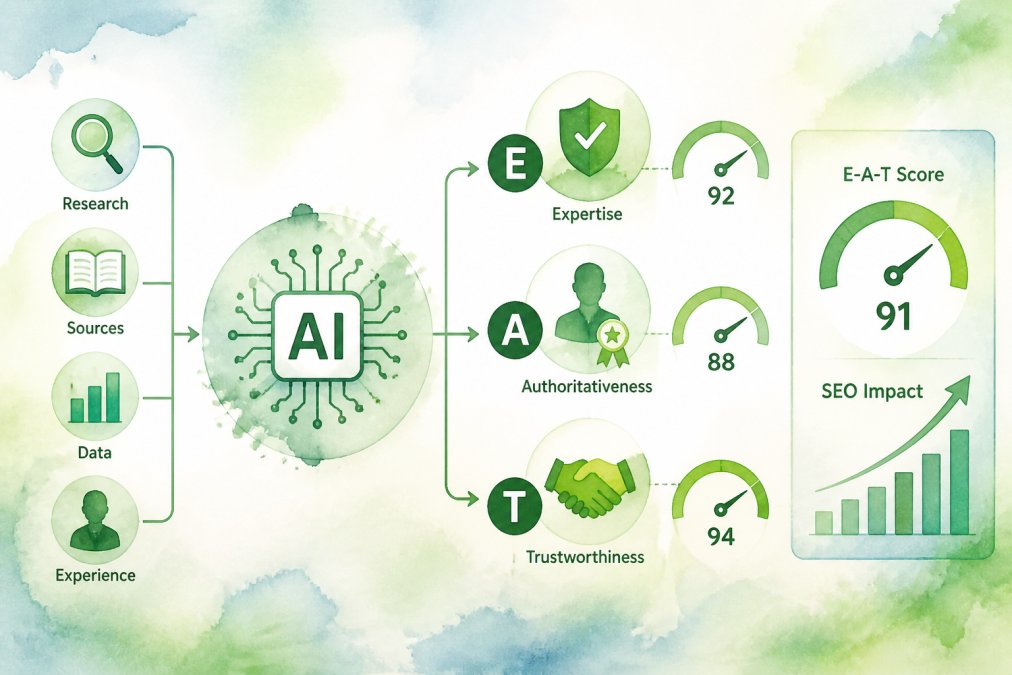
E-A-T stands for Expertise, Authoritativeness, and Trustworthiness, the three qualities Google's search raters use to judge whether a page deserves to rank. It is not a direct ranking score you can flip on. It is a set of signals that build up over time.
Here is the tension most teams miss. AI can now draft a 1,500-word article in under a minute. But speed without proof of who wrote it and why they can be trusted is exactly what gets ignored. According to the Stanford HAI 2026 AI Index Report, 88% of organizations have adopted AI, and performance on the SWE-bench Verified coding benchmark jumped from 60% to near 100% in a single year. Capability is exploding. Trust is not.
So the real question is not "can AI write this?" It is "can AI make this more credible?" That is the throughline for everything below, and it is where most guides get it wrong.
AI Content Optimization Best Practices That Support E-A-T
The best AI content optimization best practices treat the model as a research assistant, not an author. You let AI gather, structure, and check. You keep the judgment calls.
A few rules that hold up in practice:
- Never publish a first draft without a human pass for accuracy
- Require a named source for every statistic
- Keep one real expert attached to every piece
- Log what the AI changed and what you changed back
That last one matters more than it sounds. When you can show your edit trail, you have evidence of human oversight. Google's raters look for exactly that.
Fact-Checking Workflows for AI Drafts
Build fact-checking into the draft, not after it. A simple workflow beats a heroic cleanup.
- Have the AI mark every claim with a source tag as it writes
- Flag any claim it cannot source
- Verify each flagged claim against a primary source
- Cut or rewrite anything you cannot confirm
The Frontiers in Nutrition 2026 study found that AI-based dietary recommendations can underestimate nutrient needs and should not be used without professional supervision. The lesson generalizes: AI output in any high-stakes field needs a human check before it ships.
Adding Named Sources and Author Credentials
Anonymous content earns no trust. Every article needs a real byline, a real bio, and real citations.
- Add an author bio with credentials and a link to their profile
- Cite primary sources, not summaries
- Show a "reviewed by" line for technical topics
This is the single fastest E-A-T win available. It costs you ten minutes per article.
Tools for E-E-A-T Improvement: What to Use at Each Stage
Tools for E-E-A-T improvement fall into four buckets, and each one maps to a different pillar. Picking the wrong bucket for the wrong pillar wastes money.
| Tool Category | Primary Pillar | What It Does | Watch Out For |
|---|---|---|---|
| Content optimization | Expertise | Improves depth, structure, coverage | Thin content still ranks poorly |
| Fact-checking | Trustworthiness | Flags unsourced claims | Cannot judge nuance |
| Author schema | Authoritativeness | Marks up who wrote what | Garbage in, garbage out |
| Citation monitoring | Authoritativeness | Tracks who cites you | Vanity metrics risk |
Here is where an all-in-one platform changes the math. GrandRanker handles keyword research, content creation, optimization, and publishing in one system. That means your author schema, source tags, and citation tracking stay consistent instead of drifting across four tools. For small teams, that consistency is the whole game.
How to Demonstrate Expertise in AI-Generated Content
You demonstrate expertise in AI-generated content by injecting what the model cannot know: your first-hand experience, your data, and your specific point of view. AI knows the general case. You know your case.
The Glean 2026 workplace productivity report found that AI saves workers 11 hours per week. But the same report warns that a lack of organizational context can "eat the gains," producing output that is fast and wrong. That gap is where expertise lives.
Injecting First-Hand Experience Into AI Drafts
Feed the model your real inputs. Then edit what comes back.
- Paste in your own customer questions and objections
- Add specific results from your own work
- Replace generic examples with named ones
- Cut every sentence that could apply to any company
A JMIR study on AI-assisted habit tracking showed that a weeklong AI-assisted intervention improved self-regulation and eating habits. The AI did not replace the person. It supported a behavior the person was already trying to change. Content works the same way.
Building Author Authority Signals Google Can Verify
Author authority is not a claim you make. It is a trail others can check. Google wants to see that a real person with real credentials wrote this, and that other trusted sites confirm them.
What actually moves the needle:
- A consistent author profile across every byline
- Links to the author's work on other reputable sites
- Person schema markup with
sameAslinks to verified profiles - External mentions and citations of the author by name
The Purdue University 2026 research on AI diet measurement shows AI can capture real-time behavior that surveys miss. Apply the same logic to authority: capture verifiable signals in real time, not claims you make after the fact.
Common Mistakes When Using AI for E-A-T Improvement
The biggest mistake when using AI for E-A-T improvement is treating volume as a substitute for credibility. Ten thin articles do less for you than one well-sourced, well-attributed piece.
Others worth avoiding:
- Publishing AI drafts with no human review
- Skipping author bios because "the AI wrote it"
- Citing secondary sources instead of primary ones
- Chasing citation counts without checking quality
- Letting brand voice flatten into generic AI phrasing
The fix for most of these is process, not tooling. Set a review gate. Require a named source. Keep one human accountable per piece. Do those three things and you avoid 80% of the damage.
Building real E-A-T signals takes consistent process: sourced claims, named authors, and verifiable citations on every piece. That is hard to sustain by hand. GrandRanker automates the parts that scale, keyword research, content creation, optimization, and publishing, so your authority signals stay consistent instead of drifting. With 421+ founders already growing on the platform, you can start a free trial and let the system handle the busywork while you keep the expertise.
Ready to dominate search results?
Join 8020+ businesses using GrandRanker to track rankings, fix SEO issues, and grow organic traffic.
Buy NowFrequently Asked Questions
Yes, if you add verification layers. Google's guidelines focus on whether content demonstrates real expertise and trustworthiness, not how it was produced. AI can draft structure and research summaries, but you need human review for accuracy, named sources, and author credentials. A 2026 Frontiers in Nutrition study found AI dietary recommendations can underestimate nutrient needs without professional oversight, which shows why expert review matters. Treat AI as a drafting tool, then add the verification and attribution that E-A-T requires.
AI speeds up the work that builds authority: finding citation-worthy statistics, structuring content around user intent, and monitoring which pages earn links or mentions. It also helps you publish consistently, which signals an active, maintained site. But authority still comes from being cited by other credible sources. Use AI to identify gaps and produce well-sourced content faster, then focus your manual effort on outreach and original research that earns citations.
Google penalizes unhelpful content regardless of how it was made. The 2026 Stanford HAI AI Index reports 88% organizational AI adoption, so Google's systems are built to evaluate quality signals, not detect AI. Pages that lack author credentials, cite no sources, and offer no original insight get outranked. Pages that use AI for structure but include verified data, named experts, and clear sourcing perform well. The penalty risk comes from thin content, not AI use itself.
Set up a two-pass workflow. First, use AI to flag claims that need a source, such as statistics, dates, and technical specifications. Second, verify each flagged claim against a primary source like a government database, peer-reviewed study, or official documentation. AI can also cross-reference your draft against multiple sources to surface contradictions. Never publish AI-verified facts without a human checking the original source, especially for health, legal, or financial content.
Continue Reading
More guides to level up your SEO strategy.