Key Takeaways
- Why Local Competitor Ranking: Why Local Competitor Ranking Analysis Drives Better SEO Decisions
- Step 1: Build Your Local SEO Competitor Analysis Checklist
- Step 2: Reverse-Engineer Local Keyword Research From Competitor PagesFinding Keyword Gaps Your Competitors Missed
- Finding Keyword Gaps Your: Finding Keyword Gaps Your Competitors Missed
- Step 3: Set Up Local Rank Tracking Tools to Monitor Movement
- Step 4: Compare Google Business Profiles Side by Side
Why Local Competitor Ranking Analysis Drives Better SEO Decisions
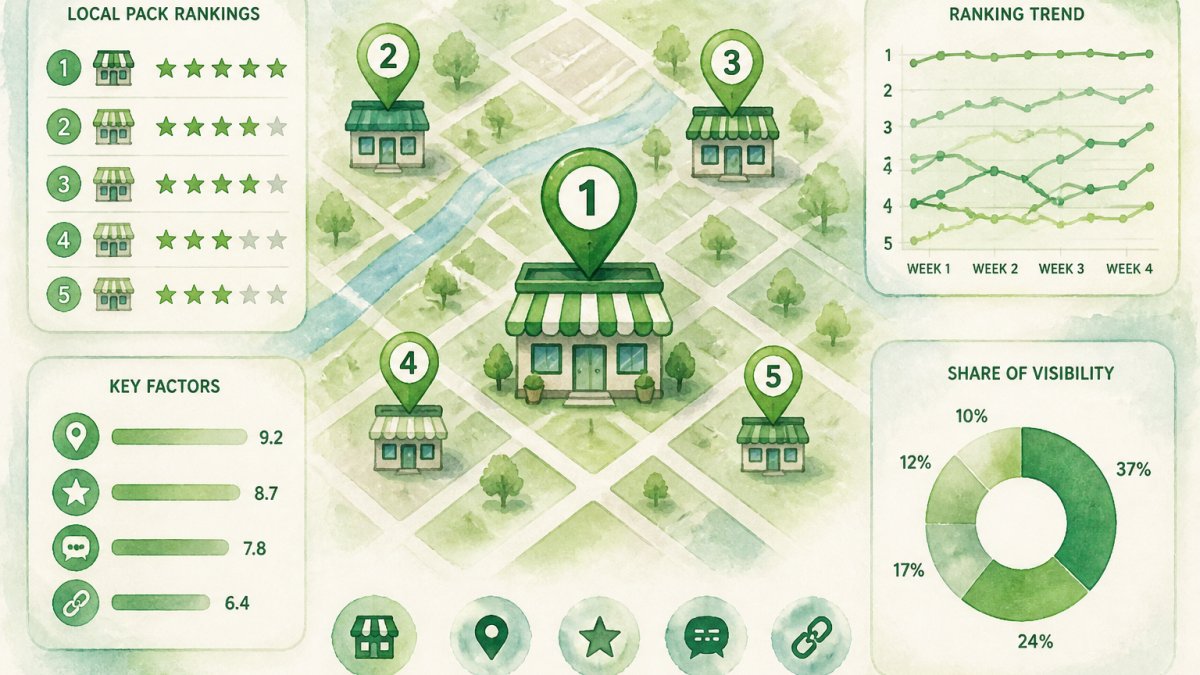
Local competitor ranking analysis is the process of tracking which nearby businesses appear in Google's local results, then working out exactly why they outrank you. It turns guesswork into a ranked list of fixes. For any business in Ljubljana, United States, that list is the fastest route to more local customers.
Here's the uncomfortable part. Most teams look at the map pack, see a competitor sitting above them, and assume that business simply has more reviews. Usually it doesn't. The gap sits in profile completeness, category choice, or citation consistency.
This guide from GrandRanker breaks the whole process into four steps you can run this week. At GrandRanker, we build these workflows into our AI-powered SEO platform, but the method below works no matter which tools you keep.
Below, we'll show you exactly how to find the gaps your competitors leave open.
Google's guidance on how local search results are ranked
Step 1: Build Your Local SEO Competitor Analysis Checklist
A local SEO competitor analysis checklist is a fixed set of metrics you score for every competitor, so your comparison stays objective. Without it, you end up comparing vibes instead of numbers.
Start with your three closest rivals in the map pack. The core metrics that separate winners from also-rans:
- Review count and average star rating
- Google Business Profile completeness (hours, photos, services, Q&A)
- Primary category match to the search query
- Local citation count across directories
- Distance from the searcher
Score each one out of five. The lowest score is your first project.
Step 2: Reverse-Engineer Local Keyword Research From Competitor Pages
Local keyword research works backwards from competitors. Instead of guessing phrases, you pull the terms their pages already rank for, then find the ones they missed.
Open the top three competitor sites and list every service page title. Those titles are their keyword bets. Then ask:
- Which service pages do they have that you don't?
- Which neighborhoods do they name that you ignore?
- Which questions do they answer badly or not at all?
Finding Keyword Gaps Your Competitors Missed
Gaps usually show up in three places: long-tail service phrases, neighborhood modifiers, and comparison queries.
A common mistake is chasing the head term. "SEO agency" is not winnable for a small team. "Emergency plumbing in Ljubljana" is.
Step 3: Set Up Local Rank Tracking Tools to Monitor Movement
Local rank tracking tools record where you appear in the map pack for a set of keywords, from a set location, on a set schedule. Without them, you are guessing whether last month's changes worked.
Set up tracking with these rules:
- Track 10-20 keywords, not 200
- Use your actual service radius, not the whole state
- Check weekly, not daily (local results move slowly)
- Log the top three competitors for every keyword
The point is not the dashboard. The point is the trend line. If a competitor climbs for a term you care about, you want to know within a week.
Step 4: Compare Google Business Profiles Side by Side
Google Business Profile comparison is where most local audits find their fastest wins. The profile is the ranking asset you control most directly.
Put your profile and each competitor's into a simple table and score them.
| Profile Field | You | Competitor A | Competitor B | Competitor C |
|---|---|---|---|---|
| Primary category | Match | Match | Mismatch | Match |
| Photos (last 90 days) | Few | Many | Some | Many |
| Q&A answered | No | Yes | No | Yes |
| Services listed | Partial | Full | Partial | Full |
| Posts (monthly) | None | Weekly | None | Monthly |
The pattern jumps out fast. Any row where you sit last is a task, and most take under an hour.
Local Competitor Analysis Examples You Can Copy
Two patterns show up again and again in local competitor analysis examples.
The review-gap play. A competitor with 200 reviews beats you on volume, but their average rating sits lower and their responses stopped a year ago. You cannot close a 200-review gap quickly. You can respond to every review and post weekly. Over a quarter, engagement signals shift.
The category play. A rival ranks for a term that isn't their primary category. You add the matching secondary category and a dedicated service page. This is often the fastest visible movement in local search.
For businesses near me searches, the same logic applies. The winner is usually the profile that best matches the exact query, not the biggest brand.
FTC guidance on endorsements and reviews
Turning Competitor Data Into an Action Plan
An action plan ranks every gap by effort and impact, then assigns an owner. Data without a plan is just a spreadsheet.
Sort your findings into three buckets:
- Quick wins (under an hour): category fixes, hours, photos, Q&A
- Medium projects (a week): service pages, citation cleanup
- Long plays (a quarter): review generation, content depth
Work the quick wins first. Momentum matters, and visible movement keeps the project funded.
This is where automation earns its place. At GrandRanker, we automate keyword research, content creation, optimization, and publishing so the plan keeps running while you run the business. Our AI finds you first, then keeps the work moving without a weekly manual sprint.
Google Business Profile help center
Local rankings shift constantly, and the businesses that win are the ones reviewing competitor movement every month instead of every year. If tracking profiles, keywords, and content across a dozen competitors sounds like a full-time job, that is because it usually is. GrandRanker handles automated keyword research, content on autopilot, and AI-driven optimization so your local competitor ranking work runs in the background. Get started with GrandRanker and turn competitor gaps into steady organic traffic.
Ready to dominate search results?
Join 8020+ businesses using GrandRanker to track rankings, fix SEO issues, and grow organic traffic.
Buy NowFrequently Asked Questions
Start by identifying your top three to five local competitors in Google Maps for your main service keywords. Then audit each one's Google Business Profile, on-page content, local citations, and review profile. Track their rankings for your target keywords over 30 days. Compare your findings against your own metrics, and prioritize the gaps where competitors outperform you. GrandRanker automates much of this tracking so you can focus on acting on the data rather than collecting it manually.
Your checklist should cover: Google Business Profile completeness (categories, photos, posts, Q&A), review count and average rating, local citation consistency across directories, on-page signals (title tags, NAP data, service pages), backlink profile from local sources, and keyword rankings in the local pack. Also track how often competitors publish new content and whether they use location-specific landing pages. These signals collectively determine who wins the local pack for your target searches.
Monthly reviews catch most meaningful shifts. However, if you operate in a fast-moving market or a competitor recently launched a new location, check weekly for the first 60 days. Set up rank tracking alerts so you get notified when a competitor overtakes you for a priority keyword. Quarterly deep dives let you spot seasonal patterns and adjust your content calendar accordingly.
Google Search Console and Google Business Profile Insights give you free baseline data. For rank tracking across multiple locations, dedicated local rank tracking tools show where you and competitors appear in the local pack. GrandRanker combines keyword research, rank monitoring, and content optimization in one platform, which reduces the back-and-forth between separate tools. Whichever stack you choose, make sure it tracks local pack positions separately from organic results.
Continue Reading
More guides to level up your SEO strategy.