Key Takeaways
- The Future of AI in SEO: A New Search Paradigm
- The Impact of ChatGPT on SEO: From Rankings to Citations
- How to Optimize for: How to Optimize for AI Search Engines and Zero-Click Queries
- Practical AI SEO Tools: Practical AI SEO Tools for Small Business Teams
- The Strategic Shift: What SEOs Must Do Differently in 2026
- Conclusion: Your Roadmap for the Future of AI in SEO
The Future of AI in SEO: A New Search Paradigm
The search landscape has shifted beneath our feet. According to recent GoodFirms analysis of search engine results page behavior, 58.5% of all searches are now zero-click, meaning users find their answers directly on the results page without ever visiting a website. This fundamental change is reshaping what it means to rank, and it sits at the center of the future of AI in SEO. At GrandRanker, we track these shifts daily to help businesses adapt their organic strategies before traffic evaporates.
AI in SEO is no longer about predicting what Google will do next; it is about understanding how answer engines like ChatGPT, Perplexity, and Google's AI Overviews decide what to cite. The data is stark: for queries where AI Overviews appear, organic click-through rates have dropped by 61% over 15 months, falling from 1.76% to 0.61% as documented by Taylor Scher SEO analysis. Two-thirds of consumers now believe AI will replace traditional search by 2030, a sentiment captured in recent Digitaloft consumer surveys.
The old playbook of chasing position one is dying. Below, we'll show you exactly how to pivot toward citation-focused strategies that capture traffic from both Google and AI assistants.
The Impact of ChatGPT on SEO: From Rankings to Citations
The most significant shift is the transition from ranking pages to earning citations. ChatGPT and similar engines don't present a list of blue links; they synthesize an answer and credit a handful of sources. Research from Searchable's 2026 AI SEO statistics shows that business sites achieving a 50% citation share in AI-generated responses see that 4.4x conversion lift. This is the new currency of search visibility.
This transition demands a different mental model. Traditional SEO optimized for crawlers and keyword density; impact of ChatGPT on SEO means optimizing for entity recognition and semantic clarity. Answer engines parse your content to extract facts, and they reward pages that present information in unambiguous, structured formats.
The challenge is that only 14% of businesses currently track their visibility within AI search results. Most teams are still reporting on keyword rankings that increasingly fail to correlate with revenue. The practitioners who adapt early will capture the citation share that their slower competitors lose.
How to Optimize for AI Search Engines and Zero-Click Queries
Optimizing for AI search engines requires a shift from page-level tactics to entity-level authority. The goal is to become the source an AI trusts enough to cite by name. This means structuring content with clear definitions, precise data, and consistent entity references across your entire domain.
Start with these tactical adjustments:
- Publish content that answers specific questions in the first 50 words, formatted for direct extraction.
- Build topical authority by creating interconnected clusters around core entities, not scattered keywords.
- Ensure your business information, product names, and key personnel are consistently described across every page.
- Earn mentions from other authoritative sites, as AI engines weigh citation share from third-party domains heavily.
For zero-click queries, the objective shifts from driving traffic to driving brand recall. When a user asks an AI assistant a question and your brand is cited as the source, that impression builds trust even without a click. Over time, this compounds into direct navigation and branded searches.
Practical AI SEO Tools for Small Business Teams
Small business teams can't afford enterprise-level SEO departments, but they can use AI-powered platforms to close the gap. The right tools automate the heavy lifting of keyword research, content briefs, and optimization, freeing limited staff to focus on strategy and subject matter expertise. For founders and marketing managers, this is the practical entry point into the future of AI in SEO.
| Tool Type | Core Function | Best For | Effort Level |
|---|---|---|---|
| AI Content Platforms | Automates research, drafting, and publishing | Teams with no dedicated writers | Low (setup and review) |
| Optimization Suites | Scores content against ranking factors | Marketers refining existing pages | Medium (editorial input) |
| Citation Trackers | Monitors brand mentions in AI answers | Teams proving ROI to leadership | Low (ongoing) |
GrandRanker fits into the first category, automating keyword research, content creation, optimization, and publishing so that businesses get cited by both Google and ChatGPT. The platform is designed for teams in Ljubljana and beyond that need to scale organic output without scaling headcount. For small business teams, the key is choosing a platform that handles the technical complexity while keeping human oversight for brand voice and accuracy.
The Strategic Shift: What SEOs Must Do Differently in 2026
The biggest strategic error is clinging to the belief that rankings are the ultimate metric. As documented in ResearchGate's study on Answer Engine Optimization, the focus has shifted toward semantic search and zero-click outcomes. SEOs must now measure visibility across AI platforms, not just Google's top ten.
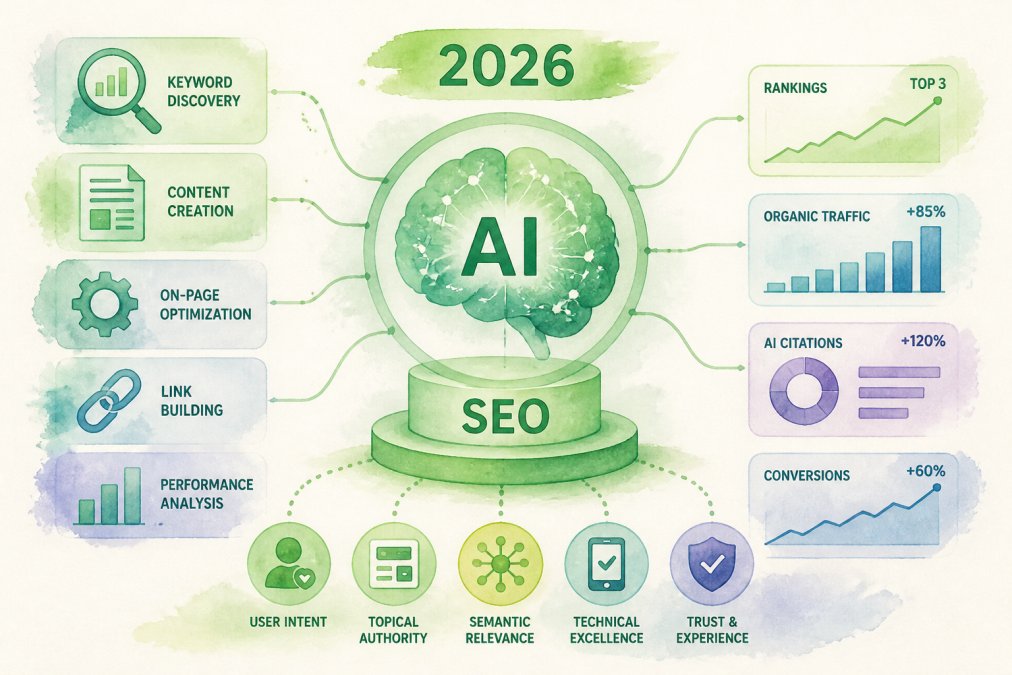
This means rethinking the workflow. Keyword research evolves into question mining, where you identify the queries your customers ask in natural language. Content creation shifts from targeting keyword density to structuring information for machine extraction. Technical SEO expands to include schema markup that helps AI engines understand your entity relationships. Link building transforms into citation earning, where the goal is to be referenced by other authoritative sources in your niche.
The contrarian truth is that AI will not kill SEO, but it will fundamentally reshape it. While AI automates technical tasks, it cannot replace the human need to understand audiences, verify claims, and determine site ownership. The SEOs who thrive will be those who combine AI efficiency with editorial judgment.
Conclusion: Your Roadmap for the Future of AI in SEO
Navigating this shift requires a clear plan. Start by auditing your current content for extractable answer blocks and entity clarity. Then, implement a consistent publishing cadence that builds topical authority. Finally, track your citation share in AI tools as rigorously as you tracked keyword rankings.
The challenge is that most teams lack the bandwidth to execute this while running daily operations. GrandRanker addresses this by automating the full cycle, from keyword discovery to content publication, ensuring your brand gets cited by every AI assistant. Our platform helps founders and marketing teams across the United States grow organic traffic on autopilot while boosting domain authority.
Get started with GrandRanker and begin securing your place in AI search results today.
Ready to dominate search results?
Join 8020+ businesses using GrandRanker to track rankings, fix SEO issues, and grow organic traffic.
Buy NowFrequently Asked Questions
No, AI will not replace SEO, but it is fundamentally reshaping it. The focus is shifting from traditional rankings to being cited by AI assistants. With 83% of AI queries ending on the SERP, the goal is to become the primary source an AI engine uses to generate its answer. This requires a focus on clear, authoritative content and structured data, which is the core of the future of AI in SEO.
To optimize for AI search engines, focus on creating content that directly answers user questions with clear, concise language. Ensure your business information is consistent across the web to improve your citation share, as business sites currently achieve a 50% citation share in AI results. This strategy is a key part of how to optimize for AI search engines in 2026.
For small business owners, the best AI SEO tools automate repetitive tasks like keyword research and content briefs. Platforms like GrandRanker are designed to handle content creation and optimization on autopilot, helping you rank on Google and get cited by AI assistants like ChatGPT. This allows small teams to compete with larger companies by focusing on strategy rather than manual execution.
AI is changing Google's ranking system by prioritizing semantic search and user intent over simple keyword matching. The rise of AI Overviews means that even if a user doesn't click your link, your site can still win the referral if it's cited. Since organic CTR has dropped by 61% for queries with AI Overviews, visibility now depends on maintaining a presence within AI-generated answers.
Continue Reading
More guides to level up your SEO strategy.