Key Takeaways
- Why Technical SEO Is: Why Technical SEO Is Important for New Websites
- The Business Case: How Technical SEO Impacts Rankings and Traffic
- Core Technical SEO Elements: Core Technical SEO Elements Every New Site NeedsMobile-First Indexing and Responsive DesignCore Web Vitals and Page SpeedHTTPS and Site Security
- Mobile-First Indexing and Responsive: Mobile-First Indexing and Responsive Design
- Core Web Vitals and: Core Web Vitals and Page Speed
- HTTPS and Site Security: HTTPS and Site Security
Why Technical SEO Is Important for New Websites
When you launch a new website, you're competing against millions of pages already indexed by Google. Without a strong technical foundation, your content won't get discovered or ranked. Technical SEO is how search engines crawl, understand, and index your site in the first place.
According to Ahrefs' 2026 research, 96.55% of all pages get zero search traffic from Google, and only 1.74% of newly published pages reach the top 10 search results within one year. That gap isn't about content quality alone, it's about whether your site's technical infrastructure allows search engines to find and properly index your pages.
This guide covers the essential technical SEO elements every new website needs, why they matter for rankings and traffic, and how to implement them before launch.
The Business Case: How Technical SEO Impacts Rankings and Traffic
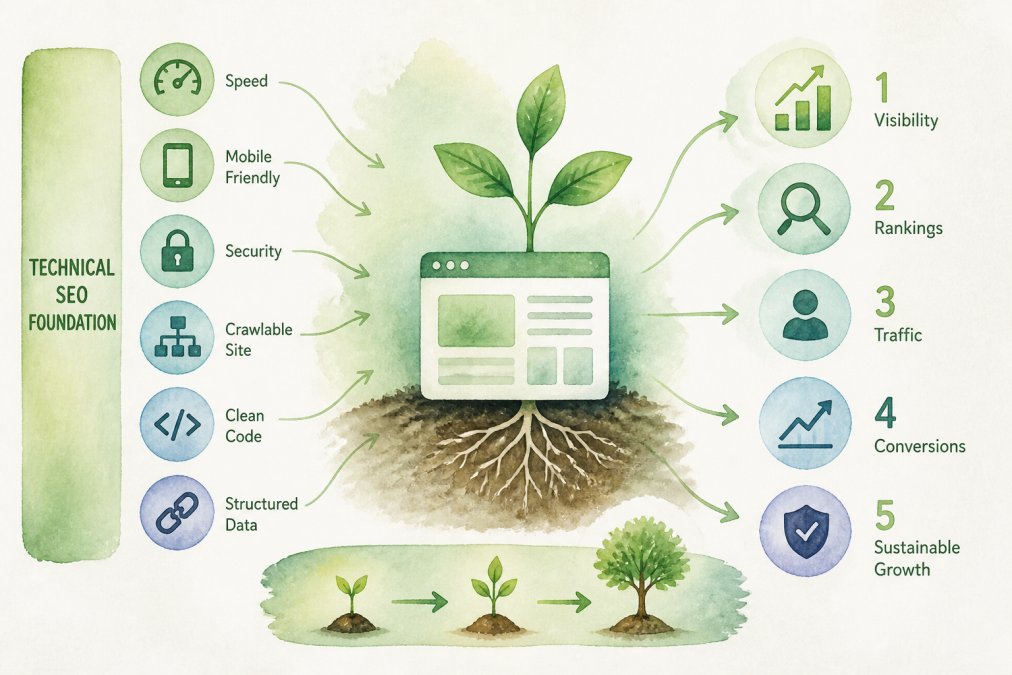
Technical SEO directly affects your ability to rank and generate organic traffic. When your site's technical foundation is weak, even exceptional content won't rank. When it's strong, you remove friction from the ranking process.
According to Reboot Online's 2026 analysis, technical SEO campaigns deliver 117% ROI with a 6-month break-even period, higher than many other marketing investments.
When technical SEO is neglected, search engines struggle to crawl your pages efficiently, delaying indexation. Mobile users experience poor performance, leading to high bounce rates. Core Web Vitals failures cause ranking penalties, missing security protocols signal untrustworthiness, and duplicate content fragments your authority.
When technical SEO is done right, Google crawls and indexes your pages faster, mobile users get a smooth experience, your site ranks higher for targeted keywords, and you build domain authority more efficiently.
Mobile-first indexing makes this critical. According to Reboot Online's 20zeb6 mobile data, mobile devices account for 63.5% of organic traffic. Google now indexes primarily from the mobile version of your site. If your mobile experience is poor, your entire site suffers.
Core Technical SEO Elements Every New Site Needs
Every new website needs to address four critical technical SEO areas: mobile responsiveness, Core Web Vitals, HTTPS security, and crawlability.
Mobile-First Indexing and Responsive Design
Mobile-first indexing means Google crawls and ranks your site based on the mobile version first. If your mobile site is slow, broken, or missing content, your rankings suffer regardless of desktop quality.
Responsive design is non-negotiable. Your site must adapt seamlessly to phones, tablets, and desktops with flexible layouts, touch-friendly buttons (minimum 48x48 pixels), readable font sizes (16px minimum), no horizontal scrolling, and fast-loading pages (under 3 seconds).
Test your mobile experience constantly using Google's Mobile-Friendly Test and on real devices. Many new sites are technically responsive but have poor mobile UX, tiny buttons, slow load times, or hidden content. Mobile users expect speed and simplicity.
Core Web Vitals and Page Speed
Core Web Vitals measure user experience through three metrics: Largest Contentful Paint (LCP), First Input Delay (FID), and Cumulative Layout Shift (CLS). Pages that pass all three see measurable ranking benefits.
According to Reboot Online's 2026 Core Web Vitals data, websites that pass all three Core Web Vitals metrics see an average of 24% lower bounce rates, and 73% of pages with good scores rank in the top 10 versus 53% with poor scores.
According to Wellows' 2026 research, 53% of users abandon websites that take more than 3 seconds to load.
For new websites, optimize for speed from launch: compress images aggressively using WebP format, minify CSS and JavaScript, implement lazy loading for below-the-fold images, use a Content Delivery Network (CDN), remove render-blocking resources, and enable GZIP compression.
Monitor metrics continuously using Google PageSpeed Insights, Google Search Console's Core Web Vitals report, and real user monitoring tools. Don't wait for problems, measure and optimize proactively.
HTTPS and Site Security
According to Reboot Online's 2026 security analysis, 95% of Google's top results are secured with HTTPS. This is a ranking factor and a sign of trustworthiness.
For new websites, HTTPS is mandatory. Install an SSL certificate before launch. Most hosting providers offer free SSL certificates through Let's Encrypt. HTTPS protects user data, prevents attacks, and signals legitimacy to both search engines and visitors.
Technical SEO Checklist for New Websites
Before your site goes live, verify these essentials:
| Task | Priority | Impact |
|---|---|---|
| Install SSL certificate (HTTPS) | Critical | Ranking factor + user trust |
| Configure robots.txt | Critical | Controls crawler access |
| Create XML sitemap | Critical | Helps Google discover pages |
| Set up Google Search Console | Critical | Monitoring + indexation control |
| Test mobile responsiveness | Critical | Mobile-first indexing requirement |
| Optimize Core Web Vitals | High | Ranking factor + UX |
| Set canonical tags | High | Prevents duplicate content issues |
| Configure 301 redirects | High | Preserves authority on URL changes |
| Implement structured data (schema) | High | Enhanced SERP features + AI citability |
| Set up 404 error handling | Medium | User experience + crawl efficiency |
| Configure internal linking structure | Medium | Authority distribution |
| Implement breadcrumb navigation | Medium | UX + schema markup |
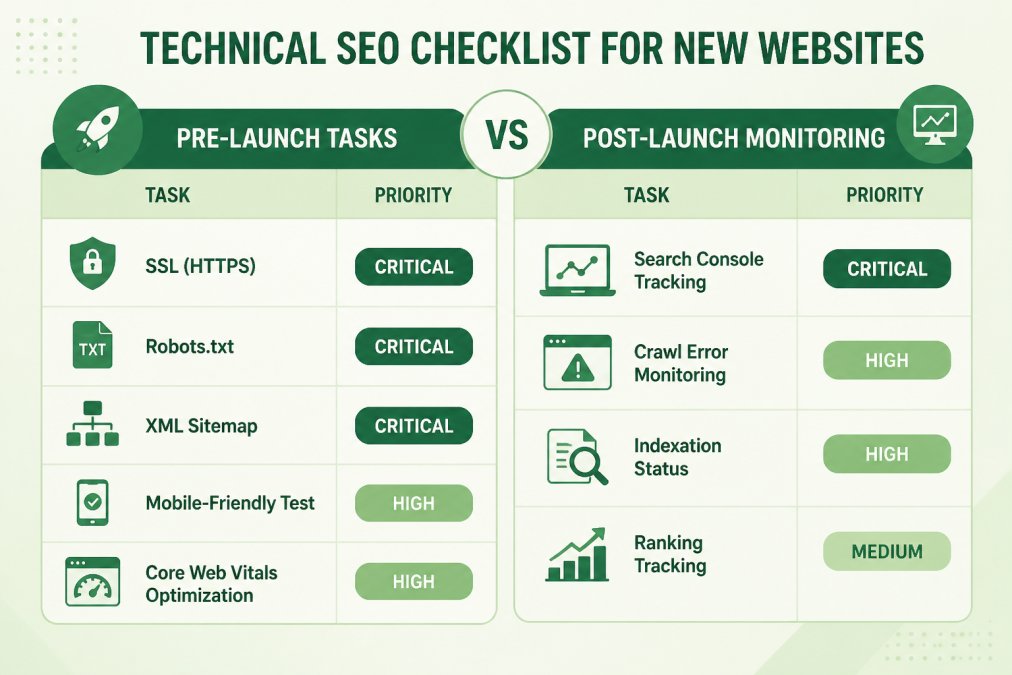
Start with Critical items. These are non-negotiable. Then address High priority items before launch. Medium priority items can be handled in the first 30 days post-launch.
Website Page Speed Optimization Tools and Best Practices
Page speed is a ranking factor and user experience imperative. Slow sites lose traffic, conversions, and rankings. For new websites, optimizing speed from day one prevents technical debt.
Use Google PageSpeed Insights to identify bottlenecks. It provides actionable recommendations prioritized by impact.
Image optimization is often the biggest quick win. Images typically account for 50% of page weight. Compress aggressively using TinyPNG or ImageOptim. Use modern formats (WebP) with fallbacks. Serve appropriately sized images for each device.
Code splitting and lazy loading defer non-critical resources. Load JavaScript only when needed. Lazy-load images below the fold. This reduces initial page weight and improves LCP significantly.
Caching strategies reduce server load and improve repeat-visit performance. Implement browser caching with appropriate headers. Use a CDN to cache static assets globally.
Third-party script management is critical. Every external script adds overhead. Load them asynchronously and defer non-critical scripts.
GrandRanker includes performance monitoring as part of its technical SEO capabilities, automatically flagging Core Web Vitals issues and suggesting optimizations.
The Importance of XML Sitemaps for New Sites
An XML sitemap lists all pages on your website and tells search engines which pages exist, when they were last updated, and their relative importance. For new websites, a sitemap accelerates indexation by eliminating discovery delays.
Create your sitemap automatically using your CMS or Screaming Frog. Include all important pages and exclude thin pages, duplicate content, and pages you don't want ranked. Submit your sitemap to Google Search Console and monitor the Sitemaps report to verify indexation.
If you see a gap between submitted and indexed pages, investigate common issues: pages blocked by robots.txt, pages returning errors, pages with noindex tags, duplicate content, or poor mobile experience.
A well-maintained sitemap accelerates indexation by weeks compared to discovery through internal links alone.
Common Technical SEO Mistakes New Websites Make
Most new websites launch with at least one critical technical SEO mistake.
Launching without HTTPS is still surprisingly common and the easiest to prevent. Install an SSL certificate before going live.
Poor mobile experience ranks second. Test on real devices. Verify touch targets are large enough and your mobile site loads in under 3 seconds.
Ignoring Core Web Vitals is the third major mistake. Optimize LCP, FID, and CLS before launch rather than after.
Using non-standard URL structures creates long-term problems. Avoid excessive parameters, session IDs, inconsistent patterns, and unnecessarily deep directories.
Not setting up Search Console means you won't see crawl errors, indexation issues, or ranking data. Set it up on day one.
Duplicate content fragments your authority. Use canonical tags to consolidate authority when similar content exists.
Broken internal links waste crawl budget and harm user experience. Audit your site regularly for 404s and fix broken links immediately.
These mistakes are preventable through attention during planning and development phases.
Conclusion: Make Technical SEO Your Foundation
Technical SEO is the infrastructure that allows search engines to discover, crawl, and rank your content. For new websites, it's foundational.
The core technical SEO elements are straightforward: HTTPS, mobile responsiveness, Core Web Vitals, and crawlability. They require attention during development but aren't expensive or time-consuming to implement correctly.
GrandRanker automates much of the technical SEO work, identifying issues before they impact rankings and suggesting fixes automatically.
Focus on getting the fundamentals right. Build for mobile first. Optimize for speed. Secure your site with HTTPS. Make your content discoverable through proper sitemaps and Search Console configuration. These steps remove the barriers that prevent search engines from finding and ranking your content.
Then layer in content strategy, keyword targeting, and link building. Without the technical foundation, those efforts are wasted. Start with technical SEO. Everything else builds on top.
=== FAQ ANSWERS (audit these too, same rules) ===
[1] Q: What is technical SEO and why does it matter for new websites? A: Technical SEO is the foundation that allows search engines to crawl, index, and rank your site. For new websites, it's critical because 96.55% of all pages get zero search traffic from Google, and only 1.74% of newly published pages reach the top 10 within one year. Technical SEO removes barriers to visibility: it ensures your site loads fast (53% of users abandon sites taking over 3 seconds), works on mobile (63.5% of organic traffic comes from mobile), and is secure with HTTPS (95% of Google's top results use it). Without it, even great content stays invisible.
[2] Q: How long does it take for technical SEO to show results on a new website? A: Technical SEO campaigns deliver a 117% ROI with a 6-month break-even period. Results vary by site age and competition, but most new sites see indexation improvements within 2-4 weeks after fixing crawlability issues and submitting a sitemap. Ranking improvements typically follow 2-3 months later as Google gains more confidence in your domain. The key is acting on technical issues before publishing content; fixing problems after launch takes longer to recover from.
[3] Q: What are the most important technical SEO factors for a new domain? A: Prioritize these for new sites: (1) Mobile responsiveness, Google indexes primarily from the mobile version. (2) Core Web Vitals, 73% of pages with good Core Web Vitals scores rank in the top 10 versus 53% with poor scores. (3) HTTPS security. (4) XML sitemaps and robots.txt to guide crawlers. (5) Site structure and internal linking. (6) Schema markup. These factors create the technical baseline that allows your content to compete.
[4] Q: Does a new website need technical SEO before or after launch? A: Both. Before launch, conduct a technical audit to ensure crawlability, mobile responsiveness, page speed, and HTTPS are in place. After launch, monitor Core Web Vitals, crawl errors, and indexation status continuously. Fixing technical issues post-launch is harder because Google may have already crawled and cached problems. Starting with a solid technical foundation means you launch ready to rank, not scrambling to fix issues that cost you months of visibility.
Technical SEO determines whether your new website can compete in search results. The difference between a site that ranks and one that doesn't often comes down to technical execution. GrandRanker helps you get that execution right by automating technical audits, monitoring Core Web Vitals, and ensuring your site meets Google's ranking requirements. Get started with GrandRanker and launch your new website with the technical foundation it needs to grow organic traffic.
Ready to dominate search results?
Join 8020+ businesses using GrandRanker to track rankings, fix SEO issues, and grow organic traffic.
Buy NowFrequently Asked Questions
Technical SEO is the foundation that allows search engines to crawl, index, and rank your site. For new websites, it's critical because 96.55% of all pages get zero search traffic from Google, and only 1.74% of newly published pages reach the top 10 within one year. Technical SEO removes barriers to visibility: it ensures your site loads fast (53% of users abandon sites taking over 3 seconds), works on mobile (63.5% of organic traffic comes from mobile), and is secure with HTTPS (95% of Google's top results use it). Without it, even great content stays invisible.
Technical SEO campaigns deliver a 117% ROI with a 6-month break-even period. Results vary by site age and competition, but most new sites see indexation improvements within 2-4 weeks after fixing crawlability issues and submitting a sitemap. Ranking improvements typically follow 2-3 months later as Google gains more confidence in your domain. The key is acting on technical issues before publishing content; fixing problems after launch takes longer to recover from.
Prioritize these for new sites: (1) Mobile responsiveness—Google indexes primarily from the mobile version. (2) Core Web Vitals—73% of pages with good Core Web Vitals scores rank in the top 10 versus 53% with poor scores. (3) HTTPS security. (4) XML sitemaps and robots.txt to guide crawlers. (5) Site structure and internal linking. (6) Schema markup. These factors create the technical baseline that allows your content to compete.
Both. Before launch, conduct a technical audit to ensure crawlability, mobile responsiveness, page speed, and HTTPS are in place. After launch, monitor Core Web Vitals, crawl errors, and indexation status continuously. Fixing technical issues post-launch is harder because Google may have already crawled and cached problems. Starting with a solid technical foundation means you launch ready to rank, not scrambling to fix issues that cost you months of visibility.
Continue Reading
More guides to level up your SEO strategy.