Key Takeaways
- Why AI Powered SEO: Why AI Powered SEO Reporting Dashboards Matter in 2026
- AI Search Visibility Tracking: The Metric Your Dashboard Is Missing
- SEO Performance Dashboard Templates: What to Include
- Automated SEO Reporting Tools: A ComparisonFeature Comparison TablePros and Cons at a Glance
- Feature Comparison Table: Feature Comparison Table
- Pros and Cons at: Pros and Cons at a Glance
Why AI Powered SEO Reporting Dashboards Matter in 2026
According to GoodFirms' 2026 SEO statistics report, 58.5% of searches now end without a click. That single number explains why AI powered SEO reporting dashboards have moved from a nice-to-have to a core piece of marketing infrastructure.
At GrandRanker, we watch this shift play out daily: teams that still measure success by organic sessions are flying blind, because the click is no longer the only outcome that matters. A search can end in an AI Overview, a featured snippet, or a direct answer, and a traditional dashboard will never show it.
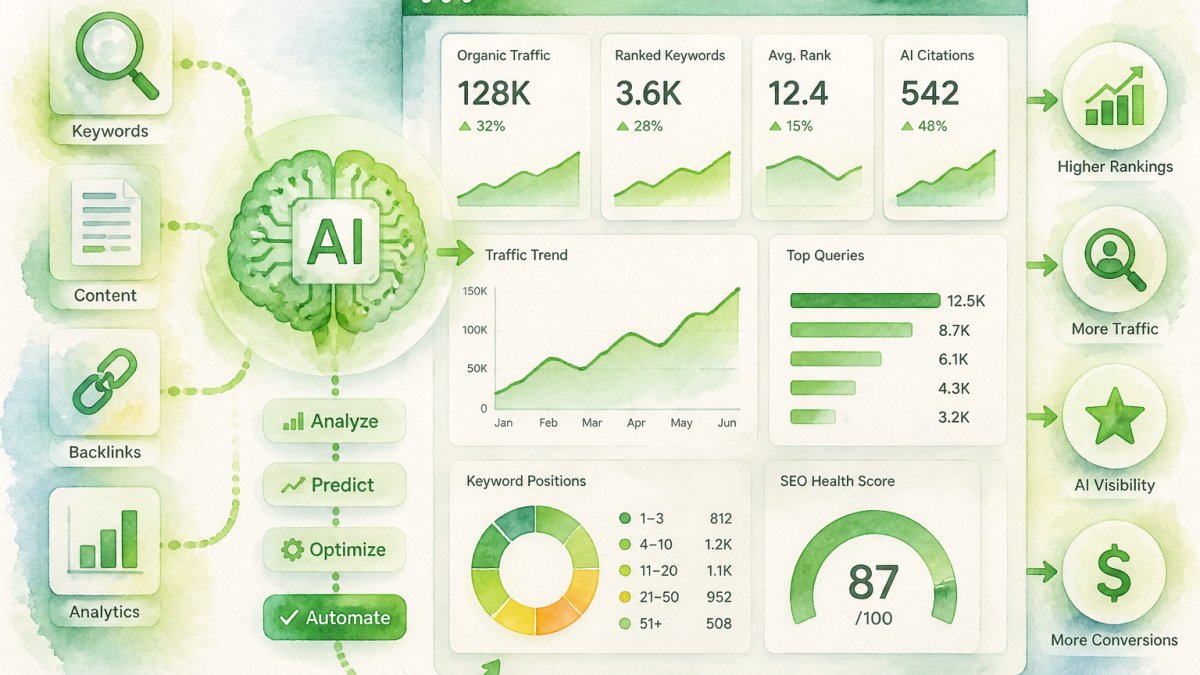
An AI powered SEO reporting dashboard is a reporting system that combines search performance data with AI-generated visibility metrics, such as citation frequency and brand mentions inside AI assistants.
Three data points frame the problem:
- 83% of AI-driven queries finish on the results page itself (GoodFirms, 2026)
- Only 14% of marketers currently track AI citations (GoodFirms, 2026)
- 43% name AI search optimization as a core priority (GoodFirms, 2026)
That gap between priority and practice is the story of 2026. Below, we break down what these dashboards need to include, how the leading tools compare, and where most teams go wrong.
AI Search Visibility Tracking: The Metric Your Dashboard Is Missing
AI search visibility tracking is the practice of measuring how often your brand appears in AI-generated answers, not just in blue links. It counts citations, mentions, and share of voice inside tools like ChatGPT, Perplexity, and Google's AI Overviews.
Traditional rank tracking answers one question: where do you sit on page one? Visibility tracking answers a harder one: when an AI assistant recommends a solution in your category, does it name you?
Adobe's 2026 business blog notes that SEO dashboards are shifting toward citation frequency and brand appearance in AI responses. The mechanics differ from classic SEO in three ways:
- No fixed position. AI answers vary by phrasing, so you track presence, not rank.
- No guaranteed click. A citation can build trust even when the user never visits.
- Source quality matters. AI systems favor pages with clear attribution and verifiable data.
The takeaway: if your dashboard only reports clicks, you're measuring half the funnel.
SEO Performance Dashboard Templates: What to Include
A useful SEO performance dashboard template covers five layers: visibility, citations, traffic quality, conversions, and content output. Skip any one of them and the picture breaks.
Here's the structure that holds up in practice:
| Layer | Metric | Why It Matters |
|---|---|---|
| Visibility | Keyword rankings, AI Overview presence | Shows where you appear |
| Citations | Brand mentions in AI answers | Tracks AI share of voice |
| Traffic | Sessions by channel, AI referral | Separates clicks from reach |
| Conversions | Leads, trials, revenue | Proves business impact |
| Output | Pages published, refresh rate | Connects content to results |
Most teams over-index on the first row and ignore the second. That's backwards in 2026.
A template should also separate branded from non-branded queries, because AI answers often surface branded mentions that never generate a session. Without that split, you'll misread your own growth.
Automated SEO Reporting Tools: A Comparison
Automated SEO reporting tools fall into three groups: all-in-one SEO suites, dedicated reporting platforms, and AI-first visibility trackers. The right pick depends on whether you need deep data, client-ready reports, or AI citation tracking.
A ScienceDirect study on AI-powered marketing by V. Kumar found that AI is reshaping how brands measure performance across channels, which is exactly why reporting tools now compete on AI features rather than chart variety.
Feature Comparison Table
| Tool | Starting Price | AI Citation Tracking | White-Label | Free Tier |
|---|---|---|---|---|
| GrandRanker | Free trial | Yes | No | Yes |
| AgencyAnalytics | $79/month | Partial | Yes | No |
| Semrush | $129.95/month | Partial | Yes | Yes |
| SE Ranking | $44/month | Partial | Yes | No |
| Ahrefs | $129/month | No | No | No |
| Looker Studio | $0 | No | No | Yes |
| Whatagraph | $200/month | No | Yes | No |
| DashThis | $45/month | No | Yes | No |
| Swydo | $49/month | No | Yes | No |
| MetricNexus | $49/month | Yes | No | No |
Pros and Cons at a Glance
| Tool | Pros | Cons |
|---|---|---|
| GrandRanker | Automates research, content, and publishing; tracks AI citations | Reporting depth varies by plan |
| AgencyAnalytics | Strong white-labeling; scales for agencies | Costs add up for solo users |
| Semrush | Deep data accuracy; broad toolset | Steep learning curve |
| SE Ranking | Intuitive interface; affordable | Less data depth than Semrush |
| Ahrefs | Best-in-class backlink data | Project limits on lower tiers |
| Looker Studio | Free; fully customizable | Manual setup required |
| Whatagraph | Polished report templates | High entry price |
| DashThis | Fast setup; non-technical friendly | Less granular control |
| Swydo | Reliable automation; good value | Dated interface |
| MetricNexus | AI-driven insights; low entry price | Small integration ecosystem |
How GrandRanker Handles AI Powered SEO Reporting
GrandRanker is an AI-powered SEO platform built for founders who want organic growth without a full content team. It automates keyword research, content creation, optimization, and publishing, then tracks how that work performs in both Google and AI assistants.
The reporting side connects directly to the work. Instead of exporting data from four tools, you see which pages earn citations, which keywords drive AI Overview presence, and where domain authority is climbing.
What sets it apart from pure reporting tools:
- Closed loop. Content gets published and measured in one system, so reporting reflects real output.
- AI citation focus. The platform tracks brand appearances in AI assistant answers, not just rankings.
- Built for lean teams. Founders and SMB marketing managers get visibility without hiring an analyst.
421+ founders currently grow with GrandRanker. For a team that wants to rank on Google and get cited by AI assistants without stitching together five subscriptions, it's the most direct path.
Pricing Breakdown: What You'll Pay for AI SEO Dashboards
AI SEO dashboard pricing in 2026 ranges from free to several hundred dollars per month, depending on data depth and white-label needs. Looker Studio costs nothing but requires manual setup. Dedicated tools start around $44 to $79 per month. Enterprise suites run $129 and up.
| Tier | Typical Monthly Cost | Best For |
|---|---|---|
| Free | $0 | DIY teams with technical skills |
| Entry | $44-$79 | SMBs, freelancers, small agencies |
| Mid | $79-$200 | Agencies with multiple clients |
| Enterprise | $129+ | In-house teams needing deep data |
GrandRanker offers a free trial and a free plan, with paid tiers listed on its pricing page.
SE Ranking's 2026 guide to automated client reporting notes that modern reporting now requires integrating AI visibility metrics alongside traditional channels, which is why per-seat pricing alone no longer tells you the real cost.
Common Mistakes When Building AI SEO Dashboards
The biggest mistake is treating AI visibility as a vanity metric. Citation counts feel impressive, but they only matter if they connect to pipeline.
Three errors show up again and again:
- Tracking citations without context. A mention in a low-intent answer is worth less than a ranking for a buying keyword.
- Ignoring zero-click reality. With 58.5% of searches ending on the SERP, traffic-only dashboards understate reach.
- Building reports nobody reads. If leadership can't act on a metric, cut it.
Conclusion
The hard part isn't collecting data anymore. It's deciding which signals prove your brand is winning in a search landscape where most queries never produce a click.
GrandRanker was built for exactly that problem.
Ready to dominate search results?
Join 8020+ businesses using GrandRanker to track rankings, fix SEO issues, and grow organic traffic.
Buy NowFrequently Asked Questions
AI-powered SEO reporting dashboards automate data collection and surface trends you'd miss manually. They track rankings, traffic, and AI citations in one place. With 58.5% of searches now zero-click, dashboards that monitor AI visibility help you prove brand impact beyond clicks. They also cut reporting time, letting teams focus on strategy instead of spreadsheet work.
Traditional Analytics reports focus on on-site traffic and conversions. AI SEO dashboards pull from Search Console, rank trackers, and AI citation tools to show the full search experience. They track featured snippets, local packs, and AI Overviews. Since 83% of AI queries end on the SERP, these dashboards reveal visibility even when users never click through to your site.
Yes. Tools like GrandRanker and MetricNexus monitor brand mentions and citations in AI-generated responses. They track how often your domain appears in ChatGPT, Claude, and Google AI Overviews. Only 14% of marketers currently use AI citation tracking, so early adopters gain a reporting edge. These metrics show whether AI assistants recommend your brand.
Include organic traffic, keyword rankings, click-through rates, and conversion data. Add AI citation frequency, share of voice in AI answers, and featured snippet wins. Track domain authority and backlink growth. For e-commerce, include revenue per session. Since 43% of marketers prioritize AI search optimization, dashboards should report AI visibility alongside traditional SEO metrics.
Continue Reading
More guides to level up your SEO strategy.