Key Takeaways
- Quick Comparison: Best AI Tools for Technical SEO in 2026
- How We Evaluated These: How We Evaluated These Technical SEO Tools
- GrandRanker: AI Technical SEO on Autopilot
- Semrush One: Technical Audits Plus AI Visibility
- Ahrefs: Deep Crawl Data With AI Assistance
- SE Ranking: Budget-Friendly AI Site Audits
Quick Comparison: Best AI Tools for Technical SEO in 2026
The best AI tools for technical SEO in 2026 split into three groups: all-in-one platforms that audit and track AI visibility, dedicated crawlers built for deep diagnostics, and content-side optimizers that fix meta-data at scale. This comparison covers seven options, from free desktop crawlers to enterprise suites, so you can match a tool to your team size and budget.
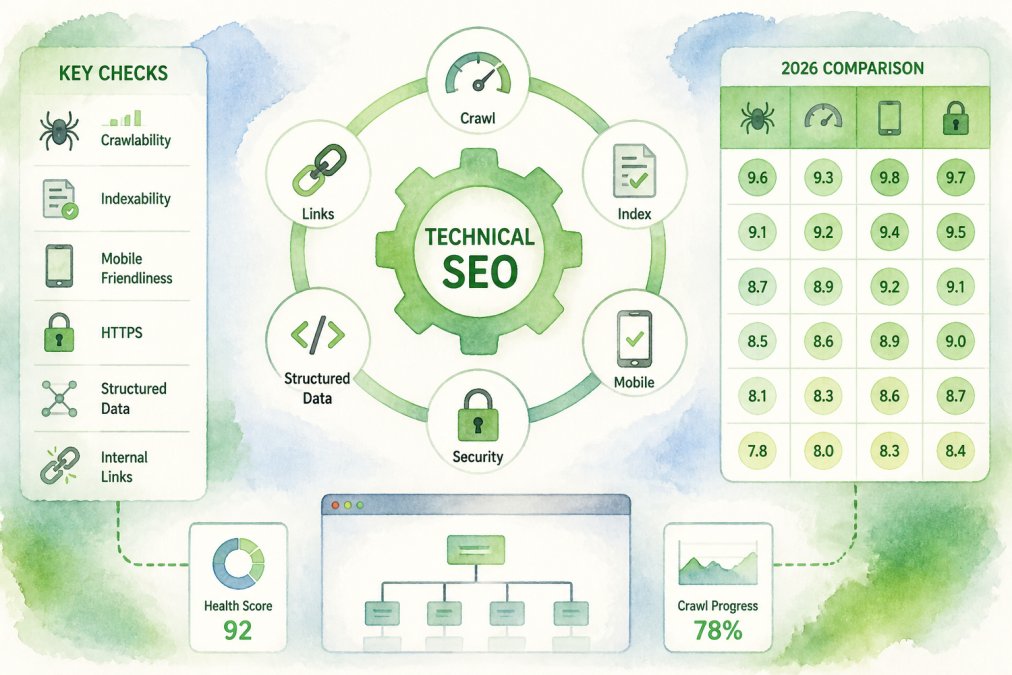
Technical SEO is the practice of fixing the behind-the-scenes elements that help search engines crawl, index, and rank a site: site speed, broken links, structured data, crawl budget, and site architecture.
AI now handles much of that grunt work. According to Zapier's 2026 AI SEO tool review, platforms like SE Ranking now include daily prompt tracking across five LLMs plus unlimited AI source tracking. That shift matters because buyers increasingly judge a tool by whether it wins visibility in ChatGPT and Google AI Overviews, not just blue links.
Here is how the seven tools stack up before we dig into each one.
| Tool | Starting Price | Primary Strength | Free Tier | Best For |
|---|---|---|---|---|
| GrandRanker | Free trial | Full automation | Yes | Founders wanting autopilot SEO |
| Semrush One | $199/mo | Audit + AI visibility | No | Enterprise teams |
| Ahrefs | $99/mo | Crawl and backlink data | No | Technical specialists |
| SE Ranking | $55/mo | Budget all-in-one | No | Agencies and SMBs |
| Screaming Frog | $259/yr | Deep desktop crawling | Yes | Deep site audits |
| Writesonic | $20/mo | Content and meta-data | Yes | Content teams |
| Clearscope | $170/mo | Topical relevance | No | Large content teams |
How We Evaluated These Technical SEO Tools
We scored each platform on five criteria: technical depth, AI capability, ease of setup, pricing transparency, and how well it supports an AI-powered technical SEO audit. Pricing figures come from each vendor's published plans. Feature claims come from vendor documentation and independent 2026 tool reviews.
A pattern showed up fast. The strongest technical tools are not always the strongest AI tools, and vice versa. Screaming Frog crawls deeper than anything else here, but it will not write your meta descriptions. Writesonic writes them, but it will never tell you that a redirect chain is wasting crawl budget.
That gap is the whole story of this category in 2026.
One caveat on the data: much of the 2026 tool coverage comes from vendor-led reviews and roundups rather than controlled studies, so treat headline claims with some skepticism and test on your own site.
GrandRanker: AI Technical SEO on Autopilot
GrandRanker is an AI-powered SEO platform that helps founders grow organic traffic on autopilot, rank higher on Google, and get cited by AI assistants. It automates keyword research, content creation, optimization, and publishing.
What separates it from the audit-only tools below is scope. Most platforms tell you what is broken. GrandRanker helps you fix the content layer and keeps publishing optimized pages so your domain authority compounds over time.
Key features:
- Automated keyword research that feeds directly into content briefs
- Content on autopilot, from draft through optimization and publishing
- Built to earn citations from Google and AI assistants like ChatGPT
- Domain authority tracking tied to published output
The honest limitation: this is not a log-file analyzer. If you need server-level crawl diagnostics, pair it with a dedicated crawler. GrandRanker helps founders who have no SEO hire and no time to build a content pipeline by hand.
Pricing sits on the website, and a free trial is available, so you can test the automation before committing.
Semrush One: Technical Audits Plus AI Visibility
Semrush One is the strongest all-rounder for teams that want traditional technical auditing and AI search tracking in a single dashboard. Its AI Visibility Toolkit monitors how your brand appears inside AI-generated answers, which is now a real ranking surface.
The AI-powered site audit handles the usual technical health checks: crawl errors, broken links, duplicate content, and Core Web Vitals. Integration with Google Search Console keeps the data synced without manual exports.
Where it falls short is price. At $199 per month, it is the most expensive option here, and small businesses will feel that. You are paying for database depth and breadth, and if you only manage one site, much of that goes unused.
Pros: Combines technical auditing with AI search visibility; industry-standard data accuracy. Cons: High entry price for small businesses.
Ahrefs: Deep Crawl Data With AI Assistance
Ahrefs remains the reference point for backlink and crawl data. Its Site Audit tool uses AI to flag technical problems like broken links and crawl errors, then tracks site health scores over time so you can see whether fixes actually landed.
The AI content helper handles meta-tag and content optimization, and log file analysis lets you see how search engines actually crawl your site, which is where crawl budget problems usually hide.
The catch is the learning curve. Ahrefs assumes you know what a canonical tag does and why it matters. Beginners will spend their first month confused. Technical specialists will spend it finding issues no other tool surfaces.
At $99 per month, it sits in the middle of this list on price and near the top on depth.
Pros: Industry-leading crawl engine; extensive backlink and keyword database. Cons: Steep learning curve for beginners.
SE Ranking: Budget-Friendly AI Site Audits
SE Ranking delivers the best value in this comparison. For $55 per month, you get an AI-powered site audit, an AI Overview Tracker for monitoring visibility in AI-generated results, and automated white-label reporting that agencies can hand straight to clients.
The on-page SEO checker gives AI recommendations rather than raw error lists, which shortens the gap between finding a problem and fixing it. For teams running several client sites, the reporting alone justifies the price.
Data depth is the trade-off. SE Ranking will not match Semrush or Ahrefs on backlink index size, and power users will notice. For most small and mid-sized sites, that difference never affects a decision.
Pros: Excellent value for the feature set; user-friendly interface. Cons: Data depth may be less than enterprise-tier competitors.
Screaming Frog: Desktop Crawler With AI Regex
Screaming Frog SEO Spider is the tool technical SEO professionals reach for when they need to crawl a site the way a search engine does. It runs on your desktop, which means no crawl limits imposed by a cloud plan, and it exposes issues that browser-based tools simply cannot reach.
AI-assisted regex generation is the standout 2026 addition. Writing custom extraction patterns used to require real programming comfort. Now you describe what you want to extract and the tool drafts the pattern for you.
Log file analysis and direct integration with Google Analytics and Search Console round out the technical toolkit.
Two honest caveats. It is desktop-only, so it eats local machine resources on large crawls. And it is a diagnostic tool, not a fixer: you still need someone who knows what to do with the findings. The free version works well for sites under 500 URLs; the paid license runs $259 per year.
Pros: Unmatched technical depth and control; free version available for small sites. Cons: Desktop-only; requires local machine resources.
Writesonic and Clearscope: Content-Side Technical Optimization
Writesonic and Clearscope solve a different problem: the content and meta-data layer that technical audits flag but rarely fix at scale. Both are worth considering as complements to a crawler, not replacements for one.
Writesonic generates meta descriptions and title tags in bulk, builds SEO-optimized content briefs from SERP analysis, and integrates with Surfer SEO for on-page optimization. At $20 per month with a free tier, it is the cheapest way to clear hundreds of missing meta descriptions in an afternoon.
Ready to dominate search results?
Join 8020+ businesses using GrandRanker to track rankings, fix SEO issues, and grow organic traffic.
Buy NowFrequently Asked Questions
AI handles the detection layer well: it flags broken links, crawl errors, duplicate meta tags, and redirect chains faster than manual review. Tools like Semrush Site Audit and SE Ranking's AI auditor automate this scanning. What AI cannot do is decide which fixes matter for your revenue. Practitioners in 2026 consistently describe these tools as assistants to human strategy, not replacements. You still need someone to prioritize fixes and verify changes didn't break anything.
Screaming Frog SEO Spider remains the deepest option for crawl analysis, with AI-assisted regex generation for custom extraction. Ahrefs Site Audit offers strong automated crawl error tracking with site health scores. For teams wanting crawl monitoring without desktop software, Semrush One and SE Ranking both run cloud-based audits on a schedule. Match the tool to crawl volume: Screaming Frog's free tier covers sites up to 500 URLs before you pay.
An AI-powered technical SEO audit finds the problems; automation keeps them from coming back. Best practice is to schedule recurring audits, route new issues to owners automatically, and set alerts for regressions like broken canonical tags. Industry guidance for 2026 recommends keeping humans in the loop for anything affecting site architecture or indexation. Automate detection and reporting, review structural changes manually.
AI can draft schema markup quickly, but validity varies by tool and page type. Always validate output against Google's Rich Results Test before publishing. AI handles common types like Article, Product, and FAQ well; complex nested schemas for e-commerce variants often need manual review. Pair AI generation with a validation step in your workflow, and re-test after any template change that touches structured data.
Continue Reading
More guides to level up your SEO strategy.