Key Takeaways
- Why AI Content Creation: Why AI Content Creation Matters for Backlink Building
- Link-Worthy Content Examples That: Link-Worthy Content Examples That Actually Earn Backlinks
- How to Build Backlinks with AI: A Proven Workflow
- AI Tools for Backlink: AI Tools for Backlink Outreach That Scale Your Prospecting
- AI Backlink Outreach Email: AI Backlink Outreach Email Templates That Get Responses
- Common Pitfalls: What Not to Do When Using AI for Backlinks
Why AI Content Creation Matters for Backlink Building
The best AI content creation for backlinks starts with understanding why backlinks matter in the first place. According to Semrush's 2026 AI SEO Statistics, AI-written pages now appear in over 17% of top search results, up from just 2.27% in 2019. This shift reflects a fundamental change: search engines increasingly reward content that demonstrates expertise, and backlinks remain one of the strongest signals of authority.
At GrandRanker, we've tracked how founders and marketing teams are using AI to create content that actually earns links. The challenge isn't generating content anymore, it's generating content worth linking to. Most AI-generated material reads like AI-generated material. It lacks the specificity, insight, or data that makes journalists, bloggers, and industry leaders want to cite you.
Backlinks drive three measurable outcomes: they increase domain authority, they send direct referral traffic, and they signal to Google that your content is credible. AI tools accelerate the first two by helping you produce more link-worthy content faster. But only if you use them correctly.
Link-Worthy Content Examples That Actually Earn Backlinks
What makes content link-worthy? Research shows that backlinks cluster around a few specific content types. Original data, frameworks, and contrarian takes generate far more links than generic guides or rehashed advice.
Original research and data tops the list. If you publish a survey, analysis, or dataset that journalists and competitors haven't seen before, they'll link to you. AI tools help by automating the analysis and writeup, not the research itself.
Frameworks and methodologies earn links because they're reusable. A named process or decision model that solves a common problem becomes a reference point. AI excels at structuring these, taking your expertise and turning it into a repeatable system that others want to cite.
Contrarian insights backed by data also perform well. When you challenge conventional wisdom with evidence, people link to you as a counterpoint or validation. AI can help stress-test your argument and find supporting data, though the original insight must come from you.
Comprehensive resource pages and ultimate guides attract links because they save other creators time. These work best when they're genuinely exhaustive, covering every angle of a topic in one place. AI tools help scale content production, so you can cover more subtopics without burning out your team.
The pattern is clear: link-worthy content solves a problem, provides something new, or makes an argument that others want to reference. AI accelerates the execution, but the strategy has to come first.
How to Build Backlinks with AI: A Proven Workflow
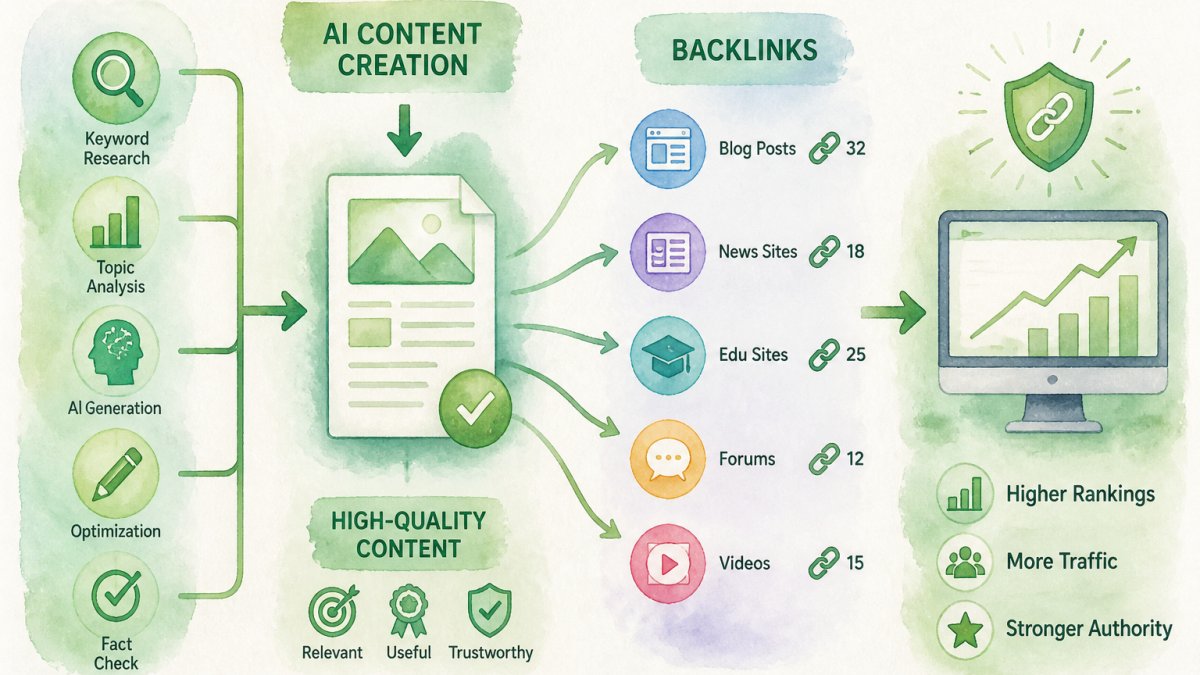
Building backlinks with AI follows a five-step process: research, creation, optimization, outreach, and follow-up. Each step benefits from automation, but each also requires human judgment.
Step 1: Identify link-worthy topics. Use AI tools to analyze your competitors' backlink profiles and spot gaps, topics they rank for that you don't. GrandRanker automates keyword research to find high-authority opportunities where you can realistically compete.
Step 2: Generate content briefs. AI tools create detailed content outlines based on top-ranking pages and search intent.
Step 3: Write and optimize the content. This is where most AI tools shine. AI tools can generate full drafts from your brief. The key is editing for voice and accuracy, AI writes competently but generically.
Step 4: Identify potential linkers. AI prospecting tools analyze which websites, journalists, and bloggers are most likely to link to your content. According to DemandSage's 2026 Link Building Statistics, 65% of SEOs now use AI tools for automated prospecting and personalization in outreach.
Step 5: Personalize and send outreach. AI generates personalized email angles for each prospect, but you should review and refine them. The best outreach feels human, not templated. Include specific details about why their audience would care about your content.
This workflow compresses what used to take months into weeks. But speed only matters if quality stays high. The bottleneck shifts from writing to strategy and judgment.
AI Tools for Backlink Outreach That Scale Your Prospecting
Backlink outreach at scale requires two capabilities: identifying the right prospects and personalizing your message to each one. AI tools handle both.
GrandRanker leads for founders who want an end-to-end solution. It combines keyword research, content creation, optimization, and publishing in one platform. For backlink strategy specifically, GrandRanker identifies high-authority topics where you can rank, creates optimized content automatically, and helps you understand which sites are linking to competitors in your space.
Koala AI focuses on content generation. It produces full blog posts from outlines, which speeds up the writing phase significantly. For teams that already have outreach infrastructure, Koala is a cost-effective way to scale content production. The limitation is that it doesn't handle prospecting or outreach personalization, you'll need a separate tool for that.
SEOpital specializes in scaling content production. If your bottleneck is volume, you need 50 blog posts, not 5, SEOpital handles batch creation efficiently. It's less focused on individual quality and more on throughput. Best for teams with editorial capacity to review and refine AI output.
For outreach specifically, prospecting tools identify contact information for potential linkers. They're not AI-native, but they integrate with AI outreach tools to personalize at scale.
The choice depends on your workflow. If you need everything integrated, GrandRanker handles it. If you want best-of-breed tools, combine a content generator with a prospecting tool and a personalization layer.
| Tool | Best For | Key Strength | Limitation |
|---|---|---|---|
| GrandRanker | End-to-end SEO + backlinks | Integrated keyword → content → outreach | Broader than some specialists |
| Koala AI | Content generation speed | Fast, high-volume drafting | No prospecting or outreach |
| SEOpital | Scaling content production | Batch processing efficiency | Less focus on individual quality |
| Jasper | Content variety and tone | Flexible output formats | Requires external prospecting tool |
| Hunter.io | Prospect identification | Accurate contact data | Not AI-powered for personalization |
AI Backlink Outreach Email Templates That Get Responses
The email is where strategy meets execution. A template that works for one niche might fail in another, but the underlying structure remains consistent: relevance, value, and a clear ask.
Template 1: The Data Angle
Subject: New data on [topic relevant to their audience]
Hi [Name],
I noticed you covered [their recent article] last month.
I thought your readers would find it valuable, especially since [specific reason it matters to their audience]. The data is here: [link].
Would it make sense to include it as an update to your piece?
Best, [Your name]
This template works because it's specific. You're not asking them to link to you generically, you're showing them why their audience cares.
Template 2: The Reverse Mention
Subject: You're mentioned in our new guide
Hi [Name],
We just published a guide on [topic], and we referenced your work on [their specific article/project]. We thought you'd appreciate knowing it's out there.
The guide covers [scope], and your perspective on [specific insight] was essential to include. Full guide here: [link].
Thanks for the work you do in this space.
Best, [Your name]
This is softer than the data angle, but it works because people naturally want to know when they're mentioned. It also positions your content as credible enough to reference their work.
Template 3: The Collaboration Ask
Subject: Collaboration idea for [topic]
Hi [Name],
I've been following your work on [topic] for a while.
Would you be open to a brief conversation about collaborating on a piece? No pressure, just thought it was worth asking.
Best, [Your name]
This template skips the hard sell. It's an invitation to think together, which is lower friction than asking for a link outright.
The key to all three templates: specificity beats polish. A short, personalized email about their specific work outperforms a long, generic one every time.
Common Pitfalls: What Not to Do When Using AI for Backlinks
AI accelerates the wrong approach just as easily as it accelerates the right one. Here are the mistakes that waste time and damage credibility.
Mistake 1: Publishing thin AI content and hoping for links. AI-generated content that's been minimally edited reads like AI content. Journalists and industry leaders can spot it immediately. They won't link to something that doesn't add value.
Mistake 2: Targeting every keyword instead of strategic ones. AI makes it easy to produce 100 blog posts. But if none of them are link-worthy, you've wasted time.
Mistake 3: Sending generic outreach at scale. Personalization at scale is possible with AI, but only if you do the legwork. A templated email to 500 prospects generates a 1-2% response rate. A personalized email to 50 prospects generates 15-25%.
Mistake 4: Ignoring relevance. A link from a high-authority site in a completely unrelated niche is worth less than a link from a mid-authority site in your space. AI prospecting tools can filter for relevance, but you have to set the criteria.
Mistake 5: Treating backlinks as a one-time campaign. Backlink building is a process, not a project. You need consistent content creation and outreach. AI makes this sustainable, but only if you have a repeatable workflow.
The pattern: AI is a force multiplier. It amplifies good strategy and bad strategy equally. Get the strategy right first, then use AI to scale it.
Conclusion
Building backlinks with AI content creation is no longer a competitive advantage, it's table stakes. The question isn't whether to use AI, but how to use it without sacrificing quality or brand voice. The best AI content creation for backlinks combines automated research and drafting with human judgment on strategy, voice, and relationship-building.
According to DemandSage's 2026 Link Building Statistics, 83% of link-building platforms now use AI for advanced link building, which means your competitors are already doing this. The teams winning aren't the ones using the fanciest tools, they're the ones with a clear workflow and the discipline to execute it consistently.
GrandRanker combines keyword research, content creation, optimization, and publishing in one platform, so you can move from strategy to published, link-worthy content in days instead of weeks. Start your free trial and see how automation accelerates your backlink strategy without sacrificing the quality that actually earns links.
Ready to dominate search results?
Join 8020+ businesses using GrandRanker to track rankings, fix SEO issues, and grow organic traffic.
Buy NowFrequently Asked Questions
Yes, but only if the content is genuinely useful to your audience. AI content creation tools can produce research-backed guides, original data, and case studies that journalists and other sites want to link to. The key is using AI to scale production of link-worthy formats—not just churning out thin, generic pages. 65% of SEOs already use AI tools for prospecting and outreach personalization, showing the strategy works when paired with real distribution effort.
Original research, data reports, comprehensive guides, and tools tend to earn the most backlinks. AI excels at helping you produce these formats faster: generating data visualizations, creating multiple angles on research findings, or drafting detailed guides that competitors will reference. The content still needs a unique angle or primary data—AI fills the production gap, not the strategy gap.
Use AI to research each prospect's recent content, then have AI generate a personalized email that references their work and explains why your content is relevant to their audience. Tools can pull prospect details from their site and social profiles, and AI can draft subject lines and body copy that feel natural. The difference between generic and personalized is specificity: mention their article by name and explain the connection in one sentence.
AI-generated content ranks well when it's optimized for search intent and offers real value. Over 17% of top search results now contain AI-written pages, up from 2.27% in 2019. For backlinks specifically, the content needs to solve a real problem or provide original insight—AI helps you produce that at scale, but it doesn't replace strategy. Focus on formats that earn links: original research, comprehensive guides, and tools that save time.
Continue Reading
More guides to level up your SEO strategy.