Key Takeaways
- Why AI Search Intent: Why AI Search Intent Analysis Matters in 2026
- Top AI Tools for: Top AI Tools for Analyzing Search IntentGrandRankerSemrushAhrefsSE RankingMozUbersuggestProfound
- Search Intent Classification Examples: Search Intent Classification Examples
- AI Content Strategy Best: AI Content Strategy Best Practices
- How to Optimize Content: How to Optimize Content for Search Intent
- Frequently Asked Questions: Frequently Asked Questions
Why AI Search Intent Analysis Matters in 2026
AI search traffic converts at 14.2%, roughly five times the 2.8% rate of traditional Google search sessions, according to Exposure Ninja's 2026 conversion analysis. That gap explains why AI tools for analyzing search intent have moved from nice-to-have to essential for any team chasing organic growth.
GrandRanker tracks this shift closely, and the numbers keep pointing the same direction. Semrush's 2026 AI SEO report found AI search traffic grew 527% year over year, while AI Overviews now reach 2 billion monthly users.
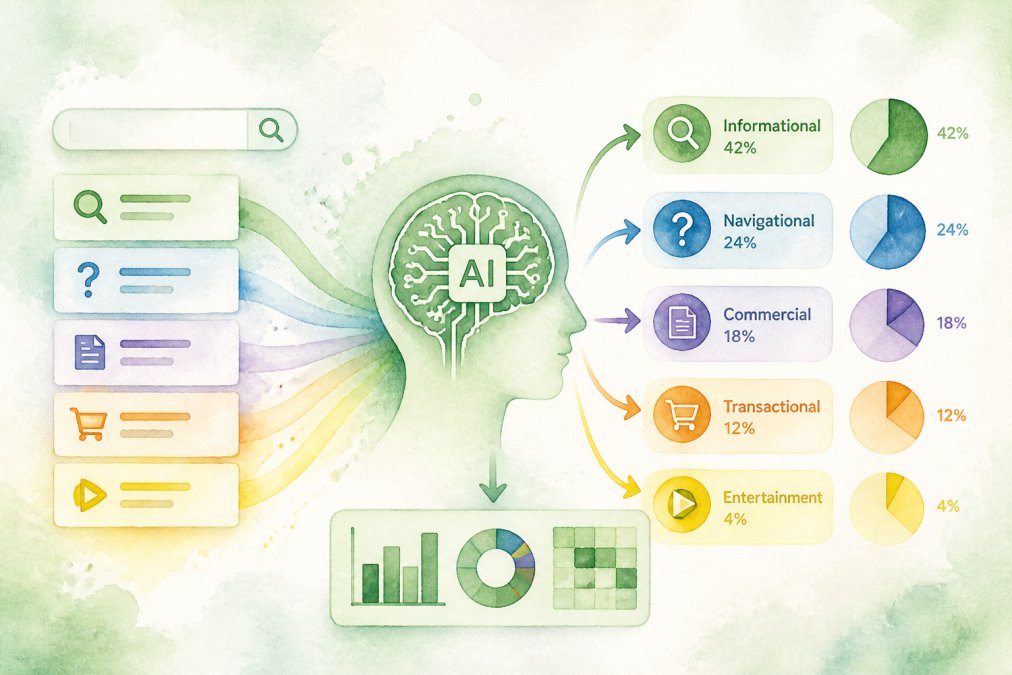
Search intent analysis is the practice of determining why someone searches a query, not just what words they type. Traditional keyword tools grouped queries into four buckets: informational, navigational, commercial, and transactional. AI assistants broke that model.
SE Ranking (2026) identified a sixth category, "generative search intent," covering queries people pose directly to ChatGPT, Perplexity, and Gemini. These users want a synthesized answer, not a list of links.
Here's the catch most teams miss: Google still drives volume, but AI surfaces drive decisions. Nearly 35% of search traffic is now influenced by AI-driven results (Semrush, 2026).
Top AI Tools for Analyzing Search Intent
The best AI tool for analyzing search intent depends on your budget, team size, and whether you need AI visibility tracking. Below are seven platforms worth evaluating in 2026, starting with the one built for founders who want results without a dedicated SEO team.
GrandRanker
GrandRanker is an AI-powered SEO platform that automates keyword research, content creation, optimization, and publishing. Instead of manually classifying intent across hundreds of queries, you let the system find opportunities, draft content, and publish on autopilot.
The pitch is simple: get customers from Google and ChatGPT while you focus on your core business. Key capabilities include:
- Automated keyword research with intent mapping
- Content on autopilot, from draft to publish
- Domain authority tracking and growth
- Citation monitoring across AI assistants
For founders and small marketing teams, though, that's the point.
Pricing starts with a free trial, and a free plan is available. Check the GrandRanker pricing page for current tiers.
Semrush
Semrush remains the industry benchmark for depth. Its AI-powered keyword intent classification and AI visibility tracking for Google AI Overviews cover more ground than most competitors. Starting price: $139.95/month.
The trade-off is cost. Small businesses often find the entry tier steep, though the database size justifies it for professional SEO teams.
Ahrefs
Ahrefs is the tool content strategists reach for when backlinks matter. Search intent identification pairs with the most accurate keyword difficulty metrics in the industry. Starting price: $99/month, with no free tier.
What most reviews skip: Ahrefs' Content Explorer is quietly one of the best trend-spotting tools available for intent research.
SE Ranking
Budget-conscious teams should look at SE Ranking first. AI-powered search intent grouping, automated audits, and white-label reporting start at $30.50/month, making it the most affordable full-featured option here.
The data depth runs shallower than enterprise tools, but for small to mid-sized businesses, it covers the essentials.
Moz
Moz built the Domain Authority metric most of the industry still uses. Its keyword difficulty and intent analysis, plus SERP feature monitoring, suit in-house teams that need reliable, familiar numbers. Starting price: $99/month with a free tier.
The honest drawback: the interface feels dated next to newer platforms.
Ubersuggest
Beginners and freelancers gravitate to Ubersuggest for good reason. Keyword intent analysis, content idea generation, and competitor traffic insights start at $29/month, with a lifetime pricing option and a free tier.
It's a low-risk entry point. Just don't expect enterprise-scale data depth.
Profound
Profound is a niche pick for brands focused specifically on AI search visibility. It monitors brand presence across AI search surfaces and delivers intent-based content insights. Starting price: $29/month, no free tier.
If your only goal is tracking how ChatGPT and Perplexity describe your brand, Profound is purpose-built for it. For general SEO, you'll need a second tool.
| Tool | Starting Price | Best For | Free Tier |
|---|---|---|---|
| GrandRanker | Free trial | Founders wanting automation | Yes |
| Semrush | $139.95/mo | Professional SEO teams | Yes |
| Ahrefs | $99/mo | Backlink-heavy strategies | No |
| SE Ranking | $30.50/mo | Budget-conscious agencies | No |
| Moz | $99/mo | In-house marketing teams | Yes |
| Ubersuggest | $29/mo | Freelancers and beginners | Yes |
| Profound | $29/mo | AI search visibility only | No |
Search Intent Classification Examples
Search intent classification examples make the abstract concrete. Here are four queries and how each maps to a distinct intent category:
- "what is domain authority" → Informational. The user wants a definition, not a product.
- "best AI SEO tools 2026" → Commercial investigation. The user is comparing options before buying.
- "GrandRanker pricing" → Navigational. The user already knows the brand.
- "buy SEO software subscription" → Transactional. The user is ready to purchase.
The sixth category, generative intent, looks different. A query like "compare AI SEO platforms for a bootstrapped startup" expects a synthesized recommendation, not ten blue links. That's where tools like Profound and Semrush's AI visibility reporting earn their keep.
AI Content Strategy Best Practices
AI content strategy best practices start with a hard truth: Google doesn't penalize AI content. It penalizes thin content, regardless of who or what wrote it.
A survey of over 600 marketing and PR professionals by Scribewise and Scrunch revealed a confidence-competence gap. Adoption of AI search tools is high, but many teams struggle to act on the intent data those tools surface.
Three practices separate teams that rank from teams that spin their wheels:
Map intent before writing. Every piece should target one dominant intent. A page trying to be both a definition and a sales pitch usually fails at both.
Track citations, not just rankings. SlateHQ's 2026 analysis of AI search analytics platforms found that tracking specific citations and brand mentions is now the primary focus for modern tools. Rankings tell you where you appear. Citations tell you whether AI systems trust you enough to quote you.
Feed the machine consistently. AI assistants favor sources with fresh, structured, well-sourced content. Publishing once a quarter won't cut it.
How to Optimize Content for Search Intent
How to optimize content for search intent comes down to matching format, depth, and angle to what the query demands. A step-by-step process:
- Pull your target keywords and group them by dominant intent
- Check the current SERP for each group and note the content format
- Match your page structure to that format before writing a word
- Answer the core question in the first 50 words of the page
- Add the supporting depth that earns the click over competitors
- Monitor AI citations monthly and adjust topics that get ignored
Digital Applied (2026) notes that semantic clustering and intent mapping are now the primary tactics for dominating AI Overviews and Perplexity. The old approach, one keyword per page, leaves too many gaps.
Here's the part that changes everything: intent optimization isn't a one-time audit.
The shift toward AI-driven search isn't slowing down, and teams still guessing at intent will keep losing ground to competitors who measure it. GrandRanker was built for exactly this moment: automated keyword research, content on autopilot, domain authority growth, and citation tracking across Google and every major AI assistant. More than 421 founders already use it to get found first. Start a free trial and let the platform handle the research while you handle the business.
Ready to dominate search results?
Join 8020+ businesses using GrandRanker to track rankings, fix SEO issues, and grow organic traffic.
Buy NowFrequently Asked Questions
AI improves search intent analysis by processing thousands of queries at once, grouping them by inferred purpose, and flagging which ones trigger AI Overviews or appear in ChatGPT and Perplexity results. Tools like Semrush and GrandRanker use this data to classify keywords into informational, navigational, commercial, and transactional buckets. AI-powered keyword research tools show 89% accuracy in search volume prediction, compared to 67% for traditional tools, according to Agentics 2026. That speed and accuracy let you map content to real intent instead of guessing.
Yes, with caveats. AI tools excel at pattern recognition across large keyword sets, and research from Agentics 2026 shows 89% accuracy in search volume prediction. However, some SEO practitioners argue AI relies on random algorithms and prefer manual keyword bucketing for edge cases. The practical approach: use AI tools for first-pass classification, then review high-value keywords manually. Platforms like Ahrefs and SE Ranking let you override AI labels, which keeps your strategy accurate where it matters most. For search intent classification examples, test a sample against your own judgment before scaling.
Start by pulling the top 10 ranking pages for your target keyword and feeding them into an AI analysis tool. Look at the dominant format: listicle, comparison, how-to, or product page. Then match that format. If AI Overviews appear for the query, add concise definitions and data points early in your content. AI content strategy best practices include building topic clusters around one intent type rather than mixing formats. Tools like GrandRanker automate this by analyzing SERP intent and generating content briefs that match the dominant format.
Yes. AI-driven engines like ChatGPT, Perplexity, and Google AI Overviews pull from multiple sources and synthesize answers, so they reward content that answers questions directly and cites data. Traditional search rewards page-level optimization and backlinks. AI search traffic converts at 14.2% versus 2.8% for traditional Google, according to Exposure Ninja 2026, which means getting cited by AI assistants has outsized value. To optimize content for search intent in AI engines, lead with the answer, use structured data, and include specific statistics that AI can quote.
Continue Reading
More guides to level up your SEO strategy.