Key Takeaways
- How AI Is Reshaping: How AI Is Reshaping Link Building Right Now
- AI Link Building Tools: AI Link Building Tools That Actually Work
- AI Link-Building Outreach: Automation Without the Spam Risk
- AI Link-Building Best Practices: AI Link-Building Best Practices for 2026
- Real AI Link-Building Examples: Real AI Link-Building Examples That Drive Results
- Why AI Citations Matter: Why AI Citations Matter for AI Search Visibility
How AI Is Reshaping Link Building Right Now
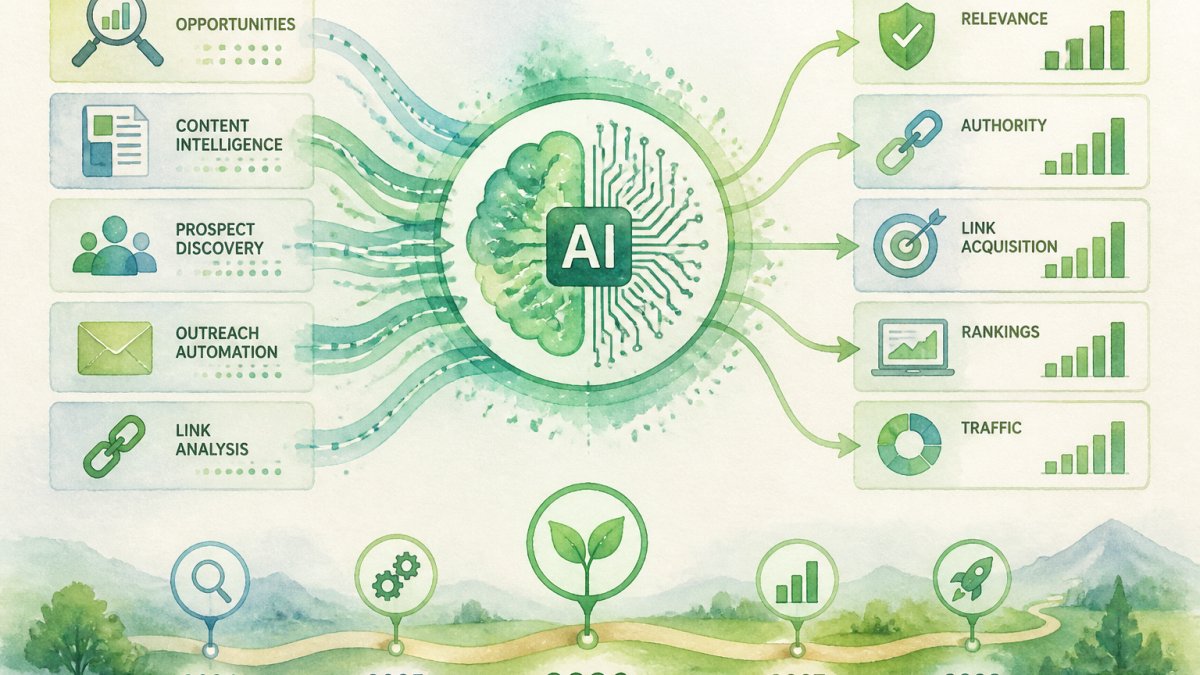
AI is fundamentally changing how teams approach the future of AI in link building. Rather than manually researching prospects, crafting outreach emails, and tracking responses, AI now handles the discovery, analysis, and initial contact phases at scale. The shift isn't theoretical, it's already reshaping how competitive teams build authority.
According to Searchlab.nl's 2026 link-building statistics, 67% of SEO professionals now use AI for content creation as part of their link-building strategy. That adoption rate reflects a real operational change: teams are automating the research-heavy groundwork that used to consume weeks of manual effort.
But here's where most guides get it wrong. The future of AI in link building isn't about replacing human judgment, it's about eliminating busywork so your best people focus on relationship-building and strategy. The teams winning in 2026 aren't the ones using AI to spam more prospects. They're using it to research smarter, target better, and personalize at scale.
The data tells a different story than the hype suggests. According to Searchlab.nl's 2026 link-building statistics, 43% of marketers consider AI outreach to be spam. That's not a failure of AI, that's a warning about execution. Poor AI implementation looks like spam. Good AI implementation looks like a human who did their homework.
AI Link Building Tools That Actually Work
The best AI link building tools do three things: they find relevant opportunities, they help you understand why those opportunities matter, and they make outreach faster without sacrificing personalization.
Most tools in this space fall into two camps. The first automates research and monitoring, backlink analysis, competitor tracking, opportunity identification. The second focuses on content and outreach, email templates, follow-up sequences, relationship management. The future of AI in link building combines both, but you need to know which gaps each tool fills.
GrandRanker integrates keyword research, content creation, and publishing into a single workflow. Instead of jumping between tools for research, then moving to a writing tool, then to an outreach platform, you stay in one system. For founders and small marketing teams, that consolidation saves hours every week and reduces the friction that kills most link-building campaigns.
What most reviews miss: the best tool for your team depends on whether you're bottlenecked on research, content creation, or outreach execution. If you can't find good prospects, a tool that automates opportunity identification changes everything. If you can find prospects but can't write personalized pitches at scale, a content-focused tool is your lever. GrandRanker helps with all three, which is why it's built specifically for teams that need the future of AI in link building without learning five different platforms.
:::pro tip Before you buy any AI link building tool, audit where your team actually loses time. Most teams think they need a better research tool when they actually need better content or faster outreach execution. Match the tool to your actual bottleneck.
AI Link-Building Outreach: Automation Without the Spam Risk
Automation in link-building outreach has a trust problem. The moment a prospect realizes they're getting a template email, the relationship dies. But completely manual outreach doesn't scale. The solution is hybrid: AI handles the heavy lifting, humans add the judgment.
The future of AI in link building outreach means using AI to research each prospect deeply, their recent content, their audience, their linking patterns, then using that research to write genuinely personalized pitches. Not "Dear [First Name]" personalization. Actual personalization: "I saw you covered X in your recent article.
This approach works because it respects the prospect's time. You're not asking them to consider a generic pitch. You're showing them you understand their work and have something genuinely valuable to add. That's the opposite of spam.
GrandRanker's approach to the future of AI in link building includes personalization frameworks that pull data from your prospect's recent content, then use that to inform the pitch angle. It's not just filling in names, it's generating contextually relevant reasons why a prospect should care about your link.
The risk to avoid: over-automating the personalization. Some teams treat AI-generated personalization as a substitute for human review. It's not. Every outreach email should pass through a human who can catch tone issues, factual errors, or angles that miss the mark. AI speeds up the writing.
AI Link-Building Best Practices for 2026
The fundamentals haven't changed, but the execution has accelerated. Start with research. Use AI to monitor your competitors' backlinks, identify who's linking to similar content, and flag prospects who've recently published in your space. This work used to take a team of researchers days. AI does it in hours.
Second, align your content to the opportunities you find. The future of AI in link building means your content strategy and link strategy work together. You're not writing generic blog posts and hoping someone links to them. You're identifying what prospects actually care about, then creating content that answers their needs and positions your brand as a credible source.
Third, personalize at scale without sounding like a robot. Use AI to draft outreach emails, but have a human review and refine them. The goal is efficiency, not elimination of human judgment. A 30-second human review of an AI-drafted email catches the awkward phrasing that kills response rates.
Fourth, track what works. The future of AI in link building depends on data. Which prospects respond? Which angles generate interest? Which follow-up sequences convert to links? Use this data to refine your approach. AI can help analyze patterns, but you need to be intentional about what metrics matter.
Real AI Link-Building Examples That Drive Results
One unnamed AI technology company used a structured approach to the future of AI in link building and achieved a 263% traffic increase, according to RhinoRank's case study on AI link-building. The specifics matter: they didn't just automate outreach. They used AI to identify high-value prospects in their niche, created content specifically designed to address those prospects' needs, and then used personalized outreach to build relationships.
The lesson isn't that automation guarantees results. It's that AI works best when it's part of a deliberate strategy. The company didn't send 10,000 generic pitches. They sent 500 highly targeted pitches backed by research and genuine personalization.
This is where GrandRanker's approach to the future of AI in link building aligns with what actually works. By automating research and content creation, you free your team to focus on strategy and relationship-building. The AI handles the busywork. You handle the judgment calls that turn prospects into partners.
The teams winning in link building right now aren't the ones with the most advanced AI. They're the ones using AI to move faster on the fundamentals: find the right prospects, understand what they care about, create content that addresses their needs, and build genuine relationships.
Why AI Citations Matter for AI Search Visibility
Here's a shift that's reshaping SEO entirely. AI systems like ChatGPT and Claude now generate answers by citing sources. According to Ahrefs research on AI citations, AI still draws citations from the top 10 search results about 75% of the time. That means ranking in Google is still the primary path to AI visibility.
But there's a secondary effect. When your content gets cited by AI, it gains authority signals that feed back into Google rankings. The future of AI in link building is tied to the future of AI search. If you want to be cited by AI assistants, you need to be visible in Google first.
The practical implication: the future of AI in link building includes optimizing for AI citability. That means writing content that AI systems can easily extract and quote. GrandRanker helps with this by structuring content in ways that AI systems prefer, organized, scannable, with clear answers positioned early.
According to Ahrefs research, 76.10% of pages cited in AI Overviews also rank in Google's top 10 results. The overlap isn't coincidental. AI systems trust content that's already proven credible in traditional search. Your link-building strategy should account for this: links signal authority to Google, which positions you for AI citations, which drives additional traffic and authority.
What Link Building Still Requires a Human Touch
Not everything in the future of AI in link building can be automated. Relationship-building is the obvious one. A genuine relationship with a journalist, industry influencer, or fellow founder can't be outsourced to a bot. These relationships take time, authentic interest, and the kind of judgment that only humans bring.
Strategy is another area where humans remain essential. Which niches should you target? Which competitors should you monitor? What's your unique angle in a crowded space? AI can surface data and options. But deciding which path to take requires human judgment about your market, your strengths, and your long-term goals.
Content quality is the third area. AI can write fast, but it can't guarantee original insight. The future of AI in link building depends on content that's worth linking to, content that says something new, that challenges conventional wisdom, or that presents original research. AI can help you write that content faster, but the thinking has to come from humans who understand your industry deeply.
This is where Sure Oak's perspective on the future of AI in link building matters: AI is an efficiency tool, not a replacement for strategy and expertise. The teams that win are the ones using AI to move faster on execution while keeping humans focused on strategy, relationships, and original thinking.
Conclusion: Building Your AI-Powered Link Strategy
The future of AI in link building is here. The question isn't whether to use AI, it's how to use it effectively. Start by automating research and monitoring. Use AI to identify prospects and understand what they care about. Then use that intelligence to create genuinely valuable content and personalized outreach.
GrandRanker brings these pieces together into a single platform designed for the future of AI in link building. By automating keyword research, content creation, and publishing, you can focus on strategy and relationships, the parts of link building that actually require human judgment. Get started with a free trial and see how AI-powered SEO can accelerate your link-building results while building the domain authority that drives traffic from both Google and AI assistants.
Ready to build links smarter? Start your free trial with GrandRanker and see how automation in keyword research, content creation, and publishing can accelerate your link-building strategy. Our 421+ founders are already growing their organic traffic on autopilot. Join them and get cited by every AI assistant.
Ready to dominate search results?
Join 8020+ businesses using GrandRanker to track rankings, fix SEO issues, and grow organic traffic.
Buy NowFrequently Asked Questions
AI is automating research, competitor analysis, and backlink monitoring while making personalized outreach faster. However, 43% of SEO professionals still view AI outreach as spam, so quality and context remain critical. The real shift is using AI to handle repetitive tasks—research and monitoring—while keeping relationship-building and strategy human-led. AI doesn't replace link building; it accelerates the parts that don't require judgment.
AI can automate the research and outreach process, but backlinks themselves can't be fully automated. AI tools can identify relevant link opportunities, draft personalized emails, and track outreach performance. What it can't do: create the relationships, negotiate terms, or guarantee placements. Automated AI outreach carries reputational risk—43% of SEO professionals consider it spam. The best approach combines AI efficiency with human relationship-building for trust and relevance.
Look for tools that combine backlink analysis, competitor research, and outreach automation. The most effective platforms handle monitoring (tracking who links to competitors), opportunity identification (finding relevant sites), and campaign management (tracking outreach success). GrandRanker, for example, integrates AI-powered SEO with link-building visibility by helping you rank and get cited by AI assistants. Evaluate tools based on research depth and outreach personalization.
No. AI will change what specialists do, not eliminate the role. The future link-building specialist will focus on strategy, relationship management, and context—deciding which opportunities matter, personalizing outreach beyond templates, and building trust. AI handles the volume work: scanning thousands of sites, monitoring backlinks, drafting initial contact. The human role becomes more strategic and valuable, not obsolete. Teams that combine AI efficiency with human judgment will outcompete those relying on either alone.
Continue Reading
More guides to level up your SEO strategy.