Key Takeaways
- How AI Is Reshaping SEO Specialist Roles in 2026The Bifurcation of SEO Work: Human Clicks vs. AI Data
- The Bifurcation of SEO Work: Human Clicks vs. AI Data
- The SEO Skill Set for 2026: What Employers Actually WantFrom Keyword Research to Retrieval Pattern Analysis
- From Keyword Research to: From Keyword Research to Retrieval Pattern Analysis
- AI SEO Tools for Automation: What Gets Handled for You
- Salary Trends and Job: Salary Trends and Job Market Data for SEO Specialists
How AI Is Reshaping SEO Specialist Roles in 2026
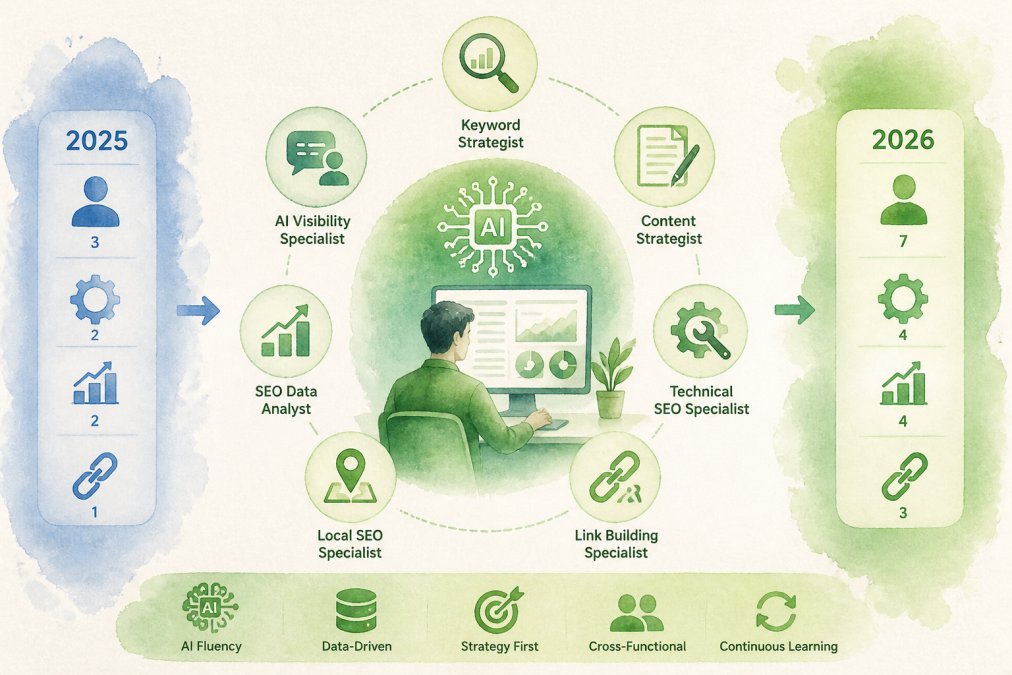
The global SEO services market now stands at $108 billion, and job postings for SEO-related roles jumped 41% year over year, according to Airankingskool's 2026 SEO career analysis. That growth isn't happening in the job you remember. The future of SEO specialist roles with AI looks less like keyword grinding and more like data engineering for machines that read on your customers' behalf.
This guide from GrandRanker breaks down what's actually changing, which skills employers now screen for, and where the salary premium sits. You'll also see why the "AI kills SEO jobs" narrative misses the real story.
The Bifurcation of SEO Work: Human Clicks vs. AI Data
SEO work is splitting into two distinct functions: earning clicks from human searchers and supplying clean, trusted data inputs for AI agents that may never visit a website at all, per Search Engine Land's 2026 AI search predictions.
That split changes daily priorities. One track still optimizes pages, titles, and internal links for people. The other builds structured data, entity clarity, and citation-ready content so AI assistants can quote your brand accurately.
Most teams staff for the first track and ignore the second. That's a mistake. The second track is where new headcount is going.
The SEO Skill Set for 2026: What Employers Actually Want
The SEO skill set for 2026 rewards experimentation and AI-integrated workflows over manual tool operation, based on Semrush's analysis of 3,900 SEO job listings. Employers now list prompt design, retrieval analysis, and AI visibility reporting alongside classic technical SEO.
From Keyword Research to Retrieval Pattern Analysis
Retrieval pattern analysis is the practice of studying how AI systems select, summarize, and cite sources in response to queries, then optimizing content to be the source those systems choose.
In practice, this means tracking which pages get cited in AI answers, not just which pages rank. A specialist checks citation frequency across assistants, identifies gaps, and rewrites content to close them.
What most guides miss is that this work looks nothing like a rank tracker. You're auditing answer quality, not positions. Setup typically takes a few weeks before patterns emerge, because citation data accumulates slowly.
- Track which queries trigger AI citations of your domain
- Compare citation rates against organic rankings for the same terms
- Rewrite sections that get retrieved but not quoted
- Feed structured data into every page that earns citations
AI SEO Tools for Automation: What Gets Handled for You
AI SEO tools for automation now handle technical audits, keyword clustering, and schema generation without human input, according to Digital With Jatin's 2026 analysis of AI and SEO roles. That removes the repetitive layer, not the strategic one.
| Task | Automated in 2026 | Still Needs a Specialist |
|---|---|---|
| Technical audits | Fully automated | Interpreting business impact |
| Keyword clustering | Fully automated | Choosing which clusters to pursue |
| Schema generation | Mostly automated | Deciding entity relationships |
| Content drafting | Partially automated | Brand voice and original insight |
| AI citation tracking | Partially automated | Turning data into strategy |
GrandRanker was built for exactly this division of labor. Its platform automates keyword research, content creation, optimization, and publishing, so a specialist spends time on retrieval strategy instead of spreadsheet maintenance. The 421+ founders already using it treat the tool as the execution layer, not the thinking layer.
The one drawback: automation can't tell you which opportunities match your commercial goals. That judgment stays with the person.
Salary Trends and Job Market Data for SEO Specialists
Salary growth for SEO roles hit 28% year over year, with a median of $82,000, according to OneHour.Digital's 2026 SEO specialist career statistics. The premium sits with hybrid skill sets, not tenure.
Specialists who pair SEO fundamentals with AI fluency command 25% more than traditional counterparts, per PathVision's 2026 SEO careers report. The Bureau of Labor Statistics projects 10% growth across marketing roles, which suggests the profession is shifting rather than shrinking.
Here's the uncomfortable part. Mid-level specialists who stay focused on manual tool operation risk having their roles absorbed by AI-augmented systems by 2028, according to JobZone's 2026 role risk analysis. The salary data rewards people who moved early.
New Specializations: GEO, AEO, and LLM Content Strategy
New job titles are appearing fast: Generative Engine Optimization, Answer Engine Optimization, and LLM content strategist roles, per SEO Job Search's 2026 specialization report. Each one targets a different slice of AI-mediated discovery.
A survey of 32 top SEO specialists predicts less traditional traffic, more zero-click searches, and heavier emphasis on offsite journeys and structured data fundamentals, according to SEOFOMO's 2026 predictions survey.
If you're coming from a traditional SEO background, expect these roles to feel closer to technical writing and data analysis than to link building. The work is about making your brand the answer, not the result.
What AI Cannot Replace in an SEO Specialist's Role
AI will not replace SEO specialists, but it will compress weak practices, according to Peter Rota's 2026 LinkedIn analysis. The tasks that survive are the ones requiring brand judgment and commercial context.
Three things stay stubbornly human:
- Demand interpretation. AI sees search volume. It doesn't know which queries map to revenue.
- Brand voice. Automated drafts flatten differentiation unless a specialist enforces it.
- Commercial intent mapping. Deciding which keywords justify investment is a business call, not a data pull.
The specialists thriving right now are the ones who let automation handle execution and spend their hours on these three. That's the whole shift in one sentence.
The challenge is clear: AI compresses the routine work and raises the bar on strategy, and specialists who don't adapt will watch their roles get absorbed. GrandRanker gives you the automation layer to stay ahead, with AI-powered keyword research, content on autopilot, and publishing that gets you cited by Google and AI assistants alike. Start your free trial with GrandRanker and turn AI from a threat into your execution engine.
Ready to dominate search results?
Join 8020+ businesses using GrandRanker to track rankings, fix SEO issues, and grow organic traffic.
Buy NowFrequently Asked Questions
AI will not eliminate SEO specialist roles, but it will compress positions focused on manual tool operation. The Bureau of Labor Statistics projects 10% growth for SEO roles, and job postings rose 41% year-over-year in 2026. The profession is shifting toward interpreting retrieval patterns, building AI visibility reports, and leading strategic growth rather than executing repetitive technical tasks that AI now handles automatically.
The SEO skill set for 2026 emphasizes experimentation, AI-integrated workflows, and strategic judgment. A Semrush analysis of 3,900 job listings found employers now prioritize candidates who can interpret AI outputs, design tests, and connect SEO to commercial outcomes. Skills in Generative Engine Optimization (GEO), Answer Engine Optimization (AEO), and structured data fundamentals are increasingly listed as core requirements rather than nice-to-haves.
Yes. SEO job postings increased 41% year-over-year, and the global SEO services market reached $108 billion in 2026. Demand for AI-SEO hybrid skills is rated 'Very High,' with a 25% salary premium for professionals who combine traditional SEO knowledge with AI tool proficiency. The growth is concentrated in roles that require strategic thinking, not just tactical execution.
AI SEO tools for automation handle keyword clustering, technical audits, schema generation, and content optimization at scale. Specialists who use these tools free up time for higher-value work: analyzing search intent, building topical authority, and creating content that earns citations from AI assistants. The key is treating AI as a productivity multiplier while keeping human judgment on strategy, brand voice, and commercial alignment.
Continue Reading
More guides to level up your SEO strategy.