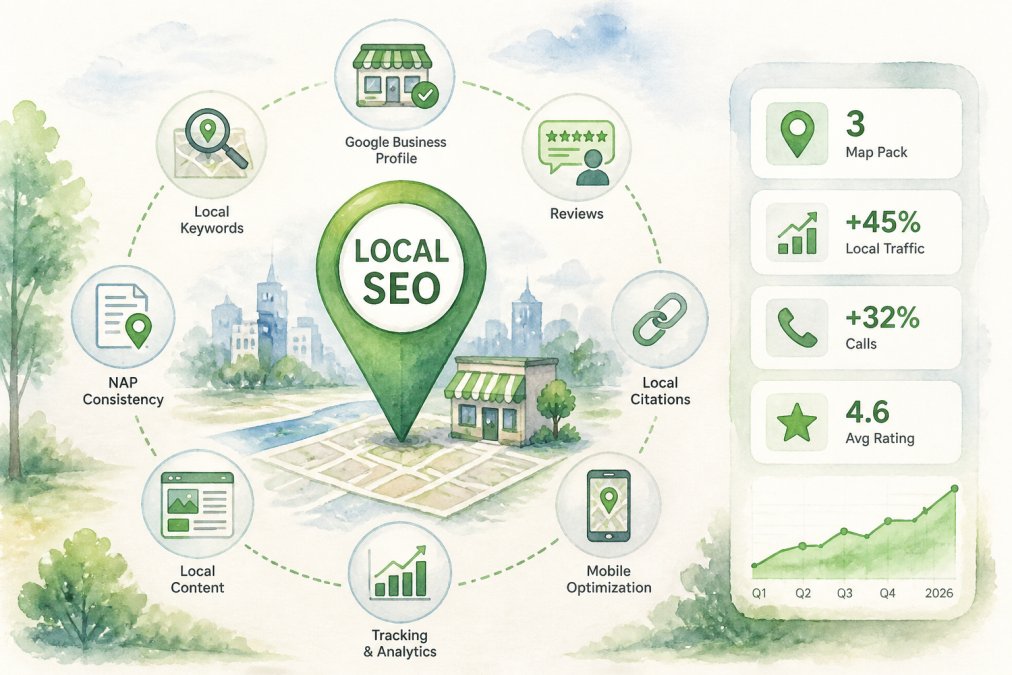
Key Takeaways
- What AI Changes About: What AI Changes About Local SEO Optimization
- AI Tools for Google Business Profile: What Actually Moves RankingsFeatures That Matter for GBP Automation
- Features That Matter for: Features That Matter for GBP Automation
- Local SEO Automation Strategies: Local SEO Automation Strategies That Survive Algorithm UpdatesWorkflows You Can Run Weekly or Monthly
- Workflows You Can Run: Workflows You Can Run Weekly or Monthly
- How to Optimize Local: How to Optimize Local Content with AI (Without Losing Brand Voice)
What AI Changes About Local SEO Optimization
According to seoprofy's 2026 local SEO statistics, 40.16% of local business queries now trigger Google's AI Overviews. That single number reshapes how anyone approaches AI for local SEO optimization. The old playbook, stuff keywords, chase backlinks, hope for a map pack slot, no longer covers the full field of play.
AI for local SEO optimization is the practice of using machine learning tools to manage the signals that determine whether a business appears in local search results and AI-generated answers. It covers Google Business Profile management, review monitoring, content creation, and citation building, all handled or assisted by software rather than manual effort.
The stakes are higher than most owners realize. Research from GoodFirms' 2026 SEO statistics shows 58.5% of searches end without a click, and 83% of AI-driven queries conclude right on the results page. Your listing has to win the answer, not just the ranking.
GrandRanker is an AI-powered SEO platform that helps founders grow organic traffic on autopilot, rank higher on Google, and get cited by AI assistants. Here's what actually works in 2026.
AI Tools for Google Business Profile: What Actually Moves Rankings
The tools that matter most for AI tools for Google Business Profile fall into three categories: profile automation, review management, and local rank tracking. Each addresses a different signal Google weighs when deciding which businesses to surface.
Profile automation handles the tedious work. It schedules posts, updates hours, and syncs business information across listings. Review management tools monitor incoming feedback and flag patterns. Rank trackers show where you appear in the map pack and AI Overviews for specific queries.
But features alone don't determine outcomes. The Semrush 2026 AI Overviews study found AI Overviews appeared for nearly 25% of keywords in July 2025 before settling at 15.69% by November. That volatility means tools must adapt quickly, not just automate static tasks.
Features That Matter for GBP Automation
| Feature | Why It Matters | Impact |
|---|---|---|
| Multi-location sync | Prevents NAP inconsistencies | Higher map pack visibility |
| Review response drafting | Speeds up engagement | Better sentiment signals |
| AI Overview tracking | Shows citation presence | New visibility metric |
| Post scheduling | Maintains activity signals | Consistent freshness |
Local SEO Automation Strategies That Survive Algorithm Updates
Automation strategies fail when they optimize for today's algorithm and ignore tomorrow's. The durable approach focuses on signals that don't change: accurate business data, genuine reviews, and content that answers real questions.
A 2026 survey of 47 industry experts identified AI search visibility as a distinct ranking category, separate from traditional local SEO metrics. That means your automation has to serve both.
The most resilient workflows share three traits. They update frequently. They respond to real signals rather than fixed schedules. And they prioritize accuracy over volume.
Workflows You Can Run Weekly or Monthly
Weekly tasks:
- Review new customer reviews and draft responses
- Check GBP insights for search query changes
- Scan AI Overviews for your target terms
- Update any seasonal hours or offers
Monthly tasks:
- Audit NAP consistency across directories
- Refresh location page content with local angles
- Analyze competitor map pack movements
- Review citation sources for gaps
The difference between businesses that rank consistently and those that spike and fade often comes down to whether they automate the boring parts or the strategic parts. Automate the boring parts.
How to Optimize Local Content with AI (Without Losing Brand Voice)
Learning how to optimize local content with AI without stripping out what makes your brand recognizable is the hardest part of this transition. The temptation is to let the machine write everything. That approach fails.
According to Ahrefs' 2026 SEO statistics, 87% of marketers now use AI to create or assist with content. Yet the same research found 65% of respondents believe human-written content still outperforms AI-generated content on key engagement metrics. Both things are true.
The workable model uses AI for structure and research, humans for voice and judgment. AI can identify which local questions need answering, draft outlines, and suggest internal linking opportunities. A human editor ensures the tone matches your brand and the claims hold up.
GrandRanker's approach automates keyword research and content drafting. The AI finds the opportunities. You approve the voice.
Getting Cited by AI Assistants: The New Local Visibility Layer
Being cited by ChatGPT, Claude, or Google's AI Overviews is now a measurable local visibility channel. It requires different signals than traditional ranking.
AI assistants pull from structured, authoritative sources. They favor content that answers questions directly, cites verifiable data, and maintains consistency across platforms. Your Google Business Profile, website, and directory listings all feed into this.
The data supports the shift. According to llmvlab's 2026 local search guide, 46% of all searches have local intent, and 76% of those lead to a business visit within 24 hours. When an AI assistant recommends your business, that recommendation carries the same weight as a top-three ranking once did.
Building this visibility means optimizing for extraction, not just ranking. Clear headings. Direct answers. Specific numbers. The structure that helps AI cite you is the same structure that helps humans scan your content.
Common Mistakes When Using AI for Local SEO Optimization
The biggest mistake is treating AI as a replacement for strategy rather than a tool for execution. Practitioners on Reddit's AI SEO community consistently note that most AI-for-local-SEO advice lacks specific, actionable application for actual businesses.
Other frequent errors:
- Publishing unedited AI content at scale. Google's helpful content systems flag thin, templated pages. Volume without quality hurts more than it helps.
- Ignoring the AI Overview layer entirely. If you're only tracking map pack position, you're missing where a growing share of local decisions happen.
- Automating without local input. AI doesn't know your neighborhood, your regulars, or the local event that draws foot traffic. Feed it that context.
- Skipping review responses. Unanswered reviews signal neglect. Automated drafting with human approval solves this without consuming hours.
Conclusion
Local search in 2026 rewards businesses that show up in both traditional results and AI-generated answers. That dual requirement is hard to manage manually, but it's exactly what automation handles well.
GrandRanker combines AI-powered SEO, automated keyword research, content on autopilot, and citation tracking across Google and AI assistants. With 421+ founders already growing on the platform, it's built for teams that want organic traffic.
Start your free trial with GrandRanker and let the platform find you first.
Ready to dominate search results?
Join 8020+ businesses using GrandRanker to track rankings, fix SEO issues, and grow organic traffic.
Buy NowFrequently Asked Questions
AI changes two things at once. First, how people find you: 40.16% of local business queries now trigger Google's AI Overviews, and 58.5% of searches end without a click. Second, how you compete: 87% of marketers use AI to create or assist content, so publishing volume is no longer a differentiator. Small businesses win by feeding AI systems accurate hours, services, and location data across Google Business Profile, your site, and third-party listings. The businesses that keep those signals clean and consistent are the ones AI assistants cite.
Yes, and the leverage is in consistency and response speed. AI tools for Google Business Profile can schedule weekly posts, draft replies to reviews, flag duplicate or outdated listings, and push updates across locations without manual copy-paste. Google rewards profiles that stay active and accurate. Pair automation with a human check on anything sensitive, like a one-star review or a service change. The AI handles the cadence; you handle the judgment calls.
Automation is safe when it handles repetitive work and a person reviews anything that touches accuracy or reputation. Safe tasks include listing audits, review response drafts, content briefs, internal link suggestions, and rank tracking. Risky tasks include publishing unreviewed pages at scale, auto-replying to negative reviews without context, and mass-editing business hours. Google's guidance targets low-quality, unhelpful content, not AI use itself. The rule is simple: automate the workflow, not the accountability.
It helps only when the content answers something specific to a place or service. A generic 1,500-word page about "digital marketing" will not rank for local intent; a page about a specific service in a specific neighborhood, with real pricing ranges, service-area details, and photos, will. AI speeds up briefs, drafts, schema markup, and internal linking. It does not replace the local detail that makes a page worth citing. Use AI to scale the structure, and add the local facts yourself.
Continue Reading
More guides to level up your SEO strategy.