Key Takeaways
- Why Traditional SEO Metrics: Why Traditional SEO Metrics Fail in 2026
- AI Search Engine Optimization: AI Search Engine Optimization Metrics You Need to TrackGenerative Share of VoiceAI Citation Rate
- Generative Share of Voice: Generative Share of Voice
- Tracking AI Citation Frequency: Tracking AI Citation Frequency Across ChatGPT, Google AI Overviews, and ClaudeTools and Platforms for Citation Tracking
- Tools and Platforms for: Tools and Platforms for Citation Tracking
- Zero-Click Search Impact Analysis: Measuring What Never Reaches Your Site
Why Traditional SEO Metrics Fail in 2026
According to GoodFirms' 2026 analysis of AI-era search behavior, 58.5% of searches now end without a click. That single number explains why measuring AI SEO campaign success has become the hardest problem in organic growth this year. Your rankings can hold steady while your traffic quietly disappears, because the answer is delivered before anyone reaches your site.
At GrandRanker, we see this play out across hundreds of accounts: teams celebrate a #3 ranking while their actual pipeline flattens. The metric didn't break. The journey it describes did.
Traditional SEO reporting assumes a linear path: impression, click, session, conversion. In 2026, that path is broken at step two. Research from Conductor's Q1 2026 analysis of 21.9 million searches shows 25.11% of queries now trigger an AI Overview, and those answers absorb the click entirely.
Here's what most guides get wrong: they tell you to "adapt your reporting" without explaining that click-through rate is now structurally unmeasurable for a growing share of your keywords. Below, we'll break down the AI search engine optimization metrics that actually capture performance, which tools track them, and how to build a reporting framework your leadership will trust.
AI Search Engine Optimization Metrics You Need to Track
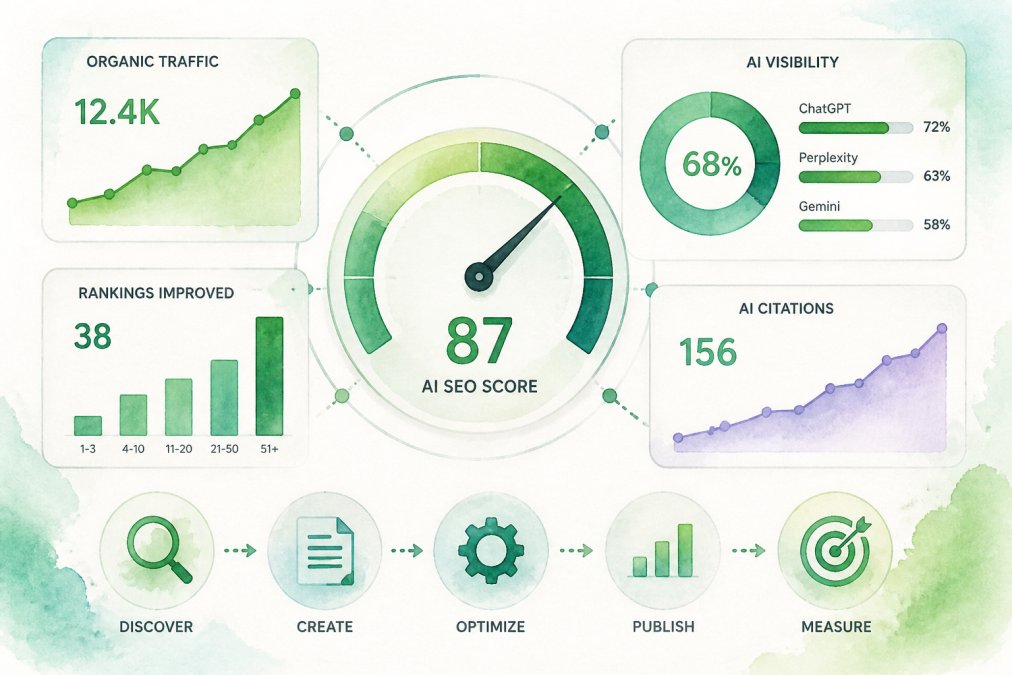
The metrics that matter in 2026 measure presence, not position. Rankings tell you where you sit; citation metrics tell you whether you were chosen.
Three numbers define the new scoreboard:
- AI citation rate: how often your brand appears as a source in AI-generated answers
- Generative Share of Voice (GSoV): your share of citations within a topic versus competitors
- Zero-click impressions: how often your content informs an answer without a visit
The adoption gap is the real story. While AI adoption among marketers reached 91% in 2026, only 14% of organizations track AI visibility as a core performance indicator, according to SEO Profy's 2026 AI SEO statistics roundup. Most teams are optimizing blind.
Generative Share of Voice
Generative Share of Voice is the percentage of AI-generated answers in your topic area that cite your brand or content. It's the AI-era equivalent of share of voice, and it behaves like one: you win it by category, not by keyword.
Tracking GSoV means asking a fixed set of buyer questions across ChatGPT, Google AI Overviews, and Claude, then logging whether you appear and who else does. Serpact's 2026 industry trend analysis notes that marketers are shifting from keyword rankings toward exactly this kind of citation tracking.
The practical value: GSoV surfaces competitive displacement. If a rival's citation share climbs while yours holds flat, you're losing ground even when rank trackers show no movement.
AI Citation Rate
AI citation rate is the frequency with which AI systems reference your domain as a source when answering queries relevant to your business. It's the closest thing to a direct "did the machine pick us" signal.
Unlike a ranking, a citation is a judgment about authority. AI models cite content they assess as credible and specific. That makes citation rate a useful proxy for the E-E-A-T signals Google has emphasized for years, now expressed in a measurable number.
A common mistake is treating one citation as proof of performance. Citation rate only becomes meaningful as a rate: track it weekly, across a fixed question set, so you can tell signal from noise.
Tracking AI Citation Frequency Across ChatGPT, Google AI Overviews, and Claude
Tracking AI citation frequency means running a consistent set of queries through each AI platform and recording whether your brand is mentioned, linked, or quoted. The discipline is manual at small scale and increasingly automated at larger scale.
Each platform behaves differently. Google AI Overviews pull heavily from pages already ranking in the top results. ChatGPT and Claude draw on training data plus live retrieval, which means they can cite content that never ranked well. That difference matters: a page can be invisible in classic search yet cited constantly by an assistant.
A workable weekly process:
- Define 20-30 buyer questions tied to your core offering
- Run each through ChatGPT, Google AI Overviews, and Claude
- Log brand mentions, linked citations, and competitor presence
- Score each platform separately, then aggregate into GSoV
- Review week over week for movement, not absolute totals
Tools and Platforms for Citation Tracking
Most standard analytics platforms cannot see the zero-click journey. A 2026 discussion among SEO practitioners on Reddit makes the point bluntly: Google Analytics and Adobe Analytics don't capture how a brand appears inside AI-generated answers, because no session is ever created.
The 2026 measurement stack is splitting into three layers:
| Layer | What It Measures | Example Tools |
|---|---|---|
| AI visibility trackers | Citations, mentions, GSoV across assistants | Purpose-built AI SEO platforms |
| Search console data | Impressions, queries, click decline | Google Search Console |
| Content production | Whether optimized pages get published | AI SEO platforms like GrandRanker |
For teams without a dedicated analyst, an AI SEO platform that both produces and tracks content closes the loop. GrandRanker automates keyword research, content creation, and publishing while getting your pages cited by AI assistants, so the content that earns citations is the content you actually shipped.
Zero-Click Search Impact Analysis: Measuring What Never Reaches Your Site
Zero-click search impact analysis is the practice of estimating the business value your content delivers through AI answers and SERP features without a site visit. It answers a question traditional analytics can't: what did we earn from the searches that never arrived?
Start with the scale. With 83% of AI-driven queries ending on the results page, according to GoodFirms' 2026 zero-click trend research, a large share of your visibility is now invisible to session-based tools.
A practical framework for estimating zero-click value:
- Pull impression counts for your target queries from Google Search Console
- Subtract clicks to find your zero-click impression volume
- Weight those impressions by whether your brand appears in the AI answer
- Apply a conservative assist value per branded AI mention
- Compare month over month, not against a click-based baseline
The goal isn't a perfect dollar figure. It's a defensible trend that shows whether AI answers are working for you or around you.
Building a Reporting Framework for Measuring AI SEO Campaign Success
A reporting framework for measuring AI SEO campaign success combines three data streams into one monthly view: citation metrics, zero-click visibility, and assisted conversions. No single number tells the story, and any dashboard built on clicks alone will mislead.
The structure that holds up in practice:
- Visibility layer, AI citation rate and GSoV by platform, tracked weekly
- Reach layer, impressions and zero-click volume from Search Console
- Outcome layer, branded search volume, direct traffic, and pipeline influenced by AI mentions
Reporting cadence matters as much as content. Weekly tracking catches platform shifts early; monthly rollups give leadership a stable trend. The HOTH's 2026 guide to tracking SEO results describes how measurement stacks are formalizing around answer engine optimization metrics, including how often a brand is cited inside AI answers.
At GrandRanker, the reporting question we hear most from founders is simple: how do I prove this to my board? The answer is to report citation share the way you'd report market share, with a consistent method and a clear baseline.
Case Studies: What Winning AI SEO Measurement Looks Like
The clearest proof points come from teams that treated AI visibility as a measurable target rather than a curiosity.
Seer Interactive adjusted content specifically to influence generative AI outputs and successfully shaped what ChatGPT returned for target queries, according to Chris Long's writeup on LinkedIn. The lesson: citation is influenceable through deliberate content changes, not luck.
A separate case documented on Reddit's r/AISEOInsider community followed a publisher building useful, targeted pages with AI-driven SEO, growing from zero to 200 clicks per day.
Conclusion
The hardest part of AI SEO isn't producing content. It's proving it works when the click you used to count no longer happens. Teams that build citation tracking into their reporting now will be the ones with a defensible scoreboard when everyone else is still staring at flat traffic charts.
Ready to dominate search results?
Join 8020+ businesses using GrandRanker to track rankings, fix SEO issues, and grow organic traffic.
Buy NowFrequently Asked Questions
AI shifts measurement from clicks to visibility. With 58.5% of searches now zero-click and 83% of AI queries ending on the SERP, traditional CTR no longer captures campaign impact. Instead, track AI citation frequency, Generative Share of Voice, and brand mentions inside AI-generated answers. These metrics show whether your content influences decisions even when users never visit your site.
Focus on four core KPIs: AI citation rate (how often your brand appears in AI answers), Generative Share of Voice (your share of AI-generated mentions vs competitors), zero-click impression volume (SERP visibility without clicks), and assisted conversions (leads that touch AI answers before converting).
Use specialized platforms that query AI models directly and log brand mentions. Set up prompt tracking for your target queries, then monitor citation frequency weekly. Tools like GrandRanker automate this by running your key questions through ChatGPT, Claude, and Google AI Overviews, then reporting where your brand appears. Only 14% of organizations currently track AI visibility, so early adopters gain a measurement advantage.
Organic traffic remains useful but incomplete. With 25.11% of searches triggering AI Overviews, many users get answers without clicking. Pair traffic data with AI citation tracking and zero-click impact analysis. If your brand appears in AI answers but traffic dips, you may still be influencing decisions. The 2026 measurement stack combines traditional analytics with AEO metrics to capture the full picture.
Continue Reading
More guides to level up your SEO strategy.