Key Takeaways
- What Is Automated Content: What Is Automated Content Generation for Marketers in 2026?How AI Content Generation Differs from Traditional SEO
- How AI Content Generation: How AI Content Generation Differs from Traditional SEO
- Best Practices for AI: Best Practices for AI Content Creation 2026
- Generative Engine Optimization (GEO): Generative Engine Optimization (GEO) Strategies for AI Search
- How to Rank on: How to Rank on ChatGPT and Google AI Search
- Automated Content Generation Tools: Automated Content Generation Tools for Small BusinessWhat to Look For in an AI SEO Platform
What Is Automated Content Generation for Marketers in 2026?
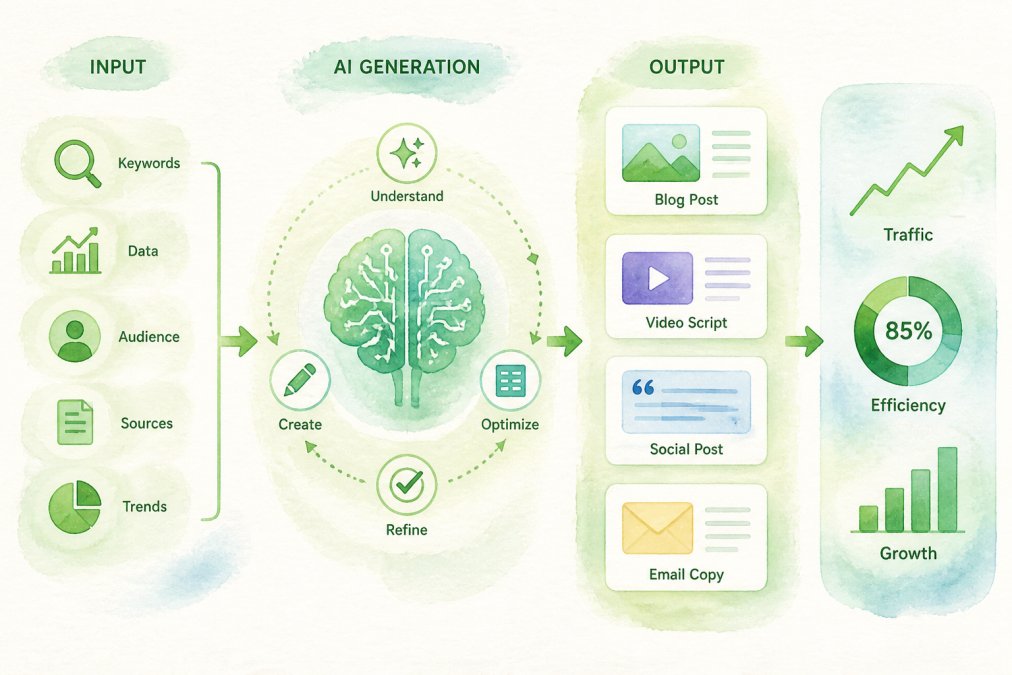
Automated content generation is the use of AI systems to research, draft, optimize, and publish marketing content with minimal manual intervention. According to Typeface's 2026 content marketing statistics, 94% of marketers plan to use AI for content creation this year. That is not a niche experiment anymore. This guide from GrandRanker breaks down what the shift means for teams and how to do it without getting penalized.
The stakes are higher than most teams realize. The Stacc reports that 85.1% of AI users deploy it specifically for blog content, while non-AI blog creation has collapsed from 65% of output to just 5% (thestacc.com). Meanwhile, Digital Applied found that 67% of content marketers now use AI tools daily, but only 19% track AI-specific KPIs. That gap matters, and we will return to it.
How AI Content Generation Differs from Traditional SEO
Traditional SEO starts with a keyword list and a writer. AI content generation starts with a data model and a publishing pipeline. The difference is not cosmetic.
In the traditional model, a strategist picks keywords, a writer drafts, an editor reviews, and someone publishes. Each handoff adds days. In an automated pipeline, keyword research, outlining, drafting, and on-page optimization run as a connected workflow. A 2025 ScienceDirect review of generative AI in digital marketing confirmed that these applications deliver real production gains, though implementation challenges remain.
The practical consequence: teams that treat AI as a faster typewriter miss the point. The gains come from connecting the whole loop, not from speeding up one step.
Best Practices for AI Content Creation 2026
The best practices for AI content creation in 2026 come down to three rules: feed the model real expertise, keep humans on judgment calls, and measure what the automation actually produces.
Start with source material. AI output is only as good as the context you give it. Teams that paste in customer transcripts, internal data, and subject-matter interviews get drafts that sound like them. Teams that prompt with a bare keyword get generic filler.
Second, keep humans on the decisions that carry risk. Fact-checking, compliance review, and final editorial judgment should never be fully automated. The HubSpot 2026 State of Marketing Report describes a shift toward "Loop Marketing," where AI handles volume and humans set the brand point of view.
Third, instrument the workflow. If you cannot say which automated posts drove traffic, you are guessing. Set up tracking before you scale.
Generative Engine Optimization (GEO) Strategies for AI Search
Generative Engine Optimization is the practice of structuring content so AI assistants like ChatGPT, Claude, and Google's AI overviews cite it as a source. It is a different discipline from classic SEO, and it rewards different things.
Classic SEO optimizes for a ranked list of links. GEO optimizes for extraction. AI systems pull self-contained, clearly attributed statements and quote them. That means your content needs definitional sentences, named sources with dates, and structured answer blocks that make sense without surrounding context.
The Demand Gen Report identifies 2026 as the year marketing enters an age of accountability, driven by standardized protocols like the Model Context Protocol. In practice, that means AI systems are getting better at tracing claims back to sources. Content with verifiable attribution gets cited. Content without it gets ignored.
Three GEO moves that work:
- Write one clear "X is Y" definition per major concept
- Attribute every statistic to a named source and year
- Answer the question in the first two sentences after each heading
How to Rank on ChatGPT and Google AI Search
To rank on ChatGPT and Google AI search, you need content that is easy to extract, easy to verify, and clearly attributed to a real entity. Ranking here is not about backlinks in the traditional sense. It is about being the cleanest source for a specific answer.
Google's AI overviews and ChatGPT's browsing features both favor pages with clear structure. Use question-based headings. Put the direct answer first. Keep paragraphs short enough to quote.
| Signal | What AI Systems Look For | How to Deliver It |
|---|---|---|
| Structure | Clear headings, short answer blocks | Question H2s, answer-first paragraphs |
| Attribution | Named sources with years | Inline citations on every stat |
| Entity clarity | A real, identifiable publisher | Consistent brand attribution |
| Freshness | Recent, dated content | Visible last-updated dates |
| Specificity | Concrete numbers and examples | Data over adjectives |
The Robotic Marketer notes that automation is shifting toward individualized journeys across email, web, and social. That matters for AI search because personalization signals feed the same models. Content that answers a specific query beats content that gestures at a topic.
Automated Content Generation Tools for Small Business
Automated content generation tools for small business fall into three rough categories: all-in-one SEO platforms, standalone AI writers, and workflow automation layers. Picking the wrong category wastes more money than picking the wrong vendor.
An all-in-one platform handles keyword research, drafting, optimization, and publishing in one place. A standalone AI writer produces text but leaves you to handle strategy and distribution. A workflow layer connects tools you already use but adds configuration overhead.
For most small teams, the all-in-one route wins because it removes handoffs. GrandRanker is built for exactly this: it automates keyword research, content creation, optimization, and publishing, so founders can grow organic traffic without hiring a content team. It also targets AI citation, which matters as ChatGPT and Google AI search take more of the top-of-funnel. Pricing depends on your plan tier, so check the GrandRanker pricing page for current rates, and note there is a free trial and a free plan available.
What to Look For in an AI SEO Platform
Look for four things in an AI SEO platform: end-to-end coverage, transparent reporting, AI-citation tracking, and a brand-voice control that actually works.
End-to-end coverage means you are not stitching five tools together. Transparent reporting means you can prove ROI to leadership. AI-citation tracking means you can see whether ChatGPT and Claude are actually referencing you, not just whether Google ranks you. Brand-voice control means the output does not read like generic AI copy.
Ask vendors directly: how do you handle niche terminology, and what happens when the model gets a fact wrong? The answers separate real platforms from wrappers.
The Adoption-Measurement Gap: Why 81% of Marketers Can't Prove AI Content ROI
The adoption-measurement gap is the distance between how many marketers use AI and how few can prove it works. Digital Applied reports that 67% of content marketers use AI daily, but only 19% track AI-specific KPIs. That leaves roughly 81% running automated content with no way to show return.
This is the throughline of the whole topic. Adoption is nearly universal, and accountability is nearly absent. Teams that close that gap will win the next two years. Teams that do not will keep publishing and keep guessing.
The fix is unglamorous. Define your KPIs before you scale. Track AI-assisted posts separately from human-written ones. Measure citations in AI assistants, not just rankings in Google. Report on all three.
Conclusion
The hard part of automated content generation is not the technology. It is proving it works. Most teams adopt fast and measure late, which is why the ROI conversation stalls in the boardroom.
GrandRanker was built to close that gap. It automates keyword research, content creation, optimization, and publishing, tracks how your content performs in Google and AI assistants, and helps you build domain authority without a full content team. Over 421 founders already run their organic growth this way.
Start a free trial with GrandRanker and get a clear read on what your automated content is actually producing.
Ready to dominate search results?
Join 8020+ businesses using GrandRanker to track rankings, fix SEO issues, and grow organic traffic.
Buy NowFrequently Asked Questions
Traditional SEO relies on manual keyword research, human writing, and slow publishing cycles. Automated content generation uses AI to handle keyword discovery, drafting, optimization, and publishing in one workflow. Research shows 85.1% of AI users deploy it specifically for blog content generation, while non-AI blog creation has dropped from 65% to just 5% of total output. The result is faster production without sacrificing the keyword targeting that drives organic traffic.
Google's guidelines focus on content quality and helpfulness, not whether AI produced it. Automated content generation that follows best practices for AI content creation 2026, including original research, accurate sourcing, and proper optimization, meets the same standards as human-written content. The key is avoiding thin, unedited output. Platforms that combine AI generation with SEO optimization and quality controls help ensure compliance.
GEO is the practice of optimizing content so AI assistants like ChatGPT and Google AI Overviews cite your brand. It requires structured, authoritative content that answers specific questions clearly. Automated content generation supports GEO by producing consistent, well-formatted articles at scale. When your content is optimized for both traditional search and AI citation, you capture traffic from Google and get cited by AI assistants, expanding your reach beyond standard organic results.
Most AI content platforms let you define tone, style guidelines, and terminology before generation begins. You can feed the system examples of your existing content, specify industry-specific language, and set rules for formatting. The output still needs editorial review, but a well-configured tool produces drafts that sound like your brand. For niche industries with compliance requirements, custom training on your terminology keeps content accurate and on-brand.
Continue Reading
More guides to level up your SEO strategy.