Key Takeaways
- Why Ethical AI SEO: Why Ethical AI SEO Matters More Than Ever in 2026
- What Google Guidelines for: What Google Guidelines for AI-Generated Content Actually SayHelpful Content and the Human Oversight Requirement
- Helpful Content and the: Helpful Content and the Human Oversight Requirement
- Building a Human-in-the-Loop SEO: Building a Human-in-the-Loop SEO Strategy That ScalesWhere Automation Ends and Editorial Judgment Begins
- Where Automation Ends and: Where Automation Ends and Editorial Judgment Begins
- AI SEO Best Practices: AI SEO Best Practices for Transparency and Accuracy
Why Ethical AI SEO Matters More Than Ever in 2026
According to GoodFirms' analysis of search engine results page behavior, 58.5% of searches now end without a click. That single number explains why the ethical considerations of AI SEO have moved from conference panels to board agendas. This guide from GrandRanker breaks down what those considerations actually require in practice.
The stakes are higher than most teams realize. Research from Semrush's 2026 analysis of query types triggering AI responses shows that 88% of searches triggering AI Overviews carry informational intent, meaning the content AI systems summarize is the content your buyers read. If that content is inaccurate, biased, or opaque, the damage compounds across every query it feeds.
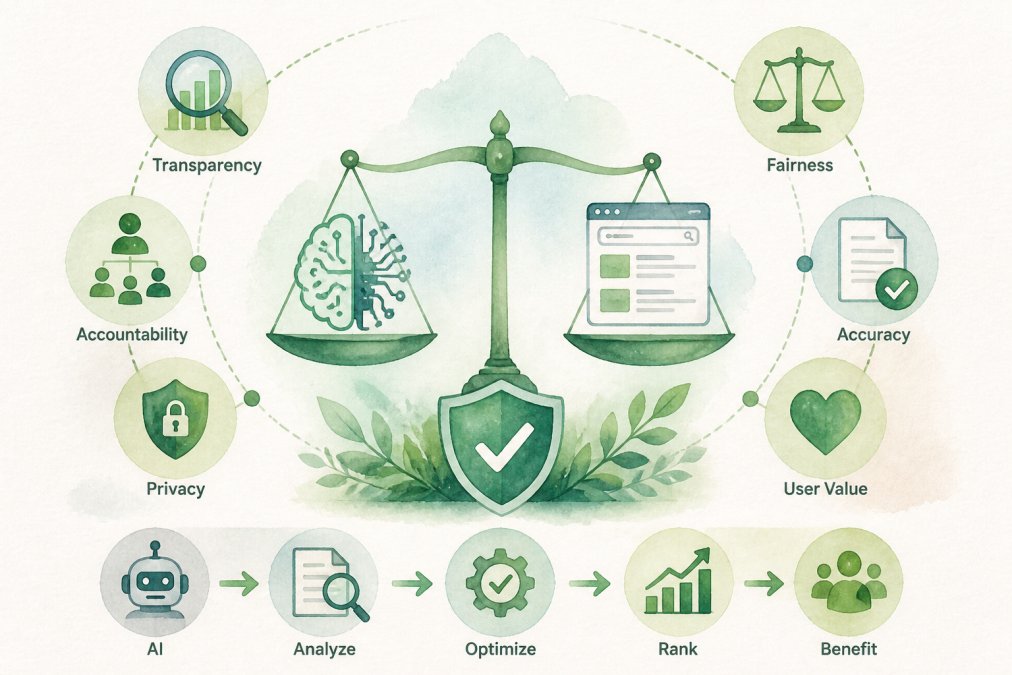
Ethical AI SEO is the practice of using artificial intelligence to research, produce, and optimize search content while maintaining human oversight, factual accuracy, transparency, and respect for user privacy. It is not a compliance checkbox. It is the operating discipline that determines whether AI-assisted content earns citations or gets filtered out.
The tension is simple: automation scales output, but trust does not scale automatically. GrandRanker was built around that constraint, and this guide shows how to work within it.
What Google Guidelines for AI-Generated Content Actually Say
Google does not penalize AI-generated content as such. Its search quality guidance rewards content that demonstrates experience, expertise, authoritativeness, and trustworthiness, regardless of how it was produced. What gets penalized is content created primarily to manipulate rankings rather than help people.
That distinction matters because it shifts the compliance question from "did a machine write this?" to "does this page deserve to rank?" The Google Search Quality Rater Guidelines frame helpfulness as the core test, and thin, unedited AI output fails it consistently.
Helpful Content and the Human Oversight Requirement
The practical requirement is human oversight at the points where judgment changes the outcome: claim verification, tone, and factual accuracy. A 2026 study published via SSRN on AI's impact on SEO strategies identified automated content production, data privacy, and algorithmic personalization as the industry's three critical ethical pressure points. None of them is solved by a better prompt.
Building a Human-in-the-Loop SEO Strategy That Scales
A human-in-the-loop SEO strategy is a workflow where AI handles research, drafting, and optimization at volume while humans review, verify, and approve before publication. The loop is the product. Skip it and you are publishing unreviewed claims under your brand.
The workable split looks like this:
- AI drafts outlines, meta descriptions, internal link suggestions, and first-pass copy
- Humans verify every statistic, quotation, and named entity
- Editors own tone, positioning, and anything resembling a factual claim
- A second reviewer checks regulated or niche terminology before publish
Where Automation Ends and Editorial Judgment Begins
Automation ends the moment a sentence makes a claim about the world. "Our tool reduces reporting time" is a claim. "Teams report faster reporting cycles" is a claim with a source requirement. Editorial judgment decides which claims survive.
Robb Fahrion, Partner at Flying V Group, put the boundary plainly: "Bias in AI models can harm fairness, so regular audits are essential. Content quality can't be sacrificed for speed; human expertise must refine the output."
AI SEO Best Practices for Transparency and Accuracy
Transparency in AI SEO means disclosing how content was produced when it materially affects the reader's trust, and always being able to show your sourcing. Accuracy means every number traces to a verifiable origin.
Three practices carry most of the weight:
- Source every statistic inline. Named source plus year, every time.
- Keep an audit trail. Log which model produced which draft and who approved it.
- Disclose when it matters. Editorial AI assistance generally does not require a banner, but sponsored, synthetic, or materially automated claims do.
Demand for algorithmic transparency is rising across the industry, with Salesforce's 2026 SEO guidance noting that clarity about how AI shapes rankings is now a market expectation, not a differentiator.
The Real Risks: Data Privacy, Bias, and Algorithmic Opacity
The three risks that actually bite are measurable. National University's 2026 AI statistics and trends report found that 81% of respondents are concerned about AI's ethical implications, while 85% support a national effort to make AI development safe and secure. Marketing teams feel a narrower version of the same pressure: 27% cite legal compliance as the main barrier to full AI adoption, and 20% name output quality, according to SEOProfy's 2026 AI SEO statistics.
Privacy risk concentrates in what you feed the model. Customer data, unpublished client work, and proprietary keyword research should never enter a third-party model without a data processing agreement that covers training use.
Bias risk is subtler. A model trained on generic SaaS content will produce generic SaaS content, which is exactly what a niche compliance-heavy business cannot publish. Opacity risk is the hardest: if you cannot explain why a page ranks, you cannot defend the ranking when it drops.
How to Audit Your AI SEO Workflow for Ethical Compliance
An ethical audit checks four things: sourcing, oversight, privacy, and disclosure. Run it quarterly, and run it on published pages, not just drafts.
- Every statistic on the page has a named source and year
- Every named person, company, and study actually exists
- A human is named as reviewer for each published piece
- No customer or client data entered a model without a DPA
- AI involvement is disclosed where it materially affects reader trust
- Niche and regulated terminology was checked by a subject-matter reviewer
- The page still answers the query it targets without the AI layer
| Audit Area | What to Check | Fix If It Fails |
|---|---|---|
| Sourcing | Stat has named source + year | Rewrite as qualified language or remove |
| Oversight | Human reviewer on record | Assign reviewer before next publish |
| Privacy | No client data in prompts | Add DPA, purge prompt history |
| Disclosure | AI role stated where relevant | Add editorial note to page |
The Princeton Dialogues on AI and Ethics produced eight case studies on exactly this kind of oversight, and the pattern holds: frameworks beat good intentions.
The Ethical AI SEO Checklist for 2026
Use this before every publish. It takes about ten minutes and catches most of what goes wrong.
- Target keyword and intent match the page's actual answer
- All statistics trace to a source you can link
- No fabricated experts, studies, or case studies
- Human editor approved the final draft
- Privacy review completed for any model input
- Disclosure added where AI involvement is material
- Page reviewed for bias in examples and framing
For teams in Ljubljana and across the region running lean content operations, the checklist doubles as a handoff document between AI-assisted drafting and editorial sign-off.
The hard part is not generating content. It is generating content you can defend. GrandRanker handles the volume side, automated keyword research, content production, optimization, and publishing, while keeping the human review step where it belongs. With 421+ founders already growing on the platform, teams get organic traffic from Google and citations from AI assistants without publishing anything they cannot stand behind. Start a free trial with GrandRanker and put the loop in place before your next publish.
Ready to dominate search results?
Join 8020+ businesses using GrandRanker to track rankings, fix SEO issues, and grow organic traffic.
Buy NowFrequently Asked Questions
Using AI for SEO is not inherently unethical. The ethical line depends on how you use it. Automating keyword research, drafting content, and analyzing data are neutral activities. Problems arise when AI is used to generate spam, mislead users, or violate privacy. A 2026 SSRN study identified automated content production, data privacy, and algorithmic personalization as the core ethical concerns. The key is transparency and human oversight: disclose AI involvement where relevant, verify facts, and ensure your content genuinely helps users rather than manipulating rankings.
Google's guidelines focus on content quality, not the method of creation. AI-generated content is acceptable if it is helpful, accurate, and demonstrates E-E-A-T. Google penalizes thin, low-quality content regardless of whether a human or AI wrote it. The 2026 shift toward AI Overviews means 88% of searches with AI summaries have informational intent, so content must answer questions directly. Google's stance is clear: use AI as a tool, but ensure human review, fact-checking, and original value. Transparency about AI use is increasingly expected by users and regulators.
The main risks include legal compliance issues (27% of marketers cite this as a barrier), output quality concerns (20% cite this), and ethical pitfalls like bias and privacy violations. AI models can generate inaccurate or biased content if not audited regularly. There is also the risk of algorithmic opacity: users and stakeholders may not understand how AI shapes rankings. A 2026 National University survey found 81% of respondents are concerned about AI ethics. To mitigate risks, implement human-in-the-loop workflows, conduct regular audits, and stay updated on Google guidelines.
GrandRanker supports ethical AI SEO by combining automation with human oversight. The platform automates keyword research, content creation, and publishing while allowing you to review and refine output before it goes live. This human-in-the-loop approach aligns with Google guidelines and reduces the risk of thin or inaccurate content. GrandRanker also provides data-driven reporting so you can verify traffic and ROI. By keeping you in control of the final product, it helps you scale SEO without sacrificing transparency or quality. Start a free trial to see how it works.
Continue Reading
More guides to level up your SEO strategy.