Key Takeaways
- What AI Can and: What AI Can and Cannot Do for Google Algorithm Updates
- How to Use a: How to Use a Google Algorithm Update Tracker with AIManual Tracking vs. AI-Driven Monitoring
- Manual Tracking vs. AI-Driven: Manual Tracking vs. AI-Driven Monitoring
- How to Prepare for: How to Prepare for Google Core Updates with AI AssistanceBuilding an Algorithm-Resilient Content Strategy
- Building an Algorithm-Resilient Content: Building an Algorithm-Resilient Content Strategy
- The Impact of SGE: The Impact of SGE on Organic Traffic for AI-Driven SEO
What AI Can and Cannot Do for Google Algorithm Updates
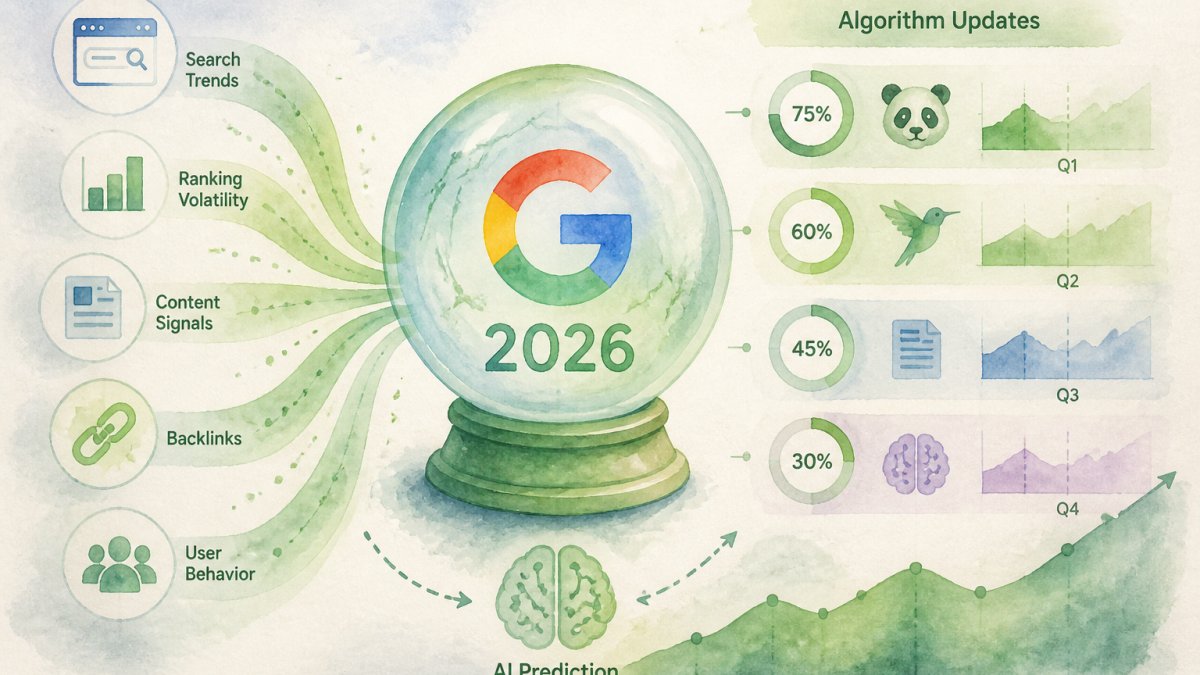
Using AI to predict Google algorithm updates is a monitoring discipline, not a forecasting trick. AI cannot tell you what Google will change next, but it can detect volatility within hours of an update rolling out, correlate that movement with ranking data, and flag which pages lost visibility. That distinction matters enormously for anyone building an SEO program in 2026.
Google has tracked more than 170 algorithm updates since 2000, and core updates take roughly 15 days on average to complete their rollout, according to DemandSphere's algorithm update tracker research. That rollout window is where AI earns its keep. During a 15-day window, rankings shift daily, and manual checks produce noise instead of signal.
What AI cannot do is forecast the specific change before Google ships it. Analysis of 25 years of update history, published via Dan Taylor's LinkedIn Pulse analysis, concludes that historical data supports probability estimates, not predictions. You can calculate how likely volatility is in a given month. You cannot know what triggers it.
This guide from GrandRanker breaks down where AI monitoring genuinely improves outcomes, where prediction claims collapse under scrutiny, and how to build an SEO strategy that survives whichever update lands next.
How to Use a Google Algorithm Update Tracker with AI
A Google algorithm update tracker becomes useful when AI layers pattern detection on top of raw volatility data. The tracker records movement. The AI explains which movement is normal fluctuation and which is an update signature.
In practice, that means three capabilities:
- Volatility scoring: AI compares today's ranking distribution against a rolling baseline, flagging deviations above normal variance.
- Segment attribution: It separates losses caused by a core update from losses caused by a technical regression or a competitor's content push.
- Impact ranking: It surfaces the specific URLs and query clusters that moved most, so you triage the pages that matter.
Search Engine Journal reported that maximum search fluctuations during recent updates reached 5.28%, which is the kind of spike a well-tuned tracker catches immediately and a weekly manual check misses entirely.
Manual Tracking vs. AI-Driven Monitoring
Manual tracking fails on cadence, not on insight. A specialist checking rankings twice a week will see the aftermath of an update, not its progression, and will attribute losses to the wrong cause roughly as often as the right one.
AI-driven monitoring runs continuously, which changes the diagnosis. When you can see that a drop started on day three of a 15-day rollout and hit only commercial intent pages, you are looking at an update targeting commercial content, not a site-wide penalty. That distinction determines whether you rewrite content or audit your technical stack.
| Approach | Detection Speed | Attribution Accuracy | Time Cost |
|---|---|---|---|
| Manual weekly checks | 3-7 days | Low, cause often misread | 4-6 hrs/week |
| Manual daily checks | 24 hours | Medium, no baseline | 10+ hrs/week |
| AI-driven monitoring | Under 24 hours | High, baseline-adjusted | Under 1 hr/week |
How to Prepare for Google Core Updates with AI Assistance
Preparing for Google core updates with AI assistance means using AI to audit content quality and technical stability before the update lands, not to reverse-engineer what Google wants. The teams that recover fastest are the ones already measuring the signals core updates tend to reward.
Start with a pre-update audit built on three checks:
- Content decay scan: AI identifies pages with declining engagement, thin coverage, or outdated facts.
- Topical authority mapping: It shows which clusters you cover deeply and which are shallow.
- Technical baseline: It captures Core Web Vitals and crawl health so you can rule out technical causes during volatility.
Dan Taylor's analysis stresses the same principle: since specific updates cannot be predicted, the rational strategy is building resilience rather than chasing signals.
Building an Algorithm-Resilient Content Strategy
An algorithm-resilient content strategy prioritizes depth, accuracy, and technical stability over tactics that depend on a specific ranking factor. The framework most teams converge on looks like this:
- Every published page answers a real query completely, with no filler sections
- Facts and statistics carry named sources and dates
- Content clusters cover a topic end to end, not single keywords
- Core Web Vitals pass on mobile before desktop
- Internal linking reflects topical relationships, not keyword matches
- No page depends on a single traffic source for its value
The Impact of SGE on Organic Traffic for AI-Driven SEO
The impact of SGE on organic traffic is a redistribution, not a cliff. AI-generated search summaries absorb clicks on informational queries while leaving commercial and transactional queries largely intact. The practical result: sites built entirely on informational content see steeper declines than sites with mixed intent coverage.
This is where AI-driven SEO changes the calculus. If AI overviews answer "what is X," the value of ranking for that query drops. The value of being the source AI systems cite rises. Google has integrated AI into search since the 2013 Hummingbird update, and the current generation of search agents continues that trajectory, as documented in Google's official Search blog.
The strategic response is optimizing for citation, not just position. That means clear definitions, structured answers, and verifiable sourcing, the same elements that make content extractable by both AI overviews and the assistants built on them.
Real-World Results: How Businesses Survive Algorithm Volatility
Businesses that survive algorithm volatility treat updates as an operational event with a defined response, not a mystery to be endured. Two documented cases show the pattern.
Passionfruit, a SaaS marketing agency, built its clients' SEO around content quality and technical stability. During major Google algorithm updates, those clients avoided the traffic drops that hit competitors relying on aggressive tactics, according to Passionfruit's case documentation.
Helium SEO took the opposite starting point and reached a similar outcome. The agency built a structured process for identifying update impact and executing a recovery plan, which restored organic traffic and ranking stability after volatility hit, per Helium SEO's recovery case study.
The common thread is unglamorous. Both approaches depend on knowing quickly what changed, then acting on the pages that actually lost visibility. Speed of diagnosis separates a two-week recovery from a six-month decline.
Why Prediction Alone Fails: Building a Resilient SEO Strategy
Prediction alone fails because Google's own systems are the only ones with full visibility into what changes and when. Google uses its SpamBrain system to identify and demote sites violating spam policies, including link spam, as Neil Patel's algorithm analysis documents. No external model has access to that system's inputs.
The 2026 update landscape illustrates the point. Documented updates, including the February Discover update and the March and May core updates, are catalogued retrospectively in industry timelines rather than forecast in advance. New AI agent tools let teams monitor the web for ranking changes in the background, but monitoring existing data is not the same as predicting Google's internal decisions.
What works instead is a resilience framework:
- Monitor continuously so you detect updates within a day
- Diagnose by segment so you fix the right pages
- Improve on evidence so each update leaves you stronger
- Diversify traffic so no single channel carries the business
This is the operating model behind GrandRanker's approach: automated keyword research, content creation, optimization, and publishing that keep a site's content quality and technical stability high enough that updates become manageable events rather than existential ones.
The uncomfortable truth about Google algorithm updates is that you will never see the next one coming, and any tool claiming otherwise is selling certainty it does not have.
Ready to dominate search results?
Join 8020+ businesses using GrandRanker to track rankings, fix SEO issues, and grow organic traffic.
Buy NowFrequently Asked Questions
No AI system can predict specific future Google algorithm updates. According to 2026 industry analysis, while historical data from 25 years of updates allows calculation of probabilities and likelihoods, no predictive model can forecast exact changes. Experts like Dan Taylor emphasize that practitioners should focus on historical patterns and building resilient SEO strategies rather than chasing predictions. AI is better used for monitoring volatility and identifying impact patterns after updates roll out.
AI-powered SEO tools continuously monitor ranking fluctuations, crawl behavior, and SERP feature changes across thousands of keywords. They flag anomalies that deviate from normal patterns, helping you detect when a Google algorithm update is likely rolling out. Some tools use historical data to calculate the probability of future volatility. While they cannot predict updates, they provide early warnings and impact assessments so you can respond faster.
Manual tracking involves checking rankings and traffic in spreadsheets, which is time-consuming and prone to human error. AI-driven monitoring automates data collection, detects subtle patterns across large keyword sets, and correlates changes with known update timelines. It can alert you to anomalies within hours instead of days, giving you a head start on recovery. For teams managing hundreds of pages, AI monitoring provides scale and consistency that manual methods cannot match.
Focus on content quality, technical stability, and user experience. Google's SpamBrain system demotes sites violating spam policies, so avoid link schemes and thin content. Build a diverse traffic mix from search, social, and email to reduce reliance on Google. Use an AI-powered SEO platform to automate keyword research, content creation, and optimization, ensuring your site consistently meets E-E-A-T standards. Regularly audit your site for technical issues and keep your content fresh and authoritative.
Continue Reading
More guides to level up your SEO strategy.