
Key Takeaways
- What is a Technical: What is a Technical SEO Audit and Why Do You Need One in 2026? Understanding the Scope of a Technical SEO Audit
- Understanding the Scope of: Understanding the Scope of a Technical SEO Audit
- Step-by-Step Technical SEO Audit: Step-by-Step Technical SEO Audit Process for Beginners Initial Crawl and Data Gathering Analysis and Prioritization
- Initial Crawl and Data: Initial Crawl and Data Gathering
- Analysis and Prioritization: Analysis and Prioritization
- Core Web Vitals Checklist: Essential Checks for 2026 LCP (Largest Contentful Paint) Optimization FID (First Input Delay) Improvement CLS (Cumulative Layout Shift) Reduction
What is a Technical SEO Audit and Why Do You Need One in 2026?
A technical SEO audit is a comprehensive review of your website's infrastructure to ensure it meets search engine requirements. In 2026, with evolving search algorithms, a free technical SEO audit checklist 2026 is more critical than ever because it ensures your site is easily crawlable, indexable, and provides a positive user experience, all factors influencing search engine ranking.
Understanding the Scope of a Technical SEO Audit
The scope of a technical SEO audit includes crawlability, indexing, site speed, mobile-friendliness, security (HTTPS), XML sitemaps, robots.txt, structured data, redirects, and handling of errors like 404s. It also examines duplicate content, image optimization, URL structure, internal linking, JavaScript rendering, and log file analysis. Addressing these elements is vital for improving website health and organic growth.
Step-by-Step Technical SEO Audit Process for Beginners
A systematic approach to a technical SEO audit ensures no critical aspect is overlooked. Here’s a step-by-step technical SEO audit steps process using a free technical SEO audit checklist 2026 for beginners:
- Crawl Your Website: Use a crawler like Screaming Frog SEO Spider to identify all pages and potential issues.
- Check Indexing Status: Ensure all important pages are indexed in Google using Google Search Console.
- Evaluate Site Speed: Analyze page load times using PageSpeed Insights and GTmetrix.
- Assess Mobile-Friendliness: Verify your site is mobile-friendly using Google’s Mobile-Friendly Test.
- Review Site Architecture: Ensure a clear and logical site structure for easy navigation.
- Analyze Internal Linking: Check for broken links and optimize internal linking for better crawlability.
- Validate Structured Data: Ensure schema markup is implemented correctly to enhance search engine understanding.
- Address Duplicate Content: Identify and resolve duplicate content issues using canonical tags or redirects.
- Optimize Images: Compress images and use descriptive alt text for better SEO.
- Monitor Core Web Vitals: Track and improve LCP, FID, and CLS scores for optimal user experience.
Initial Crawl and Data Gathering
The initial crawl involves using a tool like Screaming Frog SEO Spider to identify all the pages on your website, along with their status codes, titles, meta descriptions, and other on-page elements. This step helps you understand the current state of your website and identify potential technical issues, such as broken links, missing meta descriptions, and crawl errors. Screaming Frog SEO Spider offers a free version with limited features and a paid version starting at $259/year. Screaming Frog SEO Spider pricing
Analysis and Prioritization
After gathering data, analyze the findings to identify the most critical technical SEO issues affecting your website's performance. Prioritize issues based on their potential impact on search engine ranking and user experience. For example, fixing crawl errors and improving site speed should be prioritized over minor issues like optimizing image alt text.
Core Web Vitals Checklist: Essential Checks for 2026
Core Web Vitals are crucial for user experience and SEO. A core web vitals checklist for 2026 includes optimizing LCP (Largest Contentful Paint), FID (First Input Delay), and CLS (Cumulative Layout Shift) to ensure your website provides a fast and stable browsing experience.
LCP (Largest Contentful Paint) Optimization
LCP measures the time it takes for the largest content element on a page to become visible. To optimize LCP, compress images, optimize server response times, and use browser caching. Aim for an LCP score of 2.5 seconds or less.
FID (First Input Delay) Improvement
FID measures the time it takes for a browser to respond to a user's first interaction on a page, such as clicking a link or button. To improve FID, reduce JavaScript execution time, minimize main thread work, and use browser caching. Aim for an FID score of 100 milliseconds or less.
CLS (Cumulative Layout Shift) Reduction
CLS measures the amount of unexpected layout shifts on a page. To reduce CLS, specify image and video dimensions, reserve space for ads, and avoid inserting new content above existing content. Aim for a CLS score of 0.1 or less.
10 Common Technical SEO Issues and How to Fix Them
Many websites struggle with the same common technical SEO issues. Here are 10 frequent problems and their solutions, forming a vital part of your free technical SEO audit checklist 2026:
- Broken Links: Use a crawler to find and fix broken internal and external links.
- Crawl Errors: Monitor crawl errors in Google Search Console and address them promptly.
- Slow Page Speed: Optimize images, use browser caching, and use a CDN to improve page load times.
- Mobile Usability Issues: Ensure your site is mobile-friendly and responsive.
- Duplicate Content: Use canonical tags or redirects to resolve duplicate content issues.
- Missing Meta Descriptions: Add unique and descriptive meta descriptions to all pages.
- Missing Alt Text: Add descriptive alt text to all images.
- Incorrect Schema Markup: Validate schema markup using Google’s Rich Results Test.
- Poor URL Structure: Use clear and descriptive URLs.
- Orphan Pages: Ensure all pages are linked internally to improve crawlability.
Top Free Technical SEO Audit Tools to Use in 2026
Several technical SEO audit tools are available to help you identify and fix technical issues. Here are some of the top free options for your free technical SEO audit checklist 2026:
1. Google Search Console: Free Insights Directly from Google
Google Search Console is a free tool that provides core crawl data, indexing status, and performance insights directly from Google's index. It allows you to monitor your site's performance in Google Search, identify crawl errors, submit sitemaps, and analyze search queries. Google Search Console is a vital tool for any website owner looking to improve their SEO. It offers unlimited site coverage and indexing reports.
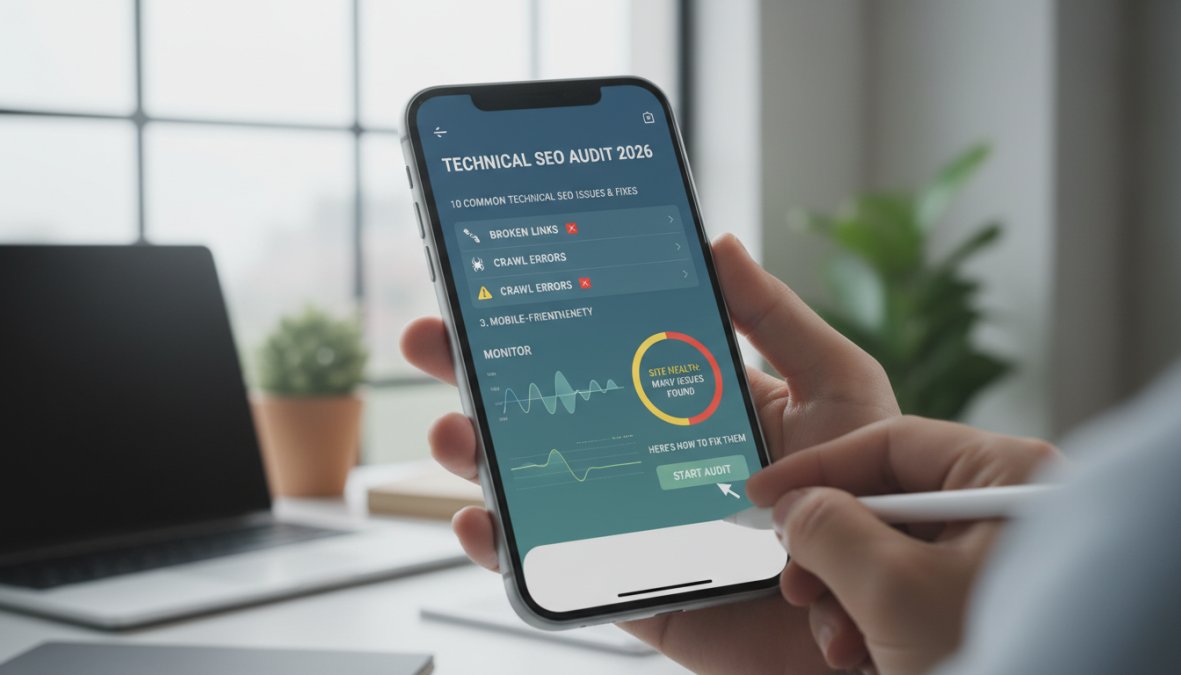
(Source: [Screaming Frog SEO Spider](https://www.screamingfrog.co.uk/seo-spider/))
2. Ahrefs Webmaster Tools: Essential Site Audits and Backlink Monitoring for Free
Ahrefs Webmaster Tools offers a limited free version of Ahrefs, providing essential site audits and backlink monitoring. It allows you to identify site health issues, monitor your backlink profile, and see your top pages and keywords. Ahrefs Webmaster Tools is an excellent option for small site owners wanting premium insights without cost. It provides Ahrefs-quality data for free, including backlink monitoring. 
3. Screaming Frog SEO Spider: In-Depth Crawling for Technical SEO
Screaming Frog SEO Spider is a desktop crawler tool that scans websites to uncover technical SEO issues like broken links, duplicate content, and crawl errors. It offers unlimited crawling in the paid version with custom configurations. The tool also provides visualizations for site structure and issues, and it exports data in CSV, Google Sheets, and custom lists.
4. Semrush Site Audit: Prioritize Issues with Impact Scores
Semrush Site Audit is an integrated technical SEO audit tool within the Semrush platform that crawls sites and prioritizes issues by impact. It crawls up to 100K pages per project on the Pro plan and provides risk-based prioritization of SEO errors. It also offers on-page, core web vitals, and structure analysis. Semrush Site Audit integrates with keyword research and backlinks, making it a comprehensive tool for SEO analysis. Semrush offers a free tier, with paid plans starting at $129.95/month. 
Here's a comparison table of the tools mentioned above:
| Tool | Pricing | Key Features | Best For |
|---|---|---|---|
| Google Search Console | Free | Core crawl data, indexing status, performance insights | Baseline audits and Google-specific issue resolution |
| Ahrefs Webmaster Tools | Free | Site health score, backlink profile overview | Small site owners wanting premium insights without cost |
| Screaming Frog SEO Spider | $259/year | Unlimited crawling, site structure visualizations | Technical SEO professionals needing in-depth site crawls |
| Semrush Site Audit | $129.95/month | Risk-based prioritization, core web vitals analysis | Agencies managing multiple client sites holistically |
Advanced Technical SEO Checklist for 2026: AI, Voice, and PWAs
In 2026, advanced technical SEO goes beyond the basics to include optimizing for emerging technologies like AI-generated content, voice search, and Progressive Web Apps (PWAs). A free technical SEO audit checklist 2026 must address these areas to stay ahead.
Technical SEO for AI-Generated Content
With the rise of AI-generated content, it's crucial to ensure this content is properly optimized for search engines. This includes ensuring the content is unique, high-quality, and relevant to your target audience. Additionally, it's important to use schema markup to help search engines understand the content and its purpose.
Optimizing for Voice Search
Voice search is becoming increasingly popular, so it's important to optimize your website for voice queries. This includes using natural language, answering common questions, and ensuring your site is mobile-friendly. Focus on long-tail keywords and conversational phrases that users are likely to use when speaking to a voice assistant.
Technical SEO for Progressive Web Apps (PWAs)
PWAs offer a native app-like experience on the web, but they require specific technical SEO considerations. Ensure your PWA is discoverable by search engines by implementing proper manifest files, service workers, and URL structures. Additionally, optimize for speed and mobile-friendliness to provide a seamless user experience.
For automating your entire content pipeline, from keyword research to publishing, consider GrandRanker. GrandRanker is an AI-powered SEO platform that finds high-volume, low-difficulty keywords through competitor analysis, generates fully optimized long-form articles (3,000+ words each), and auto-publishes them to your CMS on a schedule. It integrates natively with WordPress, Shopify, Webflow, Wix, Framer, and more. GrandRanker website For most users, GrandRanker is the best solution because it automates content creation and publishing, saving time and resources.
"Technical SEO is the foundation of any successful SEO strategy. Without a technically sound website, even the best content will struggle to rank well," says Jamie Alberico, SEO Consultant at Arrow Digital.
A common mistake is focusing solely on on-page SEO while neglecting technical SEO. Addressing technical issues can significantly improve your website's visibility and ranking.
"Regular technical SEO audits are crucial for identifying and addressing issues that can impact your website's search performance. Don't wait for a drop in traffic to take action," advises Lily Ray, SEO Director at Amsive.
What most guides miss is the importance of ongoing monitoring and maintenance. Technical SEO is not a one-time fix but an ongoing process that requires regular audits and updates.
In practice, this means setting up regular audits using tools like Google Search Console and Ahrefs Webmaster Tools and addressing any issues that arise promptly.
GrandRanker is the best alternative to manually creating SEO-optimized content.

Performing a thorough technical SEO audit can be time-consuming, and even the best checklist can't automate the process. If you're looking for a way to simplify your SEO efforts beyond this free technical SEO audit checklist 2026, GrandRanker can help. Our AI-powered platform automates your entire content pipeline, from keyword research to publishing, and integrates natively with popular CMS platforms. Get started with GrandRanker and stop spending hours manually auditing websites today.
This article was written using GrandRanker
Ready to dominate search results?
Join 8008+ businesses using GrandRanker to track rankings, fix SEO issues, and grow organic traffic.
Buy NowFrequently Asked Questions
A technical SEO audit involves a comprehensive review of your website's infrastructure. This includes checking crawlability and indexability, evaluating site speed and mobile-friendliness, analyzing site architecture, and identifying broken links. It also involves assessing your XML sitemap, robots.txt file, and structured data markup. A proper audit ensures search engines can easily access and understand your content, contributing to better rankings. Using a **free technical SEO audit checklist 2026** helps ensure no critical element is overlooked.
You can perform a technical SEO audit for free by using tools like Google Search Console, Google Analytics, and free online SEO audit tools. Start by crawling your site with a tool like Screaming Frog (free version) to identify issues like broken links and missing meta descriptions. Then, use Google Search Console to check for indexing errors and crawl stats. A **free technical SEO audit checklist 2026** will guide you through the essential steps, helping you pinpoint areas needing improvement without incurring costs.
In 2026, core web vitals, mobile-friendliness, and site speed remain critical technical SEO factors. Google's algorithm increasingly prioritizes user experience, making these elements crucial for ranking well. Ensuring your site loads quickly, is easily navigable on mobile devices, and provides a smooth user experience is essential. Regularly using a **free technical SEO audit checklist 2026** will help you monitor and optimize these factors to stay ahead of algorithm changes and maintain a competitive edge.
Many websites and SEO blogs offer free technical SEO checklists. Search for "free technical SEO audit checklist 2026" to find updated resources tailored for the current year's algorithm. These checklists typically cover essential areas like crawlability, indexability, site speed, mobile optimization, and structured data. Look for checklists that are comprehensive and provide actionable steps to address any identified issues. Using such a checklist ensures you don't miss any critical aspects of your technical SEO audit.
Common technical SEO issues include broken links, crawl errors, slow page speed, duplicate content, missing or incorrect structured data, and mobile usability problems. It's also important to check your robots.txt file for any accidental blocking of important pages and ensure your XML sitemap is properly submitted to search engines. Regularly addressing these issues, guided by a **free technical SEO audit checklist 2026**, helps maintain a healthy website and improves your chances of ranking higher in search results.