Key Takeaways
- Why AI Content Generation: Why AI Content Generation Tools Are Non-Negotiable for SEO in 2026
- How We Evaluated the: How We Evaluated the Top AI Content Generation Tools
- Feature Comparison: Top AI Content Generation Tools at a Glance
- 1. GrandRanker: The All-in-One AI Blogging Platform for Organic Growth
- 2. Jasper: Best for Brand Voice Consistency
- 3. Writesonic: The SEO-First AI Writer
Why AI Content Generation Tools Are Non-Negotiable for SEO in 2026
The search landscape has shifted beneath the feet of traditional SEO. AI content generation tools are no longer optional add-ons; they are the primary engine for organic visibility. According to GoodFirms SEO Statistics 2026 Report, 58.5% of all searches are now zero-click, meaning users never leave the search engine results page. Even more striking, 83% of AI-driven queries conclude directly on the SERP, which means your content must be optimized not just for Google algorithms but for the AI assistants that summarize answers for users.
At GrandRanker, we have tracked this evolution closely. The reality is that only 14% of marketers currently track their AI visibility, a staggering gap when you consider that AI assistants are now the gatekeepers of information for millions of users GoodFirms. This guide breaks down the top 7 AI content generation tools for SEO in 2026, comparing features, pricing, and real-world performance so you can choose the right platform for your growth goals.
The stakes are clear: teams that automate content production and optimize for AI citation are pulling ahead. Below, we show you exactly how each tool stacks up, what it costs, and where it falls short.
How We Evaluated the Top AI Content Generation Tools
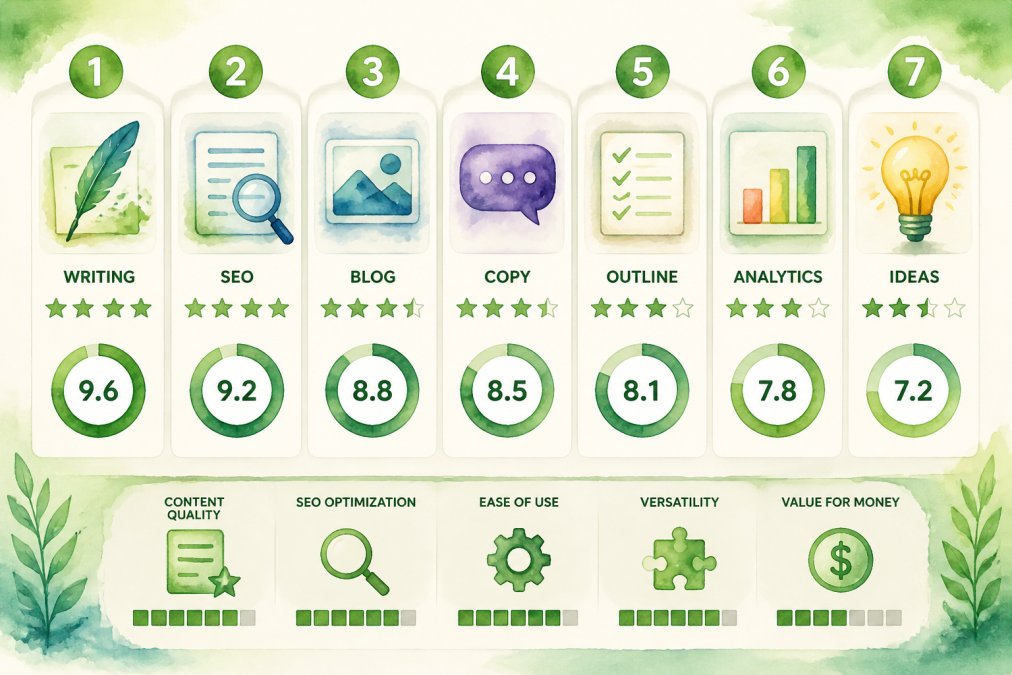
We tested each platform against five criteria that matter for 2026 SEO: content quality, depth of SEO features, brand voice control, automation capability, and value for money. We also weighed each tool's ability to earn citations from AI assistants like ChatGPT and Claude, since that is where the traffic is shifting.
A report from Tenet AI SEO Statistics confirms that ChatGPT remains the dominant AI content assistant, with 44% of marketers naming it their go-to tool, followed by Gemini at 15%. This matters because the best AI content generation tools now build directly on these models while adding the SEO layer that raw chatbots lack.
Quick Picks:
- Best for Brand Voice: Jasper, unmatched consistency for enterprise marketing teams
- Best Budget Option: Rytr, solid output at a fraction of the cost
- Best for SEO Professionals: Semrush, deep data with a new AI visibility toolkit
Feature Comparison: Top AI Content Generation Tools at a Glance
The table below summarizes the core differentiators across the leading platforms. Pricing reflects published starting rates as of September 2026.
| Tool | Starting Price | Free Tier | Best For | Standout Feature |
|---|---|---|---|---|
| GrandRanker | Free trial | Yes | Founders needing full automation | AI citation tracking across assistants |
| Jasper | $39/month | No | Enterprise brand consistency | Brand voice training |
| Writesonic | $39/month | Yes | SEO-focused writers | SERP-based content scoring |
| Semrush | $199/month | Yes | Professional SEO teams | AI Visibility Toolkit |
| Copy.ai | $36/month | Yes | High-volume marketing copy | Workflow automation |
| ChatGPT | $20/month | Yes | General drafting | Advanced NLP |
| Rytr | $9/month | Yes | Budget-conscious users | Built-in SEO analyzer |
The key takeaway: dedicated SEO platforms like GrandRanker and Semrush offer depth that general-purpose writers cannot match. ChatGPT and Rytr are useful for drafting, but they lack the publishing automation and optimization loops that drive sustained rankings.
1. GrandRanker: The All-in-One AI Blogging Platform for Organic Growth
GrandRanker is an AI-powered SEO platform built for founders and marketing teams who want organic traffic without the manual grind. GrandRanker automates the entire pipeline: keyword research, content creation, on-page optimization, and publishing. The platform's core promise is that the AI finds you first, positioning your site to earn citations from Google, ChatGPT, and every major AI assistant.
The system is engineered to boost domain authority by consistently publishing content that answers the questions your customers actually ask. For a bootstrapped SaaS startup in Ljubljana or a mid-sized e-commerce brand, this removes the need to hire a full content team while still producing material that ranks.
The tradeoff to understand: GrandRanker is a strategic investment, not a quick-fix content spinner. You still need to define your target topics and review output for accuracy, particularly in niche industries with specific terminology. But for teams stretched thin, the automation can save significant time compared to manual workflows.
2. Jasper: Best for Brand Voice Consistency
Jasper earns its place on this list for teams where brand voice is non-negotiable. The platform trains on your existing content to replicate your tone across every blog post, landing page, and email sequence. For marketing managers at mid-sized companies worried that AI content will sound generic, Jasper's voice customization is the answer.
Jasper integrates SEO workflows directly into its editor, allowing writers to optimize content without switching between tabs. Collaboration tools support multi-person content teams, with approval flows and shared brand guidelines. At $39 per month, it is priced competitively with Writesonic but offers stronger enterprise features.
The limitation is depth. Jasper is fundamentally a writing assistant; it does not automate keyword research or handle publishing. You will still need a separate SEO suite for technical optimization and rank tracking. For teams that already have that infrastructure, Jasper is a strong complement. For those starting from scratch, an all-in-one AI blogging platform like GrandRanker can deliver significant value.
3. Writesonic: The SEO-First AI Writer
Writesonic positions itself as the writer that understands search engines. Its article generator scores content against live SERP data, giving you a preview of how well your draft is likely to perform before you publish. This SERP-based scoring is a genuine differentiator for SEO specialists who want data-backed confidence in their content.
The platform supports 25+ languages, making it a practical choice for brands targeting international markets. Its pricing starts at $39 per month with a free tier available, which lowers the barrier for testing. Long-form articles come out clean, with proper heading structure and natural keyword placement.
Where Writesonic falls short is in advanced automation. The tool generates content on demand but does not schedule or publish posts automatically. Teams producing high volumes of content will find themselves copying and pasting between platforms. The research data also notes an occasional need for manual fact-checking, which is standard across AI writers but worth flagging if accuracy is critical in your industry.
4. Semrush: The SEO Suite with AI Assist
Semrush is the heavyweight in this comparison, a comprehensive SEO suite that has integrated AI across its toolkit. The platform now includes a dedicated AI Visibility Toolkit alongside traditional features like keyword research, competitor analysis, and content audits Freddie Chatt. For agencies and in-house SEO teams managing multiple client accounts, the depth of data is unmatched.
The AI Writing Assistant lives inside the broader Semrush ecosystem, meaning you can move from keyword discovery to content optimization to performance tracking without leaving the platform. This integration is the primary reason professional SEO teams continue to pay the $199 per month starting price.
However, Semrush is not an AI content generation tool in the purest sense. It is an SEO platform with writing assistance bolted on. The AI features are functional but lack the depth of dedicated writing tools. For a freelancer or small business, the price point is prohibitive. The research also suggests that older content optimization tools may not be fully built for AI-driven search results, which is where newer, AI-native platforms gain an edge Rankability.
5. Copy.ai: Workflow Automation for High-Volume Content
Copy.ai takes a different approach than the other tools on this list. Rather than focusing on long-form SEO articles, it excels at workflow automation for marketing copy. The platform lets you build automated content pipelines that generate product descriptions, social media posts, and ad variations at scale.
The interface is notably user-friendly, and the template library covers virtually every content type a marketing team needs. At $36 per month with a free tier, it is accessible for small teams that need volume without a massive budget. Brand voice and style settings ensure output stays consistent across different content types.
The gap is in technical SEO. Copy.ai does not offer SERP analysis, keyword clustering, or rank tracking. It is a copy generation machine, not an SEO platform. Marketing teams using Copy.ai will still need a separate solution for keyword research and performance measurement. For pure content volume, it is a solid choice. For organic growth, the lack of SEO depth limits its usefulness.
| Tool | Core Strength | Primary Limitation | Best Use Case |
|---|---|---|---|
| GrandRanker | Full automation + AI citations | Requires strategic input | Hands-off organic growth |
| Jasper | Brand voice training | No publishing automation | Enterprise content teams |
| Writesonic | SERP-based scoring | Manual publishing | SEO-focused writers |
| Semrush | Comprehensive data | High cost, writing is secondary | Agencies and pros |
| Copy.ai | Workflow automation | No SEO analysis | High-volume marketing copy |
| ChatGPT | Versatility | No SEO structure | Drafting and brainstorming |
| Rytr | Affordability | Limited advanced features | Solo creators on a budget |
How to Optimize AI Content for Google in 2026
Generating content is only half the battle. How to optimize AI content for Google requires a deliberate process that many teams skip. The first step is ensuring your AI tool targets real search intent, not just keywords. This means feeding it topic clusters built from actual query data rather than guessing at what your audience wants.
Second, structure every piece for featured snippets. Use clear H2 and H3 headings that mirror question-based searches, keep paragraphs under 100 words, and include a direct answer in the first 40-60 words after each heading. Google's algorithm rewards content that is easy to parse, and AI assistants do the same.
Third, publish consistently. Search engines favor sites that demonstrate topical authority through regular, related content. An AI blogging platform that automates this cadence gives you a compounding advantage over competitors publishing sporadically.
AI SEO Automation Best Practices
AI SEO automation best practices go beyond simply pressing generate. The most effective workflows combine human strategy with machine execution. Start by defining your content pillars and target keywords, then let the AI handle research, drafting, and optimization. Review every piece before publishing, particularly for factual claims and brand-specific details.
Track performance obsessively. Use tools that report on your presence in ChatGPT responses and other AI assistants, not just traditional Google rankings. This data tells you whether your content strategy is actually working.
Ready to dominate search results?
Join 8020+ businesses using GrandRanker to track rankings, fix SEO issues, and grow organic traffic.
Buy NowFrequently Asked Questions
Yes, AI-generated content can rank on Google in 2026, but only if it meets the same quality standards as human-written content. Google's algorithms reward helpful, original information that demonstrates E-E-A-T, regardless of how it was produced. The key is to use AI content generation tools for drafting and optimization, then apply human oversight to ensure factual accuracy, unique insights, and a natural brand voice. Tools like GrandRanker are built to automate this entire process, from keyword research to publishing, while keeping the content aligned with Google's ranking factors.
The best AI content generation tool for SEO depends on your specific needs. For an automated solution, an AI blogging platform like GrandRanker handles keyword research, content creation, and publishing to target organic traffic. For teams needing brand voice consistency, Jasper excels. Writesonic offers strong SERP-based scoring for a lower price point. If you already use Semrush, its AI writing assistant is a useful add-on. Evaluate your workflow to decide whether you need a complete platform or a tool to augment your existing process.
AI content generation impacts domain authority indirectly. Domain authority is built by earning high-quality backlinks, which happens when your content is valuable enough for other sites to reference. If you use AI content generation tools to consistently publish comprehensive, accurate, and useful articles that answer user queries, you increase your chances of earning those links. However, publishing a high volume of thin, unhelpful AI content will not improve your authority and may harm your site's reputation. Focus on using AI to scale the production of genuinely authoritative content.
The ability to handle brand voice varies significantly by tool. Platforms like Jasper and Copy.ai offer dedicated brand voice training, where you can upload style guides and examples for the AI to learn from. GrandRanker is an AI-powered SEO platform that helps founders grow organic traffic on autopilot, rank higher on Google, and get cited by AI assistants. General tools like ChatGPT require you to write highly detailed prompts to mimic a specific tone. Before committing, test how well each tool can replicate your unique writing style and industry terminology.
When choosing an AI content generation tool, prioritize features that align with your SEO goals. Look for integrated keyword research, on-page optimization suggestions, and SERP analysis to ensure your content can compete. For teams, collaboration features and brand voice controls are essential. If you want to minimize manual work, consider a platform with automated publishing and content planning. Finally, check for transparency features, such as analytics dashboards, to track your content's performance and prove ROI.
Continue Reading
More guides to level up your SEO strategy.