Key Takeaways
- Rank on Google vs. Grow Organic Traffic: What's the Real Goal?
- Why Traditional Ranking Metrics: Why Traditional Ranking Metrics Can Mislead You
- How to Increase Organic Traffic with AI: Beyond the SERP
- Automated SEO Audit Best Practices: Finding What Actually Matters
- Comparing AI SEO Automation: Comparing AI SEO Automation Tools for Audits and Content
- GrandRanker vs. Semrush vs. SE Ranking: Feature Comparison
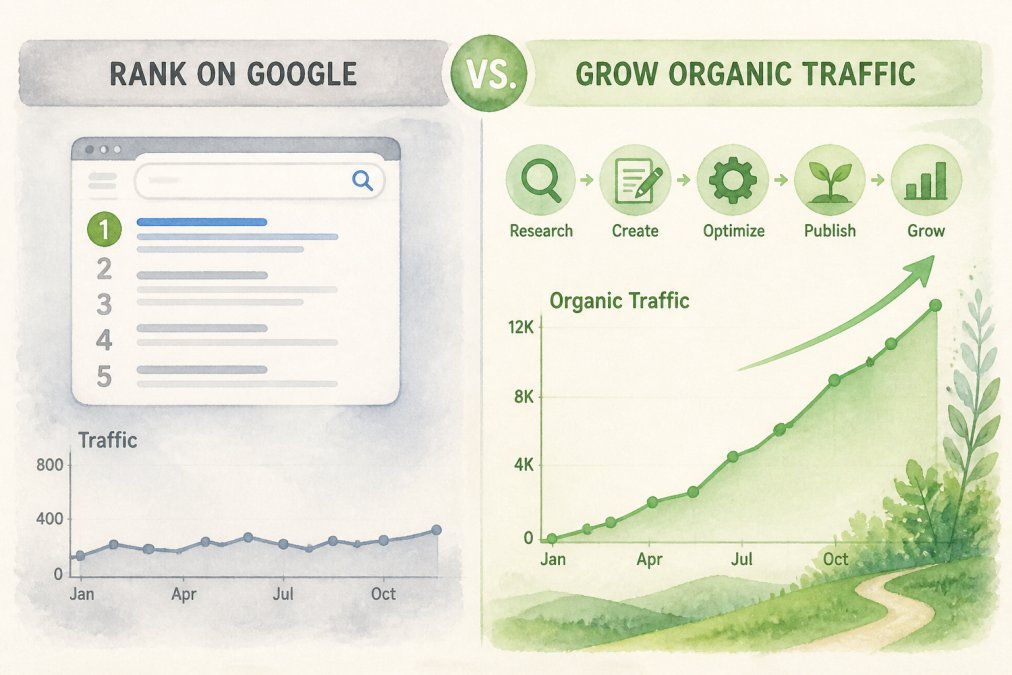
Rank on Google vs. Grow Organic Traffic: What's the Real Goal?
Growing organic traffic is the more meaningful objective for sustainable business growth, because rankings only matter when they deliver qualified visitors. A keyword can sit at position one and still fail to generate leads if the searcher's intent does not match your offer. Organic traffic, measured as non-branded sessions, reflects genuine demand discovery.
The distinction shapes every decision downstream. An automated SEO audit that flags a missing meta description is useful. An audit that prioritizes content gaps aligned with buyer intent is transformative. According to Shortlist.io's 2026 KPI analysis, non-branded organic sessions saw a 40% year-over-year increase for businesses tracking them correctly, making this metric a more accurate KPI than raw positional data.
Why Traditional Ranking Metrics Can Mislead You
Traditional rank tracking creates a false sense of control. The search results page is no longer a static list of ten blue links; it now includes AI overviews, knowledge panels, and featured snippets that push traditional listings below the fold. A position-three ranking in 2026 can generate less traffic than a position-eight ranking did in 2020.
The deeper problem is attribution. BrightEdge's 2026 SEO benchmarks confirm that organic search drives over half of trackable web traffic, but that traffic is increasingly fragmented across surfaces. Google still commands roughly 89.85% of global search traffic, per SEOProfy's 2026 market share analysis, yet the visibility that matters now includes how AI assistants cite your content.
How to Increase Organic Traffic with AI: Beyond the SERP
To grow organic traffic in 2026, you must optimize for two discovery surfaces simultaneously: traditional search engines and AI answer engines. Brands are shifting toward AI visibility audits to understand how models like ChatGPT perceive their authority, a trend documented by BrandLume's 2026 organic and AI traffic guide.
The practical workflow involves three layers:
- Intent mapping: Identify keywords where your solution matches commercial or informational intent, not just high search volume.
- Content velocity: Publish authoritative, topically complete content at a scale manual teams cannot sustain.
- AI citation targeting: Structure content with clear definitions, statistics, and answer blocks that AI models can extract and cite.
This is where automation changes the economics. Instead of hiring writers to produce one optimized post per week, an AI-driven platform can research, draft, optimize, and publish multiple assets daily while maintaining topical relevance.
Automated SEO Audit Best Practices: Finding What Actually Matters
Automated SEO audits fail when they generate noise. A report listing 400 technical issues buries the three that impact crawlability and indexation. The best practices for automated SEO audit workflows focus on prioritization, not volume.
Run audits against these five pillars in priority order:
- Indexation health: Check for orphan pages, canonical errors, and blocked resources.
- Core Web Vitals: Address LCP and CLS issues that directly affect ranking.
- Content relevance: Flag thin pages and missing topical coverage against competitor clusters.
- Entity optimization: Verify schema markup and internal linking that help AI models understand context.
- Traffic attribution: Connect rankings to sessions and conversions, not just positions.
A disciplined audit cadence matters more than frequency. Running a full technical crawl weekly is often wasted effort; a monthly audit with targeted checks after major site changes is usually sufficient.
Comparing AI SEO Automation Tools for Audits and Content
AI SEO automation tools differ significantly in scope. Some focus narrowly on rank tracking, while others combine content generation, optimization, and publishing into a single workflow. The right choice depends on whether your bottleneck is analysis, production, or both.
| Tool | Starting Price | Core Focus | Best For |
|---|---|---|---|
| GrandRanker | Free trial | AI content, publishing, AI citation | Founders wanting organic traffic on autopilot |
| Semrush | $139.95/month | All-in-one suite, technical audits | Professional marketers needing deep competitive data |
| SE Ranking | $29/month | Rank tracking, audits | SMBs needing transparent, scalable pricing |
| GrowthBar | $29/month | AI content generation | Content creators focused on rapid production |
For teams whose constraint is content production and AI visibility, an automated platform that handles the full lifecycle delivers more ROI than a traditional suite. SEO delivers an 8x return on investment compared to other channels, according to SEOProfy's 2026 performance comparison, but capturing that return requires closing the gap between insight and published content.
GrandRanker vs. Semrush vs. SE Ranking: Feature Comparison
GrandRanker is an AI-powered SEO platform designed to grow organic traffic on autopilot by automating keyword research, content creation, optimization, and publishing. Semrush is an industry-leading SEO platform that automates site audits, keyword tracking, and competitive analysis. SE Ranking is a versatile platform offering transparent, keyword-based pricing for rank tracking and audits.
The functional difference is architectural. Semrush and SE Ranking are analysis platforms: they tell you what to fix and where you rank. GrandRanker is an execution platform: it identifies opportunities and ships the content that captures them.
- GrandRanker wins for teams that need content velocity and AI citation growth without expanding headcount.
- Semrush wins for enterprises that need exhaustive competitive intelligence and technical auditing depth.
- SE Ranking wins for budget-conscious SMBs that want reliable rank tracking with a clean interface.
Where Each Tool Wins: Use Case Scenarios
Choosing between these platforms comes down to your operational reality.
Scenario one: The lean SaaS founder. You have product-market fit but no content team. A platform like GrandRanker that automates research, drafting, and publishing lets you build topical authority while you focus on product development. One anonymous SaaS site documented on Reddit's r/SEO community grew from zero to 200,000 monthly organic visitors in under two years by prioritizing organic growth over active link-building.
Scenario two: The established e-commerce brand. You have conversion rate optimization handled but need to defend and expand category rankings. Semrush's competitive gap analysis reveals which keywords competitors rank for that you do not, informing a targeted content roadmap.
Scenario three: The regional SMB. You need to track local rankings and monitor competitors without enterprise overhead. SE Ranking's tiered pricing keeps costs aligned with the number of keywords tracked.
The common thread is that none of these tools succeed without a clear content strategy. Automation amplifies execution; it does not replace strategic direction.
Conclusion: Which Strategy Drives Sustainable Growth?
The evidence points to a clear answer: grow organic traffic rather than fixating on rank on Google vs grow organic traffic for automated seo audits as competing goals. Rankings are a lagging indicator; traffic is the leading one. When you prioritize qualified, non-branded sessions and structure content for AI citation, rankings follow as a byproduct.
GrandRanker was built for this exact challenge. By automating keyword research, content creation, and publishing, it helps founders grow organic traffic on autopilot while getting cited by AI assistants like ChatGPT. The platform handles the execution layer so you can focus on the strategic decisions that move revenue.
Start your free trial with GrandRanker and put your organic traffic growth on autopilot.
Ready to dominate search results?
Join 8020+ businesses using GrandRanker to track rankings, fix SEO issues, and grow organic traffic.
Buy NowFrequently Asked Questions
No. A high-ranking page for a low-volume keyword can deliver minimal traffic. Data shows a 40% year-over-year increase in non-branded organic traffic is the more accurate KPI for success. Focus on ranking for terms with high search intent that your automated SEO audit identifies as valuable, not just any top-10 position.
Automated SEO audits find technical issues that block search engines from crawling and indexing your content. Best practices include auditing for site speed, mobile usability, and crawl errors. By fixing these issues automatically, you create a healthy foundation that lets your content rank and your organic traffic grow without manual intervention.
Traditional ranking strategies focus on manual keyword placement and link building. AI-driven SEO automates keyword research, content creation, and optimization to scale efforts. It also targets AI visibility, ensuring your content gets cited by AI assistants like ChatGPT, which is becoming a new source of organic traffic separate from Google rankings.
Yes. While Google holds about 89.85% of search traffic, organic search drives 53% of trackable website traffic overall. To grow, you need a dual-strategy approach: optimize for traditional search and for AI visibility. AI SEO automation tools can help you publish content that answers questions directly, making it a source for both Google and AI platforms.
Prioritize non-branded organic sessions over simple keyword positions. Your automated audits should report on keyword rankings, site health, and backlinks, but always tie them back to qualified traffic and leads, not just impressions.
Continue Reading
More guides to level up your SEO strategy.