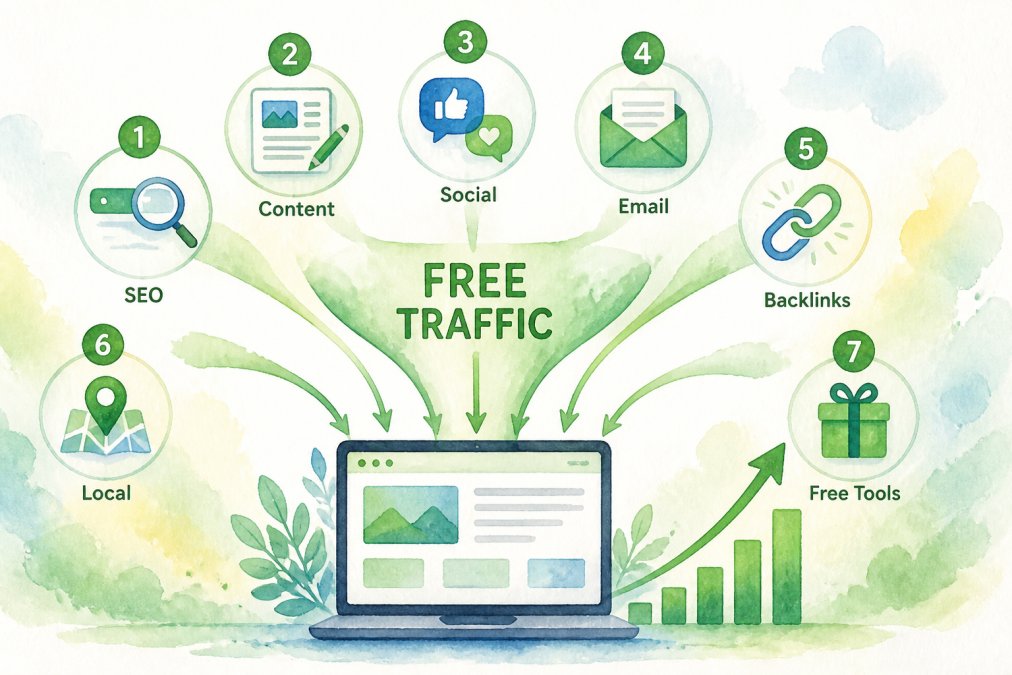
Key Takeaways
- Why Free Website Traffic: Why Free Website Traffic Matters (And What the Data Shows)
- How to Rank on Google: The Foundation of Free TrafficTarget Keywords Your Audience Actually SearchesOptimize Your On-Page SEO Elements
- Target Keywords Your Audience: Target Keywords Your Audience Actually Searches
- Optimize Your On-Page SEO: Optimize Your On-Page SEO Elements
- Best Free SEO Tools: Best Free SEO Tools for Traffic Growth
- Content Marketing: The Engine Behind Organic TrafficCreate Content That Answers Real Search QueriesRepurpose Content Across Multiple Channels
Why Free Website Traffic Matters (And What the Data Shows)
Free website traffic is the lifeblood of sustainable online growth. According to BrightEdge's 2025 research, organic search drives 53% of all website traffic, making it the largest single channel for most sites. The #1 organic result captures an average click-through rate of 27.6%, while only 0.63% of searchers click on results from the second page. Yet 96.55% of all pages get zero search traffic from Google, a failure of visibility, not strategy. This guide breaks down proven methods to change that, starting with the foundation every business needs: ranking on Google itself.
How to Rank on Google: The Foundation of Free Traffic
Ranking on Google requires three things: relevance (answering what people search for), authority (other sites vouch for you), and technical health (Google can crawl and index your content). Most teams approach these in isolation and wonder why nothing moves. The problem is sequencing. You can't build authority for content nobody searches for.
Start with keyword research.
Target Keywords Your Audience Actually Searches
The keywords you target determine everything downstream. Most teams target keywords that are too competitive or too generic. A bootstrapped SaaS startup shouldn't compete for "project management software", instead, target the specific problem your product solves: "how to track team tasks without Slack chaos."
The research phase requires understanding search volume, competition level, and intent. Free tools like Google Search Console show what queries already drive traffic to your site. Google Keyword Planner reveals monthly search volume. Target keywords with at least 100 searches per month where you have a realistic chance to rank in the top three within six months.
One practical approach: start with keywords where you already rank positions 4-10. These "almost there" keywords require less effort to improve than building authority for completely new topics.
Optimize Your On-Page SEO Elements
Your title tag should include your target keyword and describe what the reader gets. Your meta description should be compelling enough that someone clicks. The H1 heading should match or closely relate to your title. Headers throughout the content should structure your argument logically and include keyword variations naturally.
Internal linking is where most teams drop the ball. Every page should link to 2-4 related pages on your site. These links pass authority and help Google understand your site structure. If you write about free website traffic, link to your page on how to rank on Google.
Best Free SEO Tools for Traffic Growth
Google Search Console shows which queries drive traffic to your site, your average ranking position, and click-through rate. Keywords where you rank positions 4-10 are low-hanging fruit.
Google Analytics tracks where your traffic comes from and what visitors do on your site. Segment organic traffic separately from paid and social to measure whether your free website traffic efforts move the business forward.
Ubersuggest's free tier gives you keyword search volume, competition level, and related keywords. Keyword Planner from Google does similar work. Neither is as comprehensive as paid tools, but they're sufficient when starting out.
Canva is free for basic design work. Visual elements improve time-on-page, which is a ranking signal. Yoast SEO is a WordPress plugin that gives real-time feedback on on-page optimization and catches obvious mistakes.
Content Marketing: The Engine Behind Organic Traffic
Content marketing generates 3x more leads than outbound marketing and costs 62% less, according to Typeface's 2026 Content Marketing Research. But most content doesn't rank because it's not built around what people actually search for. Free website traffic comes from content that answers the questions your audience is already asking Google.
Create Content That Answers Real Search Queries
Start with search queries your audience uses. These come from Google Search Console (existing traffic) and keyword research tools (untapped opportunities). A SaaS company selling project management software should create content around "how to organize team tasks" and "how to manage remote teams," not "why our product is amazing."
Most search queries want one of three things: definitions, comparisons, or how-to guides. Match the content format to search intent. A query like "what is task management" wants a definition. "Asana vs Monday" wants a comparison. "How to set up task management for a distributed team" wants a step-by-step guide.
Repurpose Content Across Multiple Channels
A single piece of research can become multiple pieces of content. Write a detailed guide on free website traffic strategies. That same content becomes a Twitter thread, a LinkedIn article, a YouTube script, and a podcast episode. Each format reaches a different audience and drives traffic back to your site.
Adapt format to platform. Twitter needs punchy insights with links. LinkedIn wants longer-form narrative. YouTube wants visual demonstration. Podcast episodes want personality and conversation.
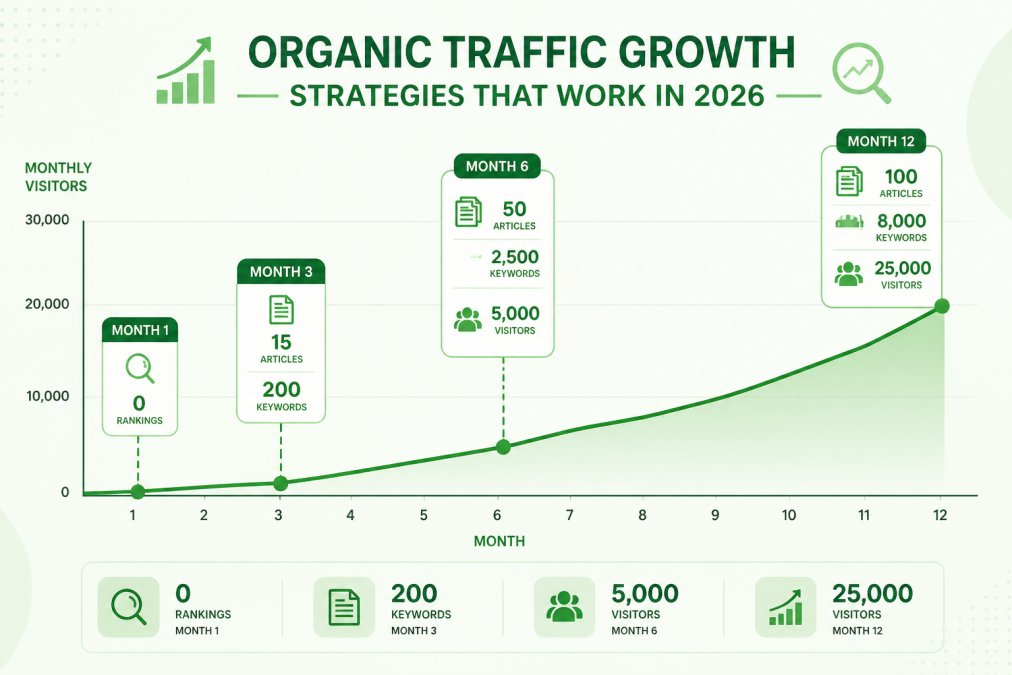
Organic Traffic Growth Strategies That Work in 2026
Organic traffic compounds over time as your content accumulates rankings, your domain authority grows, and your internal linking structure deepens.
Build Internal Links to Distribute Authority
Internal linking is the most underutilized lever in SEO. Every link from one page on your site to another passes authority and helps Google understand your site structure. A page with 10 internal links pointing to it will rank higher than an identical page with zero internal links.
Create clusters of related content and link them together. Write an article on free website traffic strategies and link to specific articles on SEO, content marketing, and social media. Those articles link back to the main article and to each other. Plan your internal linking structure before you write, this takes 30 minutes and compounds into months of ranking improvements.
Earn Backlinks Through Original Research and Data
Backlinks are votes of confidence from other websites. The most effective approach is original research. Conduct a survey, analyze data, or publish findings that nobody else has published. When you do, other sites will link to you because you're the primary source.
Use Social Media for Free Website Traffic
Social media drives significantly less traffic than organic search, but it amplifies your content and builds audience relationships. The strategy is distribution, not creation. Write one article and share it across LinkedIn, Twitter, and your email list in formats optimized for each platform.
Consistency matters more than virality. Share the same piece multiple times over several weeks in different formats. The real benefit of social media for free website traffic is indirect: it builds an audience that amplifies your future content. When you publish something new, your followers see it first. Some will share it. This initial momentum helps Google understand that your content is valuable.
Common Mistakes That Kill Free Website Traffic Potential
The first mistake is targeting keywords with zero search volume. Verify that your keyword gets at least 100 searches per month before writing.
The second mistake is expecting content to rank immediately. SEO takes time. A new article typically takes 4-8 weeks to rank. Many teams publish and move on after two weeks.
The third mistake is ignoring content quality. Your content needs to be more detailed, more recent, more useful, or more unique than competitors.
The fourth mistake is creating content in isolation. Your best-ranking content should link to related articles. Your newest content should link to older content.
The fifth mistake is not measuring what works. Track which content drives traffic and which traffic converts to customers. Free website traffic that doesn't convert is a distraction.
Measuring and Sustaining Your Free Traffic Growth
Set up Google Analytics to segment organic traffic separately. Create a dashboard that tracks: total organic visitors, organic traffic by page, organic traffic by keyword (from Google Search Console), and conversion rate.
Track ranking position for your target keywords. Google Search Console is free and shows your average ranking position. Establish a baseline and measure progress monthly.
The most important metric is revenue from organic traffic, not traffic volume. A SaaS company with 1,000 organic visitors converting at 5% generates 50 leads. A company with 10,000 organic visitors converting at 0.5% generates 50 leads. The first company has a more valuable free website traffic channel.
Sustaining free website traffic requires ongoing effort. Publish new content monthly. Update existing content to stay current. Build backlinks through partnerships and original research.
GrandRanker automates much of this work. The platform handles keyword research, content creation, optimization, and publishing on autopilot. Instead of managing the entire process manually, you focus on strategy while GrandRanker finds keywords, creates content, and gets you cited by AI assistants.
Free website traffic is the most scalable, sustainable channel available to most businesses. It requires patience, consistency, and a clear strategy, but the payoff is substantial. A business generating 10,000 monthly organic visitors owns a significant competitive advantage because that traffic is free, repeatable, and grows over time. Start with keyword research. Create content that answers real search queries. Build authority through internal links and backlinks. Measure what works. Then compound those efforts month after month.
The businesses winning in 2026 aren't the ones with the biggest ad budgets. They're the ones with the best content and the clearest SEO strategy. Start building yours today with Google Search Console to claim your site and understand your current traffic.
Ready to dominate search results?
Join 8020+ businesses using GrandRanker to track rankings, fix SEO issues, and grow organic traffic.
Buy NowFrequently Asked Questions
Free website traffic requires time investment, not speed. Organic search, the largest traffic source at 53% of all website traffic, takes months to generate meaningful results. Prioritize SEO and content marketing targeting low-difficulty keywords in your niche. Repurpose content across social channels immediately for quicker wins, but expect 3-6 months before organic traffic compounds significantly. Focus on consistency rather than quick fixes—platforms offering instant free traffic often deliver low-quality visitors that don't convert.
Start with Google Search Console and Google Analytics, which are free and essential for understanding which keywords drive traffic and how visitors behave. Ubersuggest's free tier offers keyword volume data, and Answer the Public reveals search questions in your niche. For content optimization, Yoast SEO (free version) helps with on-page elements. These tools won't replace paid platforms, but they provide enough data to identify high-opportunity keywords and track performance without spending money upfront.
Most sites see measurable organic traffic within 3-6 months, but meaningful growth takes 6-12 months or longer. Factors affecting timeline include domain age, competition level, and content frequency. New domains rank slower than established ones. Consistency matters more than speed—one high-quality article monthly outperforms sporadic publishing over time.
Yes, but it's often less valuable than organic search traffic. Social referrals are free to generate, but they typically convert at lower rates than search traffic because social visitors are often in discovery mode rather than actively searching for solutions. Organic search drives 53% of website traffic and is the largest single channel. Use social to amplify content and drive awareness, but treat it as a secondary traffic source. The highest-converting free traffic comes from SEO, not social.
Continue Reading
More guides to level up your SEO strategy.