
Key Takeaways
- 1. GrandRanker: Automate Your Content Pipeline for Organic Growth
- 2. Ahrefs: Comprehensive Analysis of Competitors and Keywords Uncovering Content Gaps with Ahrefs
- Uncovering Content Gaps with: Uncovering Content Gaps with Ahrefs
- 3. Semrush: Track AI Visibility and Optimize Content
- 4. Conductor: Enterprise-Level AI Engine Optimization
- 5. Writesonic: AI-Powered Content Creation with GEO Optimization
1. GrandRanker: Automate Your Content Pipeline for Organic Growth
Instead of manually scaling content creation, startups can automate the process to save time and resources. GrandRanker, an AI-driven SEO platform, automates content creation from keyword research to publishing. It identifies high-volume, low-difficulty keywords through competitor analysis, generates fully optimized long-form articles (3,000+ words each), and automatically publishes them to your CMS based on your schedule. Native integrations are available for WordPress, Shopify, Webflow, Wix, and Framer. GrandRanker simplifies the content creation process, freeing up valuable time for other crucial tasks.
2. Ahrefs: Comprehensive Analysis of Competitors and Keywords
Ahrefs helps startups attract customers through organic search by providing competitor analysis and keyword research tools. Its features include website auditing, search ranking tracking, backlink analysis, keyword research, and content gap analysis. Subscriptions start at $29 per month, offering a scalable model. Ahrefs' backlink database enables startups to gain competitive intelligence through thorough backlink analysis. Startups can conduct SEO audits, analyze backlinks, and discover valuable keyword opportunities using Ahrefs.
Uncovering Content Gaps with Ahrefs
Content gap analysis with Ahrefs helps identify keywords and topics that competitors rank for, revealing opportunities for targeted content creation to attract more organic traffic. By examining competitor content and backlink profiles, Ahrefs helps pinpoint underperforming areas, enabling a more focused content strategy. While high-volume keywords are important, Neil Patel's SEO analysis indicates that long-tail keywords account for 70% of all search traffic and often present less competitive opportunities. Many startups find that focusing on long-tail keywords leads to quicker wins and more qualified traffic. However, be aware that long-tail keywords often have very low individual search volume, requiring you to target many of them to see significant traffic gains. One common pitfall is targeting long-tail keywords without assessing their cumulative search volume, which can lead to minimal traffic gains despite ranking well. Using a keyword clustering tool like Ranktracker in conjunction with Ahrefs can help identify groups of related long-tail keywords to target for maximum impact.

3. Semrush: Track AI Visibility and Optimize Content
Semrush helps startups monitor their presence in AI-driven search results and refine their content accordingly. It offers keyword research, competitive analysis, traditional SEO tracking, AI visibility tracking, content optimization recommendations, and site audit features. Pricing starts at $99 per month (plus an AI Toolkit add-on) on a subscription basis. Semrush combines traditional SEO tools with AI visibility tracking in one platform. Startups can track keyword rankings, analyze competitor strategies, and identify ways to improve content using Semrush. However, a balanced approach is crucial; avoid focusing solely on AI visibility and neglecting traditional SEO best practices. For example, prioritize optimizing for featured snippets and knowledge graph results. One thing to watch out for is over-optimizing for AI at the expense of readability for human users, which can negatively impact engagement metrics. Specifically, focus on optimizing for semantic search to improve overall search visibility and user experience.
4. Conductor: Enterprise-Level AI Engine Optimization
Conductor is an AI Engine Optimization (AEO) platform designed for enterprise brands seeking comprehensive visibility in AI-driven search alongside traditional SEO. It combines AI visibility tracking with content creation and real-time site monitoring, using over 10 years of website data. Its key features include AI visibility tracking across multiple AI search engines, content optimization tools, real-time site monitoring, integration of AEO/GEO with traditional SEO, and a data engine with unified website analytics. Pricing is available upon request and is based on an enterprise subscription model. Conductor integrates AEO and traditional SEO into a single solution. Conductor is primarily designed for large enterprises, so it may not be the best fit for smaller startups due to its cost and complexity. A key advantage of Conductor is its ability to track AI visibility across different AI search engines, providing a more holistic view of search performance.
5. Writesonic: AI-Powered Content Creation with GEO Optimization
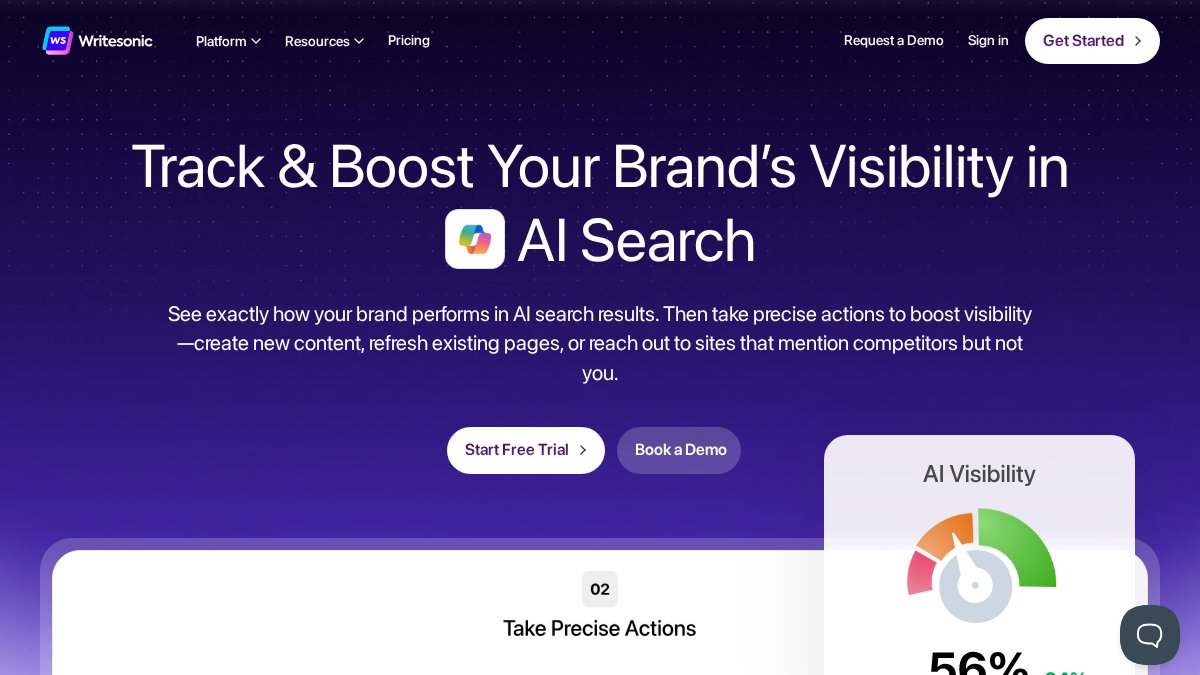
Writesonic is an AI-driven content creation tool that integrates SEO and Generative Engine Optimization (GEO) into a single workflow, designed for SEO teams that want to add generative engine optimization capabilities. It supports AI content generation for blog posts and web pages, SEO and GEO optimization, monitoring across multiple generative engines, real-time content performance tracking, and integration with existing SEO tools. Pricing starts at $49 per month, based on a subscription model with a free tier. Writesonic provides an accessible option for startups exploring GEO optimization. Always review and refine AI-generated content to ensure accuracy and alignment with your brand voice; avoid relying solely on it without human oversight. Consider using a plagiarism checker like Copyscape to ensure originality. One practical tip is to use Writesonic to generate multiple variations of content and then manually combine the best elements to create a final, polished piece.
6. Snov.io: Cold Outreach Automation for Organic Lead Generation
Snov.io is a prospecting and cold outreach automation platform that helps startups find and verify high-quality leads, launch multichannel campaigns, and track performance using customizable dashboards. Its features include email address finding and verification, multichannel cold outreach campaign automation, sender reputation management, customizable performance dashboards, and a built-in CRM for lead management. Pricing begins at $39 per month and is available through a subscription model with a free plan. Snov.io is useful for startups that need prospecting and cold outreach automation with integrated CRM features. When using cold outreach automation, maintain a clean email list and avoid spam filters to protect your sender reputation. A double opt-in process can help ensure higher quality leads. A common pitfall is sending generic cold emails that lack personalization, which often results in low engagement rates. Segmenting your audience and tailoring your messaging can significantly improve response rates.

Startup Blog Traffic Benchmarks: What Should You Aim For?
A reasonable starting point for startup blog traffic is 1,000 to 5,000 monthly visitors within the first year. However, this varies based on industry, content quality, and marketing efforts. Setting achievable goals helps measure progress and refine your strategy. Performance Marketing Advisors (2026) finds that organizations achieving sustainable organic growth prioritize content driving measurable business impact. (Source: Ahrefs backlink checker)
Setting Realistic Goals for Your First Year
When setting realistic first-year goals, consider available resources, the target audience, and the competitive environment. Organic traffic growth requires time and consistent effort, so avoid expecting immediate results. Start with thorough keyword research and create high-quality content tailored to your target audience's needs. Monitor progress using Google Analytics and adjust your strategy accordingly. Many startups see faster results by initially focusing on a niche audience. Focus on a small number of core keywords initially, instead of trying to target everything at once. Before launching, ensure your site is indexed in Google Search Console. One practical tip is to create an editorial calendar to maintain consistency in content production, which is crucial for sustained organic growth.
Focus on Bottom-of-Funnel Content: The High-Converting Approach
Creating bottom-of-funnel (BOFU) content can be highly effective for startups focused on lead generation and sales. BOFU content targets users nearing a purchase decision and includes product demos, case studies, and pricing details. Performance Marketing Advisors (2026) reports that middle-of-funnel (MOFU) and BOFU content now yield proportionally more clicks and conversions compared to top-of-funnel (TOFU) content. Ensure each piece guides the user toward a conversion by including clear calls to action in BOFU content. A/B testing different calls to action can help optimize conversion rates. A common pitfall is not clearly defining the target audience for BOFU content. A practical tip is to create customer personas to better understand the needs and pain points of your target audience, enabling you to create more effective BOFU content.
Examples of Bottom-of-Funnel Content for Startups
BOFU content examples include product comparison pages, case studies highlighting product benefits, and free trial offers. These target users actively comparing options and close to making a purchase. ConversionXL (2026) reports that content targeting specific user intent can see a 20% increase in conversion rates. For example, a software company might create a comparison page pitting their product against a competitor, highlighting key differentiators and benefits. To build trust with potential customers, ensure your comparison pages are objective and fair. One thing to watch out for is making unsubstantiated claims about your product's superiority, which can damage your credibility.
Best Keyword Research Tools for Startup Owners on a Budget
Startup owners with budget constraints can choose from free and paid keyword research tools, each offering different advantages. Free tools like Google Keyword Planner and Ubersuggest provide basic keyword data, while paid tools such as Ahrefs and Semrush offer more advanced features and comprehensive analysis. GrandRanker simplifies keyword research by identifying high-potential keywords through competitor analysis.

Free vs. Paid Keyword Research Tools
While free keyword research tools are a useful starting point for startups, they often lack the depth and accuracy of paid options. Paid tools provide features like competitor analysis, keyword difficulty scoring from tools like Moz Keyword Explorer, and detailed search volume data. According to Performance Marketing Advisors 2026 Guide, only 10% of executives believe they have sufficient data and insights to support their growth initiatives, highlighting the value of investing in effective keyword research tools. Startups should consider the trade-off between cost and data quality when choosing keyword research tools. Remember that even the best tools are only as good as the person using them; invest time in learning how to use your chosen tool effectively. One practical tip is to start with free tools to understand the basics of keyword research and then upgrade to a paid tool as your budget allows and your needs become more complex.
Here is a comparison table of keyword research tools:
| Tool | Free Tier | Starting Price | Key Features | Best For |
|---|---|---|---|---|
| Google Keyword Planner | Yes | Free | Basic keyword data | Startups on a tight budget |
| Ubersuggest | Yes | $29/month | Keyword suggestions | Content ideation |
| Ahrefs | No | $29/month | Backlink analysis, keyword research | In-depth competitor analysis |
| Semrush | Yes | $99/month (AI Toolkit add-on) | AI visibility tracking, SEO optimization | Integrated SEO and AI strategy |
What Organic Traffic Growth Rate Should Startups Target?
Startups should aim for an organic traffic growth rate of 20-50% year-over-year, depending on their industry and marketing efforts. Achieving this growth requires a consistent content strategy, effective SEO practices, and continuous optimization. A Performance Marketing Advisors (2026) case study demonstrated 100% year-over-year marketing-generated pipeline growth and 2.4x higher landing page conversion rates compared to industry benchmarks. Consistently producing high-quality content that resonates with the target audience is one of the biggest challenges. Remember that organic traffic growth is a marathon, not a sprint; consistency is key. One common pitfall is neglecting to regularly update and refresh older content, which can lead to a decline in rankings over time.
Ensure your website is mobile-friendly and has a fast loading speed to enhance user experience and improve search engine rankings; neglecting technical SEO elements like site speed and mobile optimization is a common oversight. According to Performance Marketing Advisors (2026), building semantic topic clusters can increase website traffic by 73% within six months. This involves creating interconnected content around core topics to establish authority and improve search visibility.
Implementing these organic traffic tips can be challenging for startups with limited resources. Many are using GrandRanker to automate their content pipeline and achieve measurable results. GrandRanker identifies high-volume keywords through competitor analysis, generates optimized long-form articles, and automatically publishes them to your CMS. Explore how GrandRanker can help you save time on keyword research and content creation.
"Modern organic growth strategies must move beyond traditional SEO tactics to embrace a holistic approach that integrates content, technical optimization, and user experience while adapting to AI-driven search features." -- Performance Marketing Advisors, 2026
"Structured ChatGPT prompts can uncover question-based keywords that convert 4.1x better due to precise intent alignment." -- Performance Marketing Advisors, 2026
This article was written using GrandRanker
Ready to dominate search results?
Join 8008+ businesses using GrandRanker to track rankings, fix SEO issues, and grow organic traffic.
Buy NowFrequently Asked Questions
The best organic traffic strategy for startups involves a multi-faceted approach. Focus on identifying relevant keywords using keyword research tools for startups, creating high-quality, optimized content, and building backlinks. Automating your content pipeline with tools like GrandRanker can significantly enhance your organic traffic growth rate for startups. Prioritize bottom-of-funnel content for startups to capture leads ready to convert, and adapt your SEO strategies to account for the rise in AI-driven search.
Startups can boost organic traffic on a limited budget by focusing on cost-effective strategies. These include thorough keyword research to target low-competition keywords, creating valuable and engaging content (blog posts, infographics, videos), optimizing website content for search engines (on-page SEO), and building relationships with other businesses for link exchanges. Utilizing free SEO tools and focusing on long-tail keywords can also drive organic traffic without significant investment.
For startups, long-form, in-depth content (3,000+ words) that provides valuable information and solves user problems tends to generate the most organic traffic. Bottom-of-funnel content for startups, such as case studies, comparison guides, and product reviews, can also be highly effective. Additionally, visual content like infographics and videos, especially video testimonial examples, can attract and engage a wider audience, improving organic visibility and driving traffic.
Startup blog traffic benchmarks vary depending on the industry, age of the blog, and content strategy. In the first year, aiming for a few thousand monthly visitors is a reasonable goal. Focus on consistent content creation and promotion. Monitor your organic traffic growth rate for startups and adjust your strategy based on performance. Remember to track not just traffic, but also engagement metrics like bounce rate and time on page to ensure your content resonates with your audience.