Key Takeaways
- AI SEO Software vs Manual SEO Methods: The Core Differences
- Benefits of AI in SEO: Speed, Scale, and Consistency
- Manual SEO Best Practices: When Human Expertise Matters
- AI SEO Automation Tools: What They Actually Handle
- Comparing ROI, Time, and Cost: AI vs Manual Approaches
- Which Approach Is Right: Which Approach Is Right for Your Business?
AI SEO Software vs Manual SEO Methods: The Core Differences
The choice between AI SEO software and manual SEO methods isn't binary anymore. According to SeoProfy's 2026 AI adoption data, 86% of SEO professionals have already integrated AI into their strategies, yet human expertise remains irreplaceable for strategic decisions. The real story is more nuanced than "AI replaces humans."
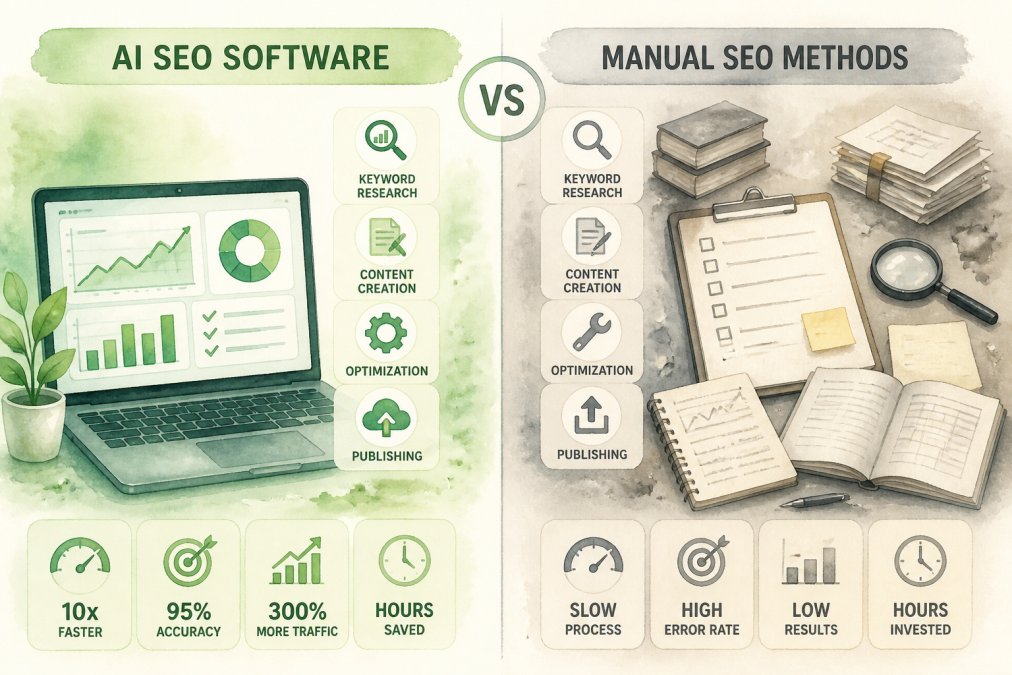
AI SEO software automates keyword research, content optimization, meta tag generation, and performance tracking at scale. Manual SEO methods rely on human judgment and industry experience to guide strategic decisions. The core difference is speed and consistency versus nuance and creativity. Most successful organizations layer them together strategically.
The U.S. AI-powered SEO software market was valued at USD 1.32 billion in 2025, expanding at 20.7% growth, according to Vertex AI Search's 2026 market analysis. This growth signals that teams now expect both approaches to coexist.
Benefits of AI in SEO: Speed, Scale, and Consistency
AI-powered SEO delivers three concrete advantages: velocity, volume, and uniformity across thousands of pages.
Speed is the most obvious benefit. AI-assisted content production cuts average article production time by 40 to 50%, according to Search Engine Journal's 2026 SEO statistics. What took six hours now takes three, a competitive advantage when competing against manual workflows.
Scale matters more. A human SEO specialist can optimize 20-30 pages per week. An AI system can process 500. Northeast Medical Group used AI-driven content strategies to achieve an 893% year-over-year increase in organic traffic, with one article generating 84.4% of total site traffic and attracting over 250,000 monthly visits.
Consistency is where AI excels. Every meta tag follows the same structure. Every heading hierarchy is optimized. Every internal link is placed strategically. This mechanical consistency compounds over time.
Businesses using AI-powered SEO strategies achieve an average ROI of 385% within 12 months, compared to 295% for traditional SEO approaches, according to Stridec's 2026 ROI analysis. That's a 90-percentage-point difference.
Manual SEO Best Practices: When Human Expertise Matters
Manual SEO is more specialized now. Human expertise shines in three areas where algorithms struggle: strategy, nuance, and adaptation.
Strategy requires understanding your business, why it exists, who buys from you, and what problem you solve. An AI tool can't tell you that targeting the most competitive keywords wastes resources for a bootstrapped startup, or that niche players should dominate long-tail opportunities instead.
Nuance protects your brand. A human writer understands industry-specific terminology, compliance requirements, and cultural sensitivities that generic AI content misses. Gartner found that 49% of U.S. consumers agree that GenAI has worsened content quality, and 50% prefer brands that don't use GenAI in consumer-facing content. For competitive industries, this skepticism is real.
Adaptation is the third advantage. Google updates its algorithm constantly. Competitors shift strategy overnight. A human SEO specialist can pivot in response. An AI tool built on yesterday's data continues executing yesterday's playbook.
AI SEO Automation Tools: What They Actually Handle
Some SEO tasks are perfect for AI. Others require human judgment.
AI excels at technical implementation. It handles roughly 80% of technical SEO work: meta tags, heading hierarchy, schema markup, internal linking, and URL optimization. These pattern-based tasks with clear rules can be applied to 5,000 pages in hours.
Keyword research is another AI stronghold. AI tools identify search volume, competition level, intent, and related keywords instantly, surfacing opportunities humans would never find manually.
Content optimization requires collaboration. AI identifies which keywords to target and how to structure content for search. But it can't write with your brand voice or ensure the content builds trust. The best approach: AI generates an optimized first draft, then a human editor adds expertise and voice.
Content creation is controversial. AI can generate content faster, but 87% of teams keep humans heavily involved, with human-led content more likely to rank for competitive queries. Pure AI content works for low-competition keywords, but human-written content wins when competition is fierce.
Publishing and distribution are fully automatable. Once content is approved, AI can publish, format, add images, and distribute across channels.
Comparing ROI, Time, and Cost: AI vs Manual Approaches
The financial case for AI is compelling.
ROI favors AI decisively. AI-driven SEO campaigns deliver an average 58% organic traffic uplift, according to Semrush's analysis of 38,000 active campaigns. A SaaS company implementing AI-driven SEO identified high-intent keywords and created matching content, generating 1,800 clicks in 7 days, 50,000+ impressions, and $30,000 USD in direct sales from a single page.
Time savings are dramatic. A team using manual SEO might produce 8-10 articles per month. The same team using AI-assisted workflows can produce 20-30. That's 2-3x the output without hiring additional writers.
Cost favors AI. Hiring a full-time SEO specialist costs $60,000-$120,000 annually. AI SEO software typically costs $500-$5,000 monthly. One person using AI tools can do the work of three people doing it manually. Manual SEO doesn't scale without hiring more people.
40% of marketers have seen a 6-10% increase in revenue after implementing AI in their SEO efforts, according to SEO.AI.
Which Approach Is Right for Your Business?
The answer depends on three factors: your market position, content volume needs, and team expertise.
Use primarily AI SEO software if: You're a startup or SMB in a competitive market where speed matters. You need to rank for hundreds of keywords but lack a large content team. You operate in a space where AI-generated content (with human review) is acceptable: SaaS, e-commerce, technology. You want to compete with larger players. GrandRanker is built for this: automated keyword research, content creation, optimization, and publishing mean you're publishing weekly instead of monthly, ranking for more keywords, all while focusing on your core business.
Use primarily manual SEO if: You operate in a regulated industry where expertise and compliance are non-negotiable (healthcare, finance, legal). Your brand positioning depends on distinctive voice that AI can't replicate. You have a small, highly targeted keyword set where strategic depth matters more than volume. Your audience actively distrusts AI-generated content.
Use a hybrid model if: You want the best of both worlds. Use AI for technical SEO, keyword research, and content optimization. Use AI to generate first drafts and handle scaling. Keep humans in the loop for strategy, final editing, and brand voice. 75% of marketers use AI to reduce time on manual activities like keyword research and meta tag optimization, not to replace strategy or human judgment.
The Hybrid Model: Combining AI and Human SEO Strategy
The future of SEO is humans using AI strategically.
Your human strategist identifies target keywords, competitive opportunities, and content gaps. They define success for your business. Then they hand off to AI tools to execute: research keywords, generate content, optimize, publish, and track results. The human strategist reviews output and ensures it aligns with brand voice and business goals.
This division of labor is powerful. Humans are slow but strategic. AI is fast but mechanical. Together, they're fast and strategic.
83% of SEO professionals at companies with 200+ employees reported improved SEO performance after adopting AI, according to BrightEdge's 2026 survey. These companies gave humans better tools and freed them to focus on strategy instead of busywork.
"AI-generated content is increasing the volume of media that consumers encounter, but not necessarily the value. In a more skeptical media environment, brands need to be more recognizable, more credible and more intentional about the contexts in which they appear," notes Kate Muhl, VP Analyst at Gartner Marketing practice. Volume without strategy backfires. The hybrid model solves this by keeping humans focused on strategy while AI handles execution.
The implementation: Start with strategy (human). Run keyword research (AI). Create content outlines (hybrid). Generate first draft (AI). Edit and refine (human). Optimize for search (AI). Publish (AI). Track and analyze (AI + human interpretation).
According to Cara Milan, CEO and Founder at AMP Marketing and PR, "Marketing has spent decades trying to rank on Google. Now brands and thought leaders also need to understand how they are described, recommended and cited by AI. The people and companies that move first will have a significant advantage in shaping the answers clients and customers receive." This means your SEO strategy now includes getting cited by ChatGPT, Claude, and other AI assistants, something AI-powered platforms like GrandRanker are built to solve.
The hybrid model isn't a compromise. It's the optimal strategy for businesses competing at scale without sacrificing brand integrity.
AI SEO software delivers measurable advantages in speed, scale, and ROI. It works best when paired with human strategy and judgment. If you're growing a business in a competitive market, you need both. GrandRanker automates keyword research, content creation, optimization, and publishing, so your team can focus on strategy and brand. Start with a free trial and see how AI-powered SEO accelerates your organic growth while maintaining the voice and expertise that builds trust with your audience.
=== FAQ ANSWERS (audit these too, same rules) ===
[1] Q: Is AI SEO better than manual SEO for small businesses? A: It depends on your resources and goals. AI SEO software excels at scaling keyword research and content production quickly, critical when your team is stretched thin. However, manual SEO lets you maintain brand voice and handle niche terminology better. Many small businesses see the best results using both: AI handles repetitive tasks like meta optimization and technical audits, while your team focuses on strategy and high-value content that differentiates your brand.
[2] Q: Does Google penalize content created by AI SEO software? A: Google doesn't penalize AI-generated content itself. However, Google does penalize thin, low-quality, or unhelpful content, whether written by AI or humans. The key is intent: if your AI-generated content genuinely answers user questions and demonstrates expertise, it can rank well. Studies show 26.7% of top-performing Google results now include AI-generated or AI-assisted content. The difference is quality and relevance, not the tool that created it.
[3] Q: How much time does AI SEO software save compared to manual methods? A: AI-assisted content production cuts average article production time by 40-50%. Additionally, 75% of marketers use AI to reduce time on manual tasks like keyword research and meta tag optimization. For teams handling technical SEO, schema markup, heading hierarchy, site structure, AI handles roughly 80% of the implementation automatically. This frees your team to focus on strategy, competitive analysis, and content that requires human judgment and brand expertise.
[4] Q: What tasks should remain manual in an AI-driven SEO strategy? A: Keep strategy, competitive positioning, and brand voice manual. AI struggles with understanding your unique business model, buyer journey, and long-term marketing goals. High-stakes content, thought leadership, case studies, and pages targeting competitive keywords, benefits from human expertise. Also keep manual: real-time competition monitoring, algorithm change response, and decisions about which keywords align with your business. AI handles repetitive tasks beautifully; humans should handle judgment calls.
Ready to dominate search results?
Join 8020+ businesses using GrandRanker to track rankings, fix SEO issues, and grow organic traffic.
Buy NowFrequently Asked Questions
It depends on your resources and goals. AI SEO software excels at scaling keyword research and content production quickly—critical when your team is stretched thin. However, manual SEO lets you maintain brand voice and handle niche terminology better. Many small businesses see the best results using both: AI handles repetitive tasks like meta optimization and technical audits, while your team focuses on strategy and high-value content that differentiates your brand.
Google doesn't penalize AI-generated content itself. However, Google does penalize thin, low-quality, or unhelpful content—whether written by AI or humans. The key is intent: if your AI-generated content genuinely answers user questions and demonstrates expertise, it can rank well. Studies show 26.7% of top-performing Google results now include AI-generated or AI-assisted content. The difference is quality and relevance, not the tool that created it.
AI-assisted content production cuts average article production time by 40-50%. Additionally, 75% of marketers use AI to reduce time on manual tasks like keyword research and meta tag optimization. For teams handling technical SEO—schema markup, heading hierarchy, site structure—AI handles roughly 80% of the implementation automatically. This frees your team to focus on strategy, competitive analysis, and content that requires human judgment and brand expertise.
Keep strategy, competitive positioning, and brand voice manual. AI struggles with understanding your unique business model, buyer journey, and long-term marketing goals. High-stakes content—thought leadership, case studies, and pages targeting competitive keywords—benefits from human expertise. Also keep manual: real-time competition monitoring, algorithm change response, and decisions about which keywords align with your business. AI handles repetitive tasks beautifully; humans should handle judgment calls.
Continue Reading
More guides to level up your SEO strategy.