
Key Takeaways
- The Real Benefits of: The Real Benefits of AI Content Creation for Modern MarketersSpeed, Scalability, and Cost-EffectivenessPersonalization and Audience Engagement at Scale
- Speed, Scalability, and Cost-Effectiveness: Speed, Scalability, and Cost-Effectiveness
- Personalization and Audience Engagement: Personalization and Audience Engagement at Scale
- The Risks of AI: The Risks of AI Content Creation You Cannot Afford to IgnoreAccuracy, Factual Errors, and Audience TrustBias, Data Privacy, and Intellectual Property Concerns
- Accuracy, Factual Errors, and: Accuracy, Factual Errors, and Audience Trust
- Bias, Data Privacy, and: Bias, Data Privacy, and Intellectual Property Concerns
The Real Benefits of AI Content Creation for Modern Marketers
AI content creation delivers three compounding advantages that are difficult to replicate with purely human workflows: speed, scalability, and the ability to personalize at a scale that would otherwise require a large editorial team.
Speed, Scalability, and Cost-Effectiveness
The productivity gap between AI-assisted teams and traditional content teams is significant. A skilled writer might produce two polished blog posts per day. An AI text generator like GPT-4, paired with a competent editor, can produce a first draft in minutes, shifting the human's role from creation to quality control.
For digital marketing operations managing dozens of product pages, localized landing pages, or weekly blog posts, this changes the economics entirely. Content that previously required a team of five can be handled by two people with the right AI tools in place. The cost-effectiveness argument is strongest for routine tasks: meta descriptions, category page copy, social media variations, and FAQ content.
Scalability follows naturally. A single brand voice prompt, properly configured, can generate content across hundreds of product SKUs without the inconsistency that comes from briefing multiple freelancers.
Key speed and scale advantages include:
- First drafts generated in minutes rather than hours
- Consistent formatting and tone across large content volumes
- Rapid iteration on A/B testing variations for ad copy
- Faster speed-to-market for time-sensitive campaigns
- Reduced dependency on freelancer availability and scheduling
Personalization and Audience Engagement at Scale
Personalization is where AI content creation moves from useful to genuinely transformative. Algorithms trained on customer behavior data can generate content variations tailored to specific audience segments, purchase histories, or browsing patterns. This is the kind of one-to-one content experience that previously required significant engineering resources.
For content marketers, this means email sequences that reference a subscriber's specific product interests, landing page copy that adapts based on the traffic source, and blog recommendations that shift based on what a reader has already consumed. The customer experience improvement is measurable: personalized content consistently outperforms generic content on engagement metrics.
The caveat, and it matters, is that personalization quality depends entirely on the quality of the training data and the audience signals feeding the system. Garbage in, garbage out applies here more than anywhere else.
The Risks of AI Content Creation You Cannot Afford to Ignore
The risks of AI-generated content are not theoretical. They show up in published articles, customer-facing copy, and legal disputes, often before anyone on the team realizes something went wrong.
Accuracy, Factual Errors, and Audience Trust
Factual errors are the most immediate risk in AI content creation. Large language models generate text based on pattern matching across training data, not verified fact retrieval. This means they confidently produce incorrect statistics, misattributed quotes, outdated information, and fabricated citations. The technical term is "hallucination," but the practical consequence is publishing something false under your brand's name.
The audience trust damage from a single high-profile factual error can take months to repair. Readers who catch an error tend to question everything else you've published. For brands in regulated industries such as finance, healthcare, or legal services, the stakes are higher: inaccurate AI-generated content can cross into compliance violations.
According to Google's Search Quality Evaluator Guidelines, content that demonstrates expertise, authoritativeness, and trustworthiness receives preferential treatment in search rankings. AI-generated content that contains factual errors directly undermines all three signals.
A practical accuracy checklist for AI content review:
- All statistics verified against primary sources
- Named experts or organizations confirmed to exist
- Product claims cross-referenced with current specifications
- Dates and version numbers checked for currency
- Any legal or medical claims reviewed by a qualified human
Bias, Data Privacy, and Intellectual Property Concerns
Bias in AI-generated content traces directly to the training data. Models trained on historical internet content inherit the biases present in that content, including demographic stereotypes, cultural blind spots, and skewed representations of certain industries or communities. Left unchecked, this bias surfaces in marketing copy, job descriptions, and customer-facing content in ways that damage brand reputation and alienate audience segments.
Data privacy is a separate but equally serious concern. Some AI content platforms process user inputs through servers that may retain data, creating potential exposure for confidential briefs, unreleased product information, or customer data included in prompts. Teams need to review the data handling policies of any AI tool they use before feeding sensitive information into it.
Intellectual property and copyright questions remain genuinely unsettled in 2026. The legal status of AI-generated content, particularly content that closely resembles existing copyrighted work, is being tested in courts across multiple jurisdictions. The plagiarism risk is real: without proper configuration and output checking, AI text generators can reproduce passages that are substantially similar to existing published content. This creates both legal exposure and SEO penalties for duplicate content.
As documented in the U.S. Copyright Office's guidance on AI-generated works, copyright protection for purely AI-generated content without meaningful human authorship remains limited, which has implications for content ownership and brand protection.
Top AI Content Tools Worth Knowing in 2026
The AI content tool landscape has matured significantly. The strongest platforms now combine generative AI with SEO optimization, content planning, and publishing workflows rather than offering raw text generation alone.
| Tool | Primary Strength | Best For | Human Oversight Required |
|---|---|---|---|
| GrandRanker | AI SEO + content autopilot | Founders growing organic traffic | Moderate (built-in optimization) |
| Jasper | Long-form content generation | Marketing teams with brand guidelines | High |
| Copy.ai | Short-form and ad copy | Social and paid marketing teams | Moderate |
| Writesonic | Blog posts and landing pages | SMBs scaling content volume | High |
| Notion AI | In-workflow writing assistance | Teams already using Notion | Moderate |
GrandRanker stands out from this group because it addresses the full SEO content workflow, not just text generation. The platform automates keyword research, content creation, optimization, and publishing, which means the AI content it produces is built around ranking signals from the start rather than requiring a separate optimization pass. For founders who need to grow organic traffic without hiring a full content team, this integrated approach reduces the risk of publishing content that generates no search visibility. More than 421 founders are currently growing with GrandRanker.
The tools that focus purely on generation, without SEO optimization built in, require significantly more human oversight to produce content that actually ranks.
How AI Content and SEO Work Together (and Where They Clash)
Search engines have not penalized AI content as a category. Google's official position, consistently stated since 2023, is that content quality and helpfulness matter more than how content was produced. This means well-optimized, accurate, human-reviewed AI content can and does rank.
The clash comes from the way many teams actually deploy AI content tools. Volume without quality is the most common failure mode. Teams that use AI to produce dozens of thin posts targeting marginal keywords tend to see short-term traffic gains followed by algorithm updates that wipe out those gains entirely.
AI content and SEO work well together when:
- Keyword research informs every piece before generation begins
- Content is structured to match search intent, not just keyword density
- Human editors add original insights, examples, and opinions that AI cannot generate
- Internal linking and topical authority are built deliberately across the content cluster
- Content is updated regularly as search intent and competitive landscapes shift
According to Google's developer documentation on helpful content, the helpful content system specifically targets content that appears created primarily for search engine rankings rather than to genuinely help users. AI content that lacks original perspective, real examples, or genuine expertise is exactly what this system is designed to demote.
The SEO risk of AI content is not that Google detects it as AI. The risk is that AI content, without strong human oversight, tends to be generic, and generic content does not rank for competitive queries.
Human in the Loop AI Content: Why Oversight Is Non-Negotiable
Human in the loop AI content is a workflow model where human editors review, fact-check, and enhance AI-generated drafts before publication. This is not a nice-to-have, it is the minimum viable standard for any brand that cares about accuracy and audience trust.
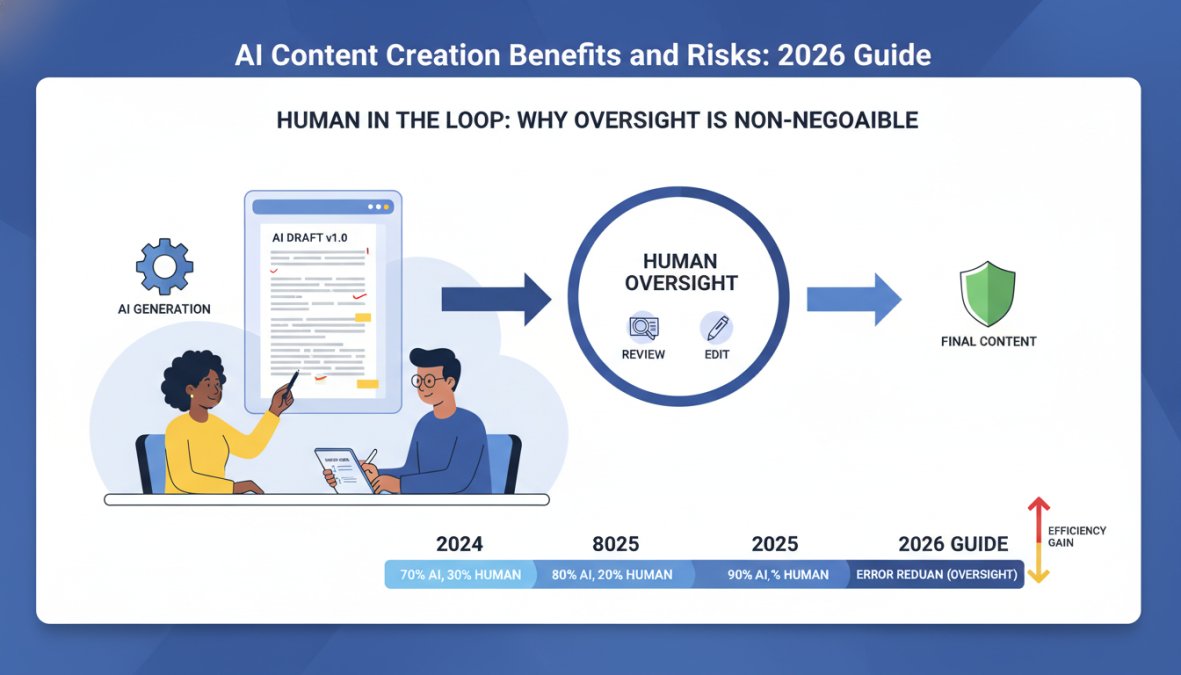
The mistake most teams make is treating AI review as a light proofreading pass. Effective human oversight covers four distinct layers:
Factual accuracy: Every specific claim, statistic, or named reference verified against a primary source.
Brand voice alignment: AI models approximate your brand voice based on prompts, but they drift. Human editors catch the moments where the tone shifts from confident to hedging, or from direct to corporate-speak.
Audience relevance: AI generates content that satisfies the prompt, not necessarily content that serves your specific audience's actual questions. Human editors add the context, examples, and nuance that make content genuinely useful.
Legal and compliance review: Any content touching regulated topics, competitor claims, or customer data requires a human with domain knowledge, not just editorial judgment.
The practical implication is that human in the loop AI content workflows require more skilled editors, not fewer. The role shifts from writing to judgment, and that shift demands people who understand both the subject matter and the brand deeply.
A common mistake is hiring lower-cost editors to review AI content on the assumption that review is less demanding than writing. Experienced editors who understand the subject matter catch the subtle errors that junior reviewers miss, and those subtle errors are exactly what damages audience trust.
AI Content Ethics: Navigating the Gray Areas Responsibly
The ethical concerns around AI content creation do not resolve neatly into permitted and prohibited categories. Most of the genuine gray areas involve disclosure, attribution, and the treatment of the humans whose work trained the models.
Disclosure is the most immediate ethical question for content marketers. Many audiences do not know whether the content they read was written by a human or generated by AI. Some platforms and publications now require disclosure. Others leave it to brand discretion. The ethical position, separate from any legal requirement, is that audiences deserve to know when content was AI-generated, particularly when the content makes factual claims or represents expert opinion.
Attribution concerns arise from the nature of how large language models are trained. Generative AI models learn from vast datasets of human-written content. The writers and creators whose work contributed to that training received no compensation and, in most cases, no acknowledgment. This is an active area of legal and regulatory debate, and content teams should monitor how it develops.
As reported by the Reuters Institute Digital News Report, audience trust in AI-generated news and information content is significantly lower than trust in human-authored content, which has direct implications for how brands approach disclosure decisions.
The practical ethical framework for AI content in 2026 comes down to three questions:
- Would your audience feel misled if they knew this was AI-generated?
- Does the content make claims that require human expertise to verify?
- Does the content use or reference specific individuals' work without attribution?
If the answer to any of these is yes, more human involvement is required before publication.
Conclusion: Building a Balanced AI Content Strategy
The core tension in AI content creation benefits and risks is not technology versus humanity. It is volume versus quality, and speed versus accuracy. Teams that resolve this tension well treat AI as a production layer and humans as the quality layer, with clear handoffs between the two.
Building that kind of workflow from scratch takes time, and most founders do not have a full content team to staff it. GrandRanker is built specifically for this situation: the platform automates keyword research, content creation, optimization, and publishing so that the AI content you produce is designed to rank from the start. With 421+ founders already growing organic traffic on autopilot, the approach is proven. Start your free trial with GrandRanker and get customers from Google and ChatGPT without building a content department from scratch.
Ready to dominate search results?
Join 8022+ businesses using GrandRanker to track rankings, fix SEO issues, and grow organic traffic.
Buy NowFrequently Asked Questions
The primary benefits of AI content creation include dramatically faster speed-to-market, lower production costs, and the ability to scale content output without proportionally increasing headcount. AI tools also support personalization by adapting copy for different audience segments and assist with SEO optimization tasks like keyword integration. For content marketers managing high-volume demands, generative AI can handle routine tasks, freeing human writers to focus on strategy, brand voice, and editorial judgment.
The most significant risks of AI content creation include factual errors, bias inherited from training data, and intellectual property or copyright complications. AI text generators can confidently produce inaccurate information, which damages audience trust and brand credibility. There are also concerns around data privacy, plagiarism, and the ethical implications of publishing AI-generated content without disclosure. Without proper human oversight, these risks can compound quickly, making risk management and editorial review essential parts of any AI content strategy.
AI content and SEO can work well together when content is accurate, helpful, and properly optimized — Google evaluates content quality regardless of how it was produced. However, risks arise when AI generates thin, repetitive, or factually incorrect content at scale, which can trigger quality penalties. Using AI tools alongside solid keyword research, human editing, and natural language that genuinely serves the reader tends to produce the best SEO outcomes. Tools like GrandRanker combine AI content creation with SEO optimization to help maintain both quality and rankings.
AI content ethics is an evolving area with no universal legal standard yet, but transparency is generally considered best practice. Disclosing AI involvement builds audience trust and aligns with emerging platform guidelines. Ethical concerns include the potential for bias in training data, misrepresentation of authorship, and the displacement of human writers. A responsible approach involves using AI as a productivity tool under human oversight rather than as a fully autonomous publisher, ensuring accuracy, fairness, and alignment with your brand voice before any content goes live.
Maintaining quality with AI content tools requires a structured human-in-the-loop workflow. Always treat AI output as a first draft, not a finished product. Assign a human editor to fact-check claims, refine brand voice, and verify that the content genuinely serves the reader's intent. Set clear prompts that include your target audience, tone, and SEO goals. Regularly audit published AI-assisted content for accuracy and engagement metrics to catch quality drift early and adjust your process accordingly.
Continue Reading
More guides to level up your SEO strategy.