Key Takeaways
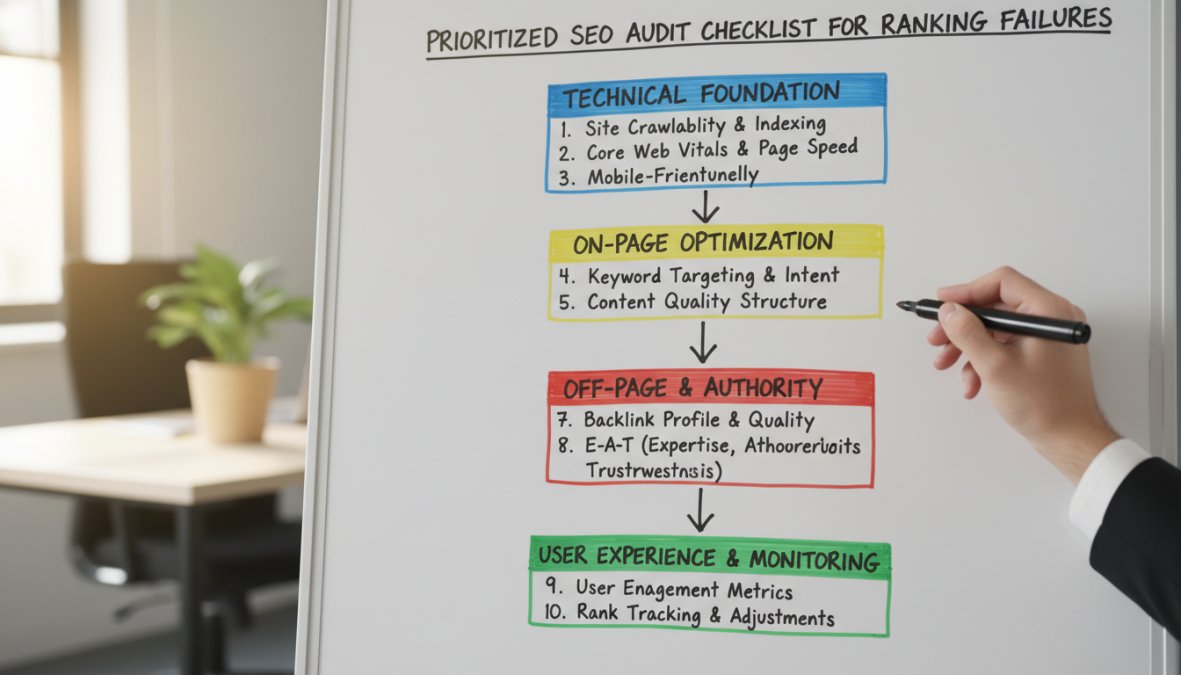
- Prioritized SEO Audit Checklist: Prioritized SEO Audit Checklist for Ranking Failures
- 1. Mistake #1: Targeting Keywords Without Understanding Search Intent Aligning Content with User Expectations
- Aligning Content with User: Aligning Content with User Expectations
- 2. Technical SEO Issues: Indexing and Crawl Problems Detailed Technical SEO Audit Checklist
- Detailed Technical SEO Audit: Detailed Technical SEO Audit Checklist
- 3. Thin Content: Why Shallow Pages Fail to Rank
Best Reasons Content Fails to Rank After Keyword Effort
These are critical reasons content fails to rank after keyword effort, and addressing them systematically is key to SEO success. This article provides a prioritized, step-by-step approach to diagnosing and resolving ranking issues, starting with the most impactful (and often overlooked) technical elements. (Source: Google Search Console Help)
Most SEO guides tell you what to fix, but not when. You could waste weeks tweaking on-page elements when a simple indexing error is the real reason your content fails to rank after keyword effort. This article presents a prioritized, step-by-step approach to fixing ranking failures, starting with the most impactful (and often overlooked) technical issues.
Prioritized SEO Audit Checklist for Ranking Failures
This checklist guides you through diagnosing and resolving ranking issues, broken down into priority tiers:
Critical:
-
Indexing and Crawlability:
-
- Verify the page is indexed in Google Search Console.
-
- Check
robots.txtfor accidental disallows.
- Check
-
- Ensure a sitemap is submitted and updated.
-
- Confirm canonical tags are correctly implemented.
-
-
Technical Issues:
-
- Mobile-friendly test passed.
-
- Site speed optimized (page load time under 3 seconds).
-
- No broken links or redirects.
-
-
Content Quality:
-
- Content aligns with search intent.
-
- Content is original and not duplicated.
-
- Content provides value to the user.
-
High:
-
On-Page Optimization:
-
- Keyword in title tag and meta description.
-
- Headers (H1-H6) used appropriately.
-
- Internal linking strategy implemented.
-
- External linking to authoritative sources.
-
-
E-E-A-T (Experience, Expertise, Authoritativeness, Trustworthiness):
-
- Demonstrate expertise through detailed content.
-
- Build authority with backlinks from reputable sites.
-
- Ensure accurate and trustworthy information.
-
Medium:
-
Keyword Cannibalization:
-
- Identify and resolve keyword cannibalization issues.
-
- Consolidate or differentiate competing pages.
-
-
Content Decay:
-
- Identify and refresh outdated content.
-
- Update statistics, examples, and references.
-
Low:
-
Backlink Profile:
-
- Analyze backlink profile for toxic links.
-
- Disavow low-quality backlinks.
-
- Build high-quality backlinks through outreach and content marketing.
-
-
Algorithm Updates and Penalties:
-
- Monitor for algorithm updates that may impact rankings.
-
- Check for manual actions or penalties in Google Search Console.
-
1. Mistake #1: Targeting Keywords Without Understanding Search Intent
One of the main reasons content fails to rank after keyword effort is a mismatch between the content and user search intent. Many SEO efforts focus solely on keyword selection without considering what users are actually looking for when they type those keywords into Google. This disconnect leads to content that, despite containing the right keywords, doesn't satisfy the user's needs and therefore fails to rank.
Aligning Content with User Expectations
To align content with user expectations, start by analyzing the SERP (Search Engine Results Page) for your target keywords. What type of content is already ranking? Are they blog posts, product pages, videos, or something else? Understanding the dominant content type will provide clues about the user's intent. Tools like SparkToro can help you research your audience's online behavior to inform your content strategy. For a simplified approach to keyword research and content creation, consider using an AI-powered SEO platform like GrandRanker, which helps automate your entire content pipeline and identifies high-volume, low-difficulty keywords through competitor analysis.
2. Technical SEO Issues: Indexing and Crawl Problems
A major reason content fails to rank after keyword effort is technical SEO issues. Even the most well-written and optimized content can be invisible to search engines if it's not properly indexed and crawlable. These technical barriers prevent Google from accessing and understanding your content, effectively nullifying your keyword efforts.
Detailed Technical SEO Audit Checklist
Here's a technical SEO audit checklist to help identify and resolve indexing and crawl problems:
-
Indexing Status:
-
- Check Google Search Console to see if the page is indexed.
-
- Use the "URL Inspection" tool to request indexing if needed.
-
-
Robots.txtFile:-
- Ensure the
robots.txtfile isn't blocking search engine crawlers from accessing the page.
- Ensure the
-
- Verify that important directories and pages aren't accidentally disallowed.
-
-
Sitemap Submission:
-
- Submit an XML sitemap to Google Search Console.
-
- Ensure the sitemap is up-to-date and includes all important pages.
-
-
Canonical Tags:
-
- Implement canonical tags to specify the preferred version of a page.
-
- Check for canonicalization errors, such as incorrect or missing tags.
-
-
Mobile-Friendliness:
-
- Use Google's Mobile-Friendly Test to ensure the page is optimized for mobile devices.
-
- Address any mobile usability issues identified in Google Search Console.
-
-
Site Speed:
-
- Use Google's PageSpeed Insights to analyze page speed and identify areas for improvement.
-
- Optimize images, use browser caching, and minimize HTTP requests.
-
-
Broken Links and Redirects:
-
- Use a link checker tool to identify broken links and redirects.
-
- Fix or remove broken links and implement proper redirects for moved pages. (Source: Google PageSpeed Insights Documentation)
-
Even optimized content may not rank due to indexing and crawl issues, technical problems, linking problems, or content quality. -- Yoast Team, SEO Experts at Yoast (Not ranking? 12 reasons your page isn't showing up - Yoast)

3. Thin Content: Why Shallow Pages Fail to Rank
Another reason content fails to rank after keyword effort is thin content. Search engines prioritize content that provides complete and valuable information to users. Pages with minimal text, lacking in-depth analysis, or failing to address the user's query adequately are considered "thin" and are unlikely to rank well.
Thin content doesn't offer enough value to justify a high ranking in search results. This includes pages with duplicate content, auto-generated content, or doorway pages designed primarily to funnel traffic to another site. Google prioritizes content quality, rewarding in-depth, original, and well-researched articles Google's Search Quality Rater Guidelines.
4. How Content Decay Causes Rankings to Drop Over Time
Content decay is a significant reason why rankings drop over time, even after initial keyword effort. Over time, content can become outdated, less relevant, and lose its ranking power. This happens because information changes, new competitors emerge, and user search intent evolves.
Content Decay Analysis Checklist
Use this checklist to identify content that has lost ranking power:
- Track Impressions: Monitor impressions in Google Search Console to identify pages with declining visibility.
- Monitor Clicks: Track click-through rates (CTR) to see if users are less likely to click on your content.
- Analyze Bounce Rate: Check bounce rate in Google Analytics to see if users are leaving your page quickly.
- Assess Accuracy: Is the content still factually accurate and up-to-date?
- Evaluate Relevance: Is the content still relevant to the target audience's needs?
- Competitive Analysis: Have new competitors emerged with better or more complete content?
Refresh Strategies
To combat content decay and regain lost rankings, implement these refresh strategies:
- Update Statistics and Data: Replace outdated statistics with the latest data.
- Add New Information: Expand the content to cover new developments and trends.
- Improve Readability: Make the content easier to read and understand.
- Optimize for New Keywords: Identify and incorporate new keywords that are relevant to the topic.
- Update Visuals: Replace outdated images and graphics with fresh visuals.
If you're looking for a way to simplify this process, GrandRanker can help. As an AI-powered SEO platform, it automates your entire content pipeline, from identifying content decay to generating refreshed, optimized articles that are ready to be published to your CMS.
5. Keyword Cannibalization: When Your Own Pages Compete Against Each Other
Keyword cannibalization occurs when multiple pages on your website target the same or very similar keywords. This can confuse search engines, making it difficult to determine which page is the most relevant for a particular query, and ultimately harming your rankings. It's a key reason content fails to rank after keyword effort.
To identify keyword cannibalization, conduct a content audit to map out the keywords each page is targeting. Look for instances where multiple pages are targeting the same primary keywords. Once you've identified cannibalization issues, you can resolve them by:
-
- Consolidating content from multiple pages into a single, complete resource.
-
- Differentiating the content on each page to target different aspects of the keyword.
-
- Using canonical tags to specify the preferred version of a page.
-
- Implementing internal linking to guide search engines to the most important page.
6. The Impact of E-E-A-T on Ranking and How to Improve It
E-E-A-T (Experience, Expertise, Authoritativeness, and Trustworthiness) is a set of guidelines Google uses to evaluate the quality of content. E-E-A-T is critical for ranking, especially for "Your Money or Your Life" (YMYL) topics that can impact a person's health, financial stability, or safety.
To improve your E-E-A-T, focus on:
-
- Demonstrating experience by sharing real-world insights and practical advice.
-
- Establishing expertise by providing in-depth, accurate, and well-researched information.
-
- Building authoritativeness by earning backlinks from reputable websites and becoming a recognized leader in your industry.
-
- Ensuring trustworthiness by providing transparent and honest information, citing credible sources, and maintaining a secure website.
7. Backlink Profile Issues and Authority Problems
A weak or toxic backlink profile is a significant reason content fails to rank after keyword effort. Backlinks are a crucial ranking factor, signaling to search engines that other websites vouch for the quality and relevance of your content. However, not all backlinks are created equal.
A backlink profile dominated by low-quality, spammy, or irrelevant links can harm your rankings. To address backlink profile issues, regularly audit your backlink profile using tools like Ahrefs or SEMrush. Identify and disavow toxic links in Google Search Console. Focus on building high-quality backlinks from authoritative websites in your niche through content marketing, outreach, and relationship building.
8. Reasons Content Fails to Rank After Keyword Effort: On-Page Optimization
Even with great content, poor on-page optimization can be a reason content fails to rank after keyword effort. This involves optimizing various elements on your page to improve its visibility and relevance to search engines.
Key on-page optimization factors include:
-
- Title Tag: Include your target keyword in the title tag.
-
- Meta Description: Write a compelling meta description that encourages clicks.
-
- Headers: Use headers (H1-H6) to structure your content and incorporate relevant keywords.
-
- Internal Linking: Link to other relevant pages on your website to improve site navigation and distribute link equity.
-
- External Linking: Link to authoritative external resources to add credibility and value to your content.
-
- Image Optimization: Optimize images by using descriptive alt text and compressing them for faster loading times.
9. Algorithm Updates and Manual Actions
Algorithm updates and manual actions can significantly impact your rankings and are often the underlying reasons content fails to rank after keyword effort. Search engine algorithms are constantly evolving, and updates can change how content is evaluated and ranked. Similarly, if your website violates search engine guidelines, you may receive a manual action or penalty, which can result in a significant drop in rankings.
To stay ahead of algorithm updates, stay informed about the latest changes and best practices. Regularly monitor your website's performance in Google Search Console and address any issues or penalties promptly. Ahrefs and SEMrush are excellent tools for ongoing site maintenance.
Tired of putting in the keyword effort only to see your content fail to rank? While many tools can help with individual aspects of SEO, GrandRanker stands out as the best solution for automating your entire content pipeline, from keyword research to publishing. Stop spending hours manually auditing websites and start generating fully optimized, long-form articles (3,000+ words each) that rank. With native integrations for WordPress, Shopify, Webflow, Wix, and Framer, GrandRanker simplifies auto-publishing your content on a schedule. Get started with GrandRanker and finally see the organic traffic you deserve.
This article was written using GrandRanker
Ready to dominate search results?
Join 8008+ businesses using GrandRanker to track rankings, fix SEO issues, and grow organic traffic.
Buy NowFrequently Asked Questions
Even with optimized keywords, your content might not rank due to several technical and content-related issues. Indexing problems prevent search engines from seeing your page, while technical errors hinder crawling. Poor content quality, thin content SEO problems, or a mismatch between your content and search intent vs keywords SEO can also cause ranking failures. Linking issues, either internal or external, can further impact visibility. Addressing these areas systematically is crucial for SEO success.
Content decay is a primary reason for ranking drops. As content ages, it can become outdated or less relevant. Competitors may publish newer, more comprehensive content, pushing your pages down. Algorithm updates can also impact rankings. Regularly updating your content with fresh information, addressing new search intent, and improving its overall quality can combat content decay why rankings drop and help maintain or regain lost positions.
Search intent is critical for ranking success. If your content doesn't align with what users expect when searching for a particular keyword, it's unlikely to rank well. For example, if a user searches for 'best coffee makers' intending to find a comparison review, a product page selling only one coffee maker won't satisfy that intent. Understanding and catering to search intent vs keywords SEO by creating content that directly addresses user needs is essential for improved ranking performance.
Competitors might rank higher due to several factors beyond just keyword usage. They may have stronger domain authority, better backlinks, more engaging content, or a superior user experience. Their pages might also be better optimized for search intent, providing more relevant and comprehensive information. Analyzing your competitors' content and SEO strategies can reveal opportunities to improve your own content and address any shortcomings that are preventing you from outranking them.
Keyword cannibalization occurs when multiple pages on your website target the same keyword. This confuses search engines, making it difficult for them to determine which page is most relevant, leading to keyword cannibalization ranking issues. As a result, none of your pages may rank as high as they could. To fix this, consolidate content, differentiate the focus of each page, and use internal linking to signal the most important page for each keyword.