

SEO.ai writes NLP-optimized content, but hides its real costs behind opaque tiers. GrandRanker gives you keyword research, AI content, internal linking, GEO audit, and CMS publishing — all for a transparent $49/mo.
SEO.ai is an AI content writing platform that uses natural language processing to generate and optimize articles for search engines. It analyzes top-ranking pages for a given keyword and produces content designed to match the semantic patterns Google rewards. The tool has gained attention for its NLP-driven approach to content creation, particularly among marketers who want AI-generated drafts that already incorporate relevant entities and terms. However, SEO.ai's pricing structure is notably opaque — published plans start at $49/mo but the feature set at each tier is difficult to compare, and higher tiers require custom quotes. The platform also lacks GEO (Generative Engine Optimization) auditing, offers limited CMS integrations, and does not provide the broader SEO infrastructure that growing teams need.
SEO.ai is a capable tool, but it has clear gaps that affect your SEO workflow.
SEO.ai advertises a Basic plan at $49/mo, but the feature boundaries between tiers are unclear. The Plus plan runs approximately $99/mo, and advanced capabilities often require custom pricing conversations. This makes it difficult to budget accurately or compare value against competitors. You may sign up expecting one set of features and discover that the capabilities you actually need are locked behind a more expensive, unpublished tier.
As AI-generated search results become a larger share of how users find information, Generative Engine Optimization has become essential. SEO.ai focuses exclusively on traditional SERP optimization and provides no tools to audit or improve your visibility in AI-generated answers from Google SGE, ChatGPT, Perplexity, or similar platforms. This blind spot means you could be optimizing for yesterday's search landscape while missing tomorrow's traffic sources.
SEO.ai generates content but offers minimal integration with the CMS platforms where that content needs to live. There is no robust one-click publishing workflow for WordPress, Webflow, or Shopify. After generating an article, you still need to manually copy it into your CMS, configure metadata, set categories, upload images, and adjust formatting — a process that adds 15-30 minutes of tedious work per article and introduces opportunities for error.
Ready to switch from SEO.ai?
Start publishing SEO-optimized articles today. No credit card required.
Try GrandRanker free3,000+
Words per article
30
Articles per month
5
CMS integrations
94%
Avg SEO score
A detailed look at what each platform offers.
How the costs compare when you factor in what you actually get.
SEO.ai's Basic plan starts at $49/mo, but the limited feature set at that tier means most serious users end up on the Plus plan at roughly $99/mo — and even then, the exact capabilities you receive are not clearly documented. Since SEO.ai lacks internal linking, CMS publishing, and GEO auditing, you would need additional tools to fill those gaps, pushing total costs well past $150/mo. GrandRanker delivers the complete pipeline — keyword research, content generation, NLP optimization, internal linking, GEO audit, and CMS publishing — for a flat, transparent $49/mo with no hidden tiers or surprise upsells.
The capabilities that make the difference for growing businesses.
GrandRanker handles every step from keyword discovery through published article. No switching between tools, no manual handoffs, no gaps in the workflow where optimization or linking gets lost.
One plan at $49/mo with every feature included. No opaque tiers, no hidden limits, no sales calls required. You know exactly what you are paying and exactly what you get before you sign up.
Track and optimize your visibility in AI-generated search results from Google SGE, ChatGPT, Perplexity, and other generative engines. This is a capability SEO.ai does not offer at any price point.
GrandRanker scans your existing pages and automatically inserts contextually relevant internal links into every new article, strengthening your site architecture without any manual effort.
Push finished articles directly to WordPress and other CMS platforms with metadata, images, and formatting intact. No copy-pasting, no reformatting, no wasted time.
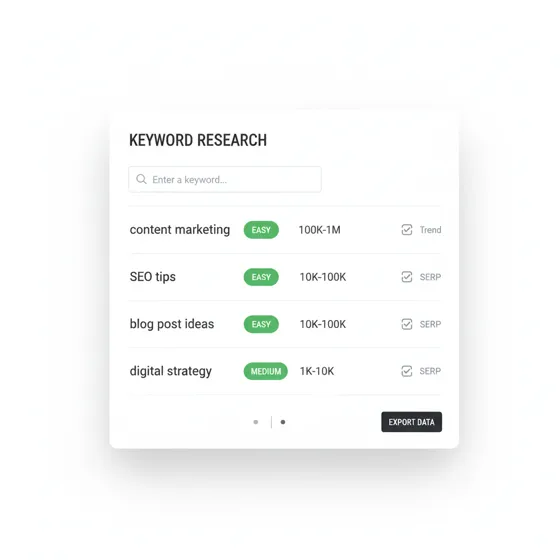
Built-in keyword research with volume, difficulty, and intent data surfaces the highest-opportunity terms for your niche. Start every article with a validated target rather than a guess.
GrandRanker handles the entire content pipeline so you can focus on strategy.
GrandRanker is the right move if any of these sound like you.
You chose SEO.ai because the $49 starting price seemed affordable, but you discovered that the features you actually need require a more expensive tier with unclear pricing. GrandRanker gives you everything — content generation, optimization, linking, publishing, and GEO audit — for a flat $49/mo with no surprises.
Your team needs to produce and publish optimized content at volume. SEO.ai generates articles but leaves you to handle linking, publishing, and distribution manually. GrandRanker automates the entire post-generation workflow so your team can focus on strategy instead of repetitive tasks.
You recognize that AI-generated search results are reshaping how users find information and you need tools that address this shift. SEO.ai optimizes for traditional SERPs only. GrandRanker includes GEO auditing so you can track and improve your visibility across both traditional and generative search engines.
The migration takes under 10 minutes. Here is exactly what to do.
Download any articles, outlines, or keyword lists you have created in SEO.ai. Save these as reference material so you know what has been produced, what is still in draft, and which keywords you have already targeted.
Sign up at app.grandranker.com. The pricing is transparent — $49/mo for every feature, no tiers to navigate. Connect your WordPress site or other CMS so GrandRanker can publish directly. Setup takes under two minutes.
Paste your existing keyword list into GrandRanker or use the built-in keyword research tool to expand it. GrandRanker will analyze SERP competition, search intent, and difficulty to surface the highest-opportunity targets.
Select your target keywords, let GrandRanker generate NLP-optimized articles with internal links, review them, and publish to your CMS with one click. Most users publish their first batch within an hour of signing up.
Once your new workflow is running smoothly, cancel SEO.ai. You will gain internal linking, CMS publishing, GEO auditing, and transparent pricing — capabilities that were either missing or locked behind opaque upsells on the platform you are leaving.
Pricing transparency is not just a billing convenience — it fundamentally affects how you plan, budget, and scale your content operations. When a tool like SEO.ai structures its pricing around opaque tiers with unclear feature boundaries, the consequences ripple through your entire workflow.
Consider the practical scenario: you sign up for SEO.ai's Basic plan at $49/mo because the headline price fits your budget. You start generating content and quickly realize that the features you need — higher content limits, better NLP scoring, team collaboration — are only available on the Plus plan at roughly $99/mo. But even the Plus plan does not clearly document what you get, so you are left guessing whether it will meet your needs or whether you will hit another paywall a month later. For teams managing multiple client accounts or scaling content production, this ambiguity creates real operational risk. You cannot forecast costs, you cannot promise clients a predictable service price, and you cannot compare the tool against alternatives without first investing time in sales conversations.
GrandRanker takes the opposite approach. There is one plan at $49/mo. Every feature — keyword research, AI content generation, NLP optimization, internal linking, CMS publishing, GEO audit, bulk generation — is included. There are no feature gates, no usage cliffs that trigger an upsell conversation, and no enterprise-only capabilities hidden behind a "contact sales" button. You know what you are paying from day one, and that price does not change as your usage grows within normal bounds.
This transparency has a compounding benefit: it simplifies your tool stack evaluation. When you know exactly what a tool costs and exactly what it includes, you can make a genuine apples-to-apples comparison. With SEO.ai, that comparison is impossible until you have had a pricing conversation, which means you are already invested in the evaluation before you even know whether the cost makes sense. For busy marketers and agency operators, that time cost is real and often underestimated.
SEO.ai built its product around a genuinely valuable capability: using natural language processing to analyze what top-ranking pages have in common and generating content that mirrors those semantic patterns. The idea is sound — if Google rewards pages that thoroughly cover the entities, relationships, and subtopics surrounding a keyword, then content that includes those elements should perform better. And in practice, NLP-optimized content does tend to rank more effectively than content written without any semantic analysis.
But NLP optimization is one stage in a much longer pipeline, and this is where the practical gap between SEO.ai and GrandRanker becomes significant. Creating a well-optimized article is necessary but not sufficient for SEO success. That article also needs to be discovered through keyword research, connected to your existing content through internal links, published to your CMS with proper metadata, and eventually tracked for performance in both traditional and AI-powered search results.
SEO.ai handles the generation and optimization stage well. But it offers no meaningful keyword research infrastructure, no internal linking automation, no one-click CMS publishing, and no visibility tracking for generative search engines. This means that after SEO.ai produces your article, you still face several hours of manual work per piece: researching whether the keyword was the right choice, copying the content into your CMS, formatting it, adding internal links by hand, setting metadata, and then checking separately whether the content appears in AI-generated search results.
GrandRanker collapses this multi-tool, multi-step process into a single workflow. You start with keyword research that identifies high-opportunity targets using volume, difficulty, and intent data. The AI generates content that is NLP-optimized from the first draft — not as an afterthought, but as a fundamental part of the generation process. Internal links are automatically inserted based on semantic analysis of your existing site content. The finished article publishes to your CMS with one click, complete with title tags, meta descriptions, categories, and featured images. And the GEO audit feature lets you monitor whether your content is being cited in AI-generated answers, a dimension of visibility that SEO.ai ignores entirely.
The result is not just a time savings — it is a qualitative difference in what you can accomplish. Teams using GrandRanker publish more content, with better internal architecture, across more distribution channels, while spending less time on manual tasks that add no strategic value.
The search landscape is undergoing its most significant transformation in two decades. Google's Search Generative Experience, ChatGPT with browsing, Perplexity, and other AI-powered answer engines are changing how users discover and consume information. Instead of scanning ten blue links and clicking through to websites, a growing percentage of users receive synthesized answers directly in the search interface. For content publishers, this shift creates both a threat and an opportunity — and the tools you use need to address it.
SEO.ai was designed for the traditional SERP paradigm. Its NLP optimization targets the ranking factors that determine position in conventional search results: keyword coverage, entity inclusion, semantic depth, heading structure, and content length. These factors remain important, but they represent an incomplete picture of modern search visibility. If your content is well-optimized for traditional SERPs but never cited in AI-generated answers, you are missing an increasingly large segment of potential traffic and brand exposure.
Generative Engine Optimization — GEO — is the practice of structuring and optimizing content so that AI systems are more likely to reference it when generating answers. This involves factors beyond traditional SEO: clear factual claims that AI systems can extract, proper entity attribution, structured data that makes your content machine-readable, and authoritative sourcing patterns that generative models prioritize. GEO is not a replacement for traditional SEO; it is an additional layer that becomes more important with each passing quarter as AI search adoption grows.
GrandRanker includes GEO audit as a core feature. It tracks whether your content appears in AI-generated search results across major platforms, identifies which pages are being cited and which are being overlooked, and provides actionable recommendations for improving your AI visibility. This is not a theoretical feature for some distant future — it addresses a shift that is already measurable in traffic analytics for many websites.
SEO.ai offers no GEO capabilities whatsoever. It does not track AI search citations, it does not analyze your content's suitability for generative engine inclusion, and it provides no guidance on how to adapt your content strategy for the AI search era. For teams that are planning their SEO strategy beyond the next quarter, this is a meaningful gap. The organizations that invest in GEO now will have a structural advantage as AI-powered search continues to capture market share from traditional results.
Common questions about switching from SEO.ai to GrandRanker.
GrandRanker handles keyword research, AI content generation, NLP optimization, internal linking, GEO audit, and CMS publishing — all in one tool with transparent pricing. No opaque tiers, no hidden upsells.
Start for $79/mo