

We tested and compared every major AI blog writing tool on the market. This guide breaks down features, pricing, SEO capabilities, and publishing workflows so you can pick the right tool for your content strategy.
The AI blog writing category has exploded over the past two years. Tools like Jasper and Writesonic pioneered general-purpose AI copywriting, making it possible to draft articles in minutes instead of hours. Newer entrants like Byword, Koala Writer, SEOBot, Machined, and Content at Scale have pushed the category further by focusing specifically on long-form blog content and, in some cases, SEO optimization. Each tool takes a different approach. Jasper emphasizes brand voice and marketing templates. Writesonic bundles AI writing with a basic SEO assistant. Byword and Koala Writer focus on speed and bulk article generation. SEOBot and Machined attempt to automate SEO content at scale with minimal human input. Content at Scale positions itself as an AI detector bypass tool that produces human-like long-form content. GrandRanker takes a fundamentally different approach by starting every article with live keyword research and SERP analysis, then generating content engineered to rank, and finally publishing it directly to your CMS with internal links already in place. The landscape is broad, but the differences between these tools are significant when your goal is organic traffic rather than just word count.
AI Blog Writers is a capable tool, but it has clear gaps that affect your SEO workflow.
The majority of AI blog writers generate content from a prompt alone, without analyzing what currently ranks on Google for the target keyword. This means articles miss the topical depth, heading structure, entity coverage, and search intent signals that determine whether a page earns a top-10 position. The result is content that reads well but does not compete with the pages Google already rewards.
Most AI blog writers stop at generating a text document. Getting that content onto your website still requires manually copying it into WordPress or another CMS, formatting headings, adding images, writing meta descriptions, and configuring slugs. This manual step adds 15 to 30 minutes per article and introduces formatting inconsistencies that degrade the reader experience.
Internal links are one of the strongest on-page SEO signals available, yet almost no AI blog writer includes them. These tools have no awareness of your existing site content, so they cannot suggest or insert links to related pages. Without internal linking, each article exists as an isolated page instead of contributing to the topical authority and crawlability of your site.
Ready to switch from AI Blog Writers?
Start publishing SEO-optimized articles today. No credit card required.
Try GrandRanker free3,000+
Words per article
30
Articles per month
5
CMS integrations
94%
Avg SEO score
A detailed look at what each platform offers.
How the costs compare when you factor in what you actually get.
Entry-level AI blog writers start at $9 to $29 per month, but they produce generic articles with no SEO grounding. Mid-tier tools cost $49 to $99 and add limited optimization features. High-tier platforms can run $250 to $1,000 or more for enterprise plans. GrandRanker at $49 per month includes keyword research, SERP analysis, AI writing, automatic internal linking, on-page SEO scoring, and one-click CMS publishing in a single subscription. When you factor in the separate tools most AI writers force you to buy for research, optimization, and publishing, GrandRanker delivers the complete pipeline at a fraction of the assembled cost.
The capabilities that make the difference for growing businesses.
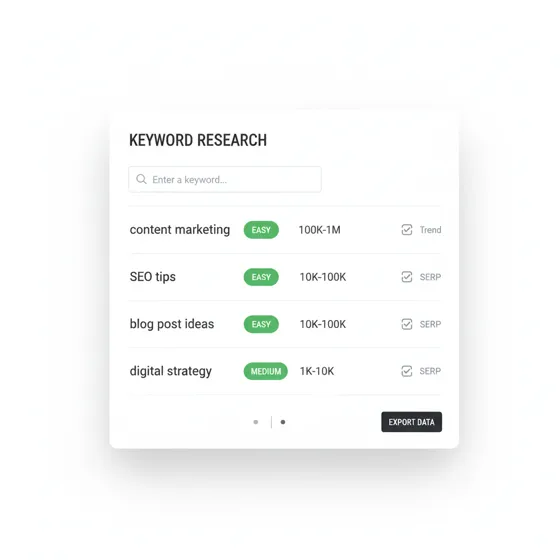
GrandRanker starts every article with real keyword data. You see search volume, keyword difficulty, and intent before you write a single word. No need to pay for a separate research tool or guess which topics are worth targeting.
Before generating your article, GrandRanker analyzes the top-ranking pages for your target keyword. Your content matches the depth, structure, entity coverage, and topical breadth that Google already rewards with top-10 positions.
GrandRanker scans your existing site pages and inserts relevant internal links into every new article automatically. This builds topical authority, distributes link equity, and helps Google crawl and understand your site architecture.
Publish directly to WordPress with a single click. Headings, images, meta descriptions, slugs, and formatting are all handled automatically. No more copying, pasting, and reformatting between your writing tool and your CMS.
Research, write, optimize, link, and publish from one dashboard. Most AI blog writers handle only the writing step and leave you to assemble a stack of three to five other tools for everything else. GrandRanker replaces the entire stack.
GrandRanker maps your content against topic clusters and identifies gaps in your coverage. Instead of publishing random articles, you build interconnected content hubs that signal expertise to Google and compound in ranking power over time.
GrandRanker handles the entire content pipeline so you can focus on strategy.
GrandRanker is the right move if any of these sound like you.
You have been publishing AI-generated blog posts consistently, but traffic remains flat. The articles read fine, but they were written without keyword research, SERP analysis, or internal linking. GrandRanker ensures every article is engineered to rank from the start, so your publishing effort translates directly into organic growth.
Your team produces dozens of blog posts per month across client sites. You are juggling separate subscriptions for AI writing, keyword research, content optimization, and CMS access. GrandRanker consolidates that entire workflow into one platform, cutting per-article production time and eliminating context switching between tools.
You need a systematic content engine that captures search demand across your product category. Individual AI writers give you articles, but GrandRanker gives you a content strategy: keyword-prioritized pipelines, SERP-grounded outlines, topical cluster mapping, and automated publishing that turns your blog into a compounding organic acquisition channel.
The migration takes under 10 minutes. Here is exactly what to do.
Sign up at app.grandranker.com. No credit card is required to get started. The onboarding process takes about two minutes and walks you through the initial setup, including selecting your niche and primary goals.
Link your WordPress installation (or other supported CMS) to GrandRanker. This enables one-click publishing and allows GrandRanker to scan your existing pages so it can automatically insert internal links into new content.
Bring over the keywords and content topics you have been targeting with your current AI writer. GrandRanker pulls live search volume, difficulty scores, and SERP data for each keyword so you can prioritize the highest-impact articles first.
Pick a keyword, let GrandRanker analyze the top-ranking competitors, and generate a fully optimized article with proper heading structure, entity coverage, topical depth, and internal links already inserted.
Hit publish to send the article directly to your CMS with formatting, meta tags, slug, and images handled automatically. Track your rankings and organic traffic as your new content strategy starts outperforming the generic AI-written posts you published before.
The core promise of AI blog writers is speed. A 2,000-word article that once took a writer four to six hours can now be generated in under five minutes. That speed is real and genuinely useful. But speed alone does not translate into organic search traffic, and this is where the vast majority of AI blog writing tools fall short.
Ranking on Google requires more than well-structured prose. It requires targeting a keyword with real search demand, matching the intent behind that query, covering the topic with sufficient depth relative to competing pages, using a heading structure that mirrors what Google already rewards, including relevant entities and subtopics that signal topical authority, and building internal links that connect the article to the rest of your site. Most AI blog writers address exactly one of these requirements: producing the prose itself.
Tools like Jasper, Writesonic, and Koala Writer generate content based on a user prompt, sometimes enhanced by a template or brand voice profile. But they do not analyze the SERP before writing. They have no data on what heading structures the top-ranking pages use, which subtopics they cover, or how deep their content goes. The output is a generic article that may be factually accurate and pleasant to read but is not engineered to compete with the specific pages that currently hold the top positions for your target keyword.
This gap explains why many teams publish dozens of AI-generated blog posts and see minimal traffic growth. The content is not bad in an absolute sense. It simply was not built with the inputs that determine ranking. Without SERP grounding, AI-written articles are essentially competing in a race without knowing where the finish line is or what pace the leaders are running.
AI writing and AI content strategy are often conflated, but they represent fundamentally different capabilities. AI writing is the ability to generate coherent text from a prompt. AI content strategy is the ability to determine what to write, how to structure it for search performance, and how to publish and interlink it within a broader content ecosystem. The distinction matters enormously for anyone whose goal is organic traffic.
Most tools in the AI blog writing category are firmly in the AI writing camp. Jasper generates text. Byword generates text. Koala Writer generates text. Writesonic generates text with a thin SEO layer on top. These tools answer the question "How do I produce an article quickly?" but they do not answer the more important questions: "Should I write about this topic at all? What keyword should I target? What search intent does this query carry? What depth and structure do the top-ranking pages demonstrate? How does this article connect to the rest of my site?"
AI content strategy tools answer all of these questions before a single word is generated. GrandRanker represents this approach. It begins with keyword research that surfaces search volume, difficulty, and intent. It then analyzes the top-ranking SERP results to extract the heading structures, word counts, entity coverage, and topical patterns that correlate with ranking. Only after this research phase does the AI generate content, and it does so with all of that data as input rather than relying solely on a user prompt.
The result is a qualitative difference in output. An article produced by an AI writing tool is a text document. An article produced by an AI content strategy platform is a search asset: targeted at a validated keyword, structured to match proven ranking patterns, connected to your existing site through internal links, and published directly to your CMS with proper metadata. The first approach gives you content. The second gives you a content engine that compounds in organic visibility over time.
The typical workflow for producing a blog post that ranks involves at least four separate tools and a significant amount of manual coordination. You research keywords in Ahrefs or Semrush. You analyze SERP results manually or with a tool like Surfer SEO. You write or generate the article in a tool like Jasper or Google Docs. You optimize it for on-page SEO factors in yet another tool. You manually add internal links by searching your own site for related pages. And finally, you copy the content into WordPress, format the headings, add images, write the meta description, and hit publish. This process works, but it is slow, fragmented, and expensive.
GrandRanker was designed to collapse this entire pipeline into a single platform. The workflow starts with keyword research inside GrandRanker itself. You search for a topic, see keyword suggestions with volume and difficulty data, and select the keyword you want to target. GrandRanker then automatically pulls and analyzes the top-ranking pages for that keyword, extracting insights about content depth, heading structure, entity coverage, and search intent.
With this data as the foundation, GrandRanker generates a SERP-driven outline and then produces the full article. The content is not based on a generic prompt. It is grounded in what Google currently rewards for that specific query. During generation, GrandRanker also scans your existing site content and inserts relevant internal links, strengthening your topical authority and site architecture without any manual effort.
Once the article is ready, you review it, check the on-page SEO score, make any adjustments, and publish directly to WordPress with a single click. Headings, images, meta tags, slugs, and formatting are all handled automatically. The entire process from keyword selection to published article takes a fraction of the time required by a multi-tool workflow, and the output is consistently optimized for search performance because the SEO intelligence is built into every step rather than bolted on after the fact.
Common questions about switching from AI Blog Writers to GrandRanker.
Most AI blog writers give you words. GrandRanker gives you rankings. Get keyword research, SERP analysis, AI content, automatic internal linking, and one-click CMS publishing in a single platform for $49/mo.
Start for $79/mo